
How to Find a Voice Teacher for Sacred Music Singers
By Heidi Vass | Adapted from my lecture for the Catholic Institute of Sacred Music
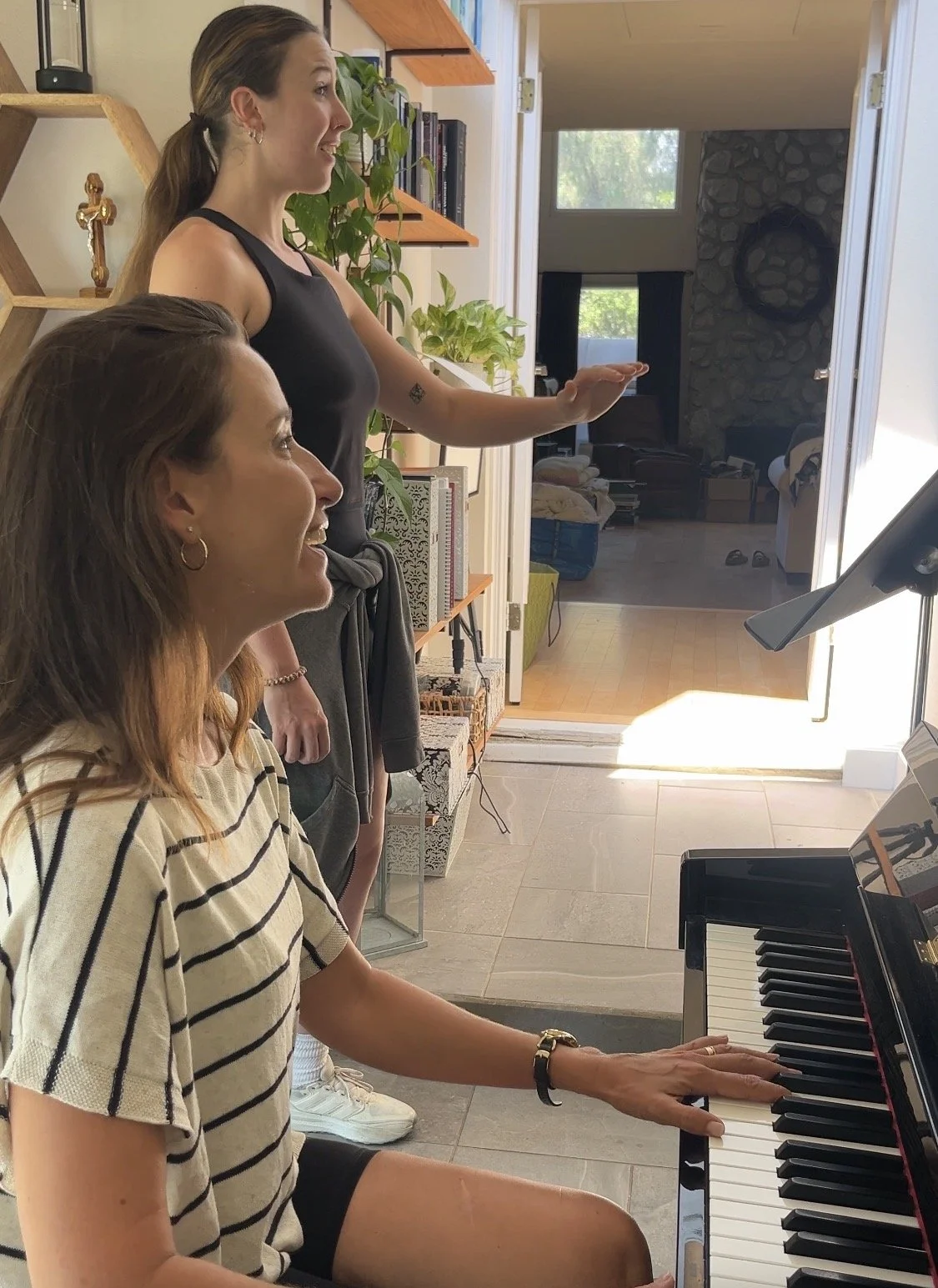
You can read music, learn your part, and show up prepared for rehearsal. But perhaps you still run out of breath before the end of a phrase, struggle with register transitions, or wonder why your voice feels tired after Sunday’s services.
More rehearsal may not answer those questions. You may need someone to help you develop the instrument itself.
Voice lessons are not reserved for aspiring opera singers. Cantors, choristers, schola members, music directors, and members of religious communities can all benefit from thoughtful vocal training. For those of us who sing in the Church, that training has a particular purpose: to prepare us to serve the sacred music entrusted to us with greater skill, freedom, and understanding.
To find a voice teacher for sacred music, look for training in vocal pedagogy, experience with your musical needs, clear communication, and an approach that adapts to you. Interview potential teachers, arrange a trial lesson, and consider online as well as local options.
In my lecture for the Catholic Institute of Sacred Music, I addressed what sacred musicians should look for, what questions to ask, and why the nearest available teacher may not be the best fit.
Voice teacher vs. vocal coach: What is the difference?
We often look for a teacher by asking, “Who has a beautiful voice?” That can be a starting point, but it is not enough.
Performing a skill and teaching that skill are different abilities. A singer may produce a beautiful sound without knowing how to help someone with a different instrument, background, or learning process.
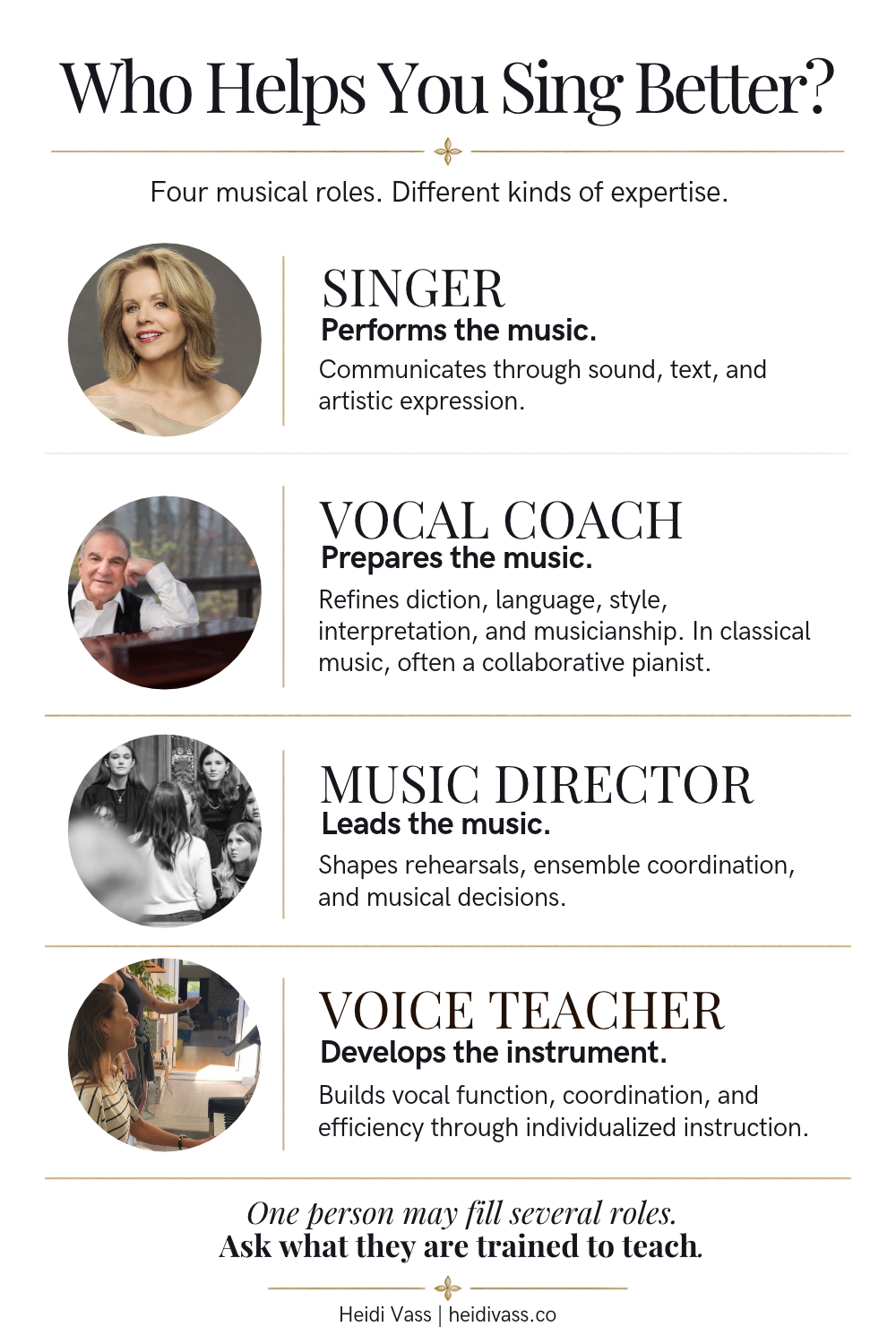
It helps to distinguish several roles:
A singer performs the music, communicating through sound, text, and artistic expression.
A vocal coach helps prepare the music, often working on diction, language, style, interpretation, and musicianship. In classical music, this person is frequently a collaborative pianist.
A music director leads the music, shaping rehearsals, ensemble coordination, and musical decisions.
A voice teacher develops the instrument, helping the singer improve vocal function, coordination, and efficiency.
One person may fill several of these roles. Titles also vary, especially across musical styles. The important question is what the person is actually trained to teach.
If you need help navigating your middle voice, a beautiful interpretation of a motet will not, by itself, solve the problem. You need someone who can hear what is happening, choose an appropriate strategy, and help you develop that coordination.
What qualifications should a voice teacher have?
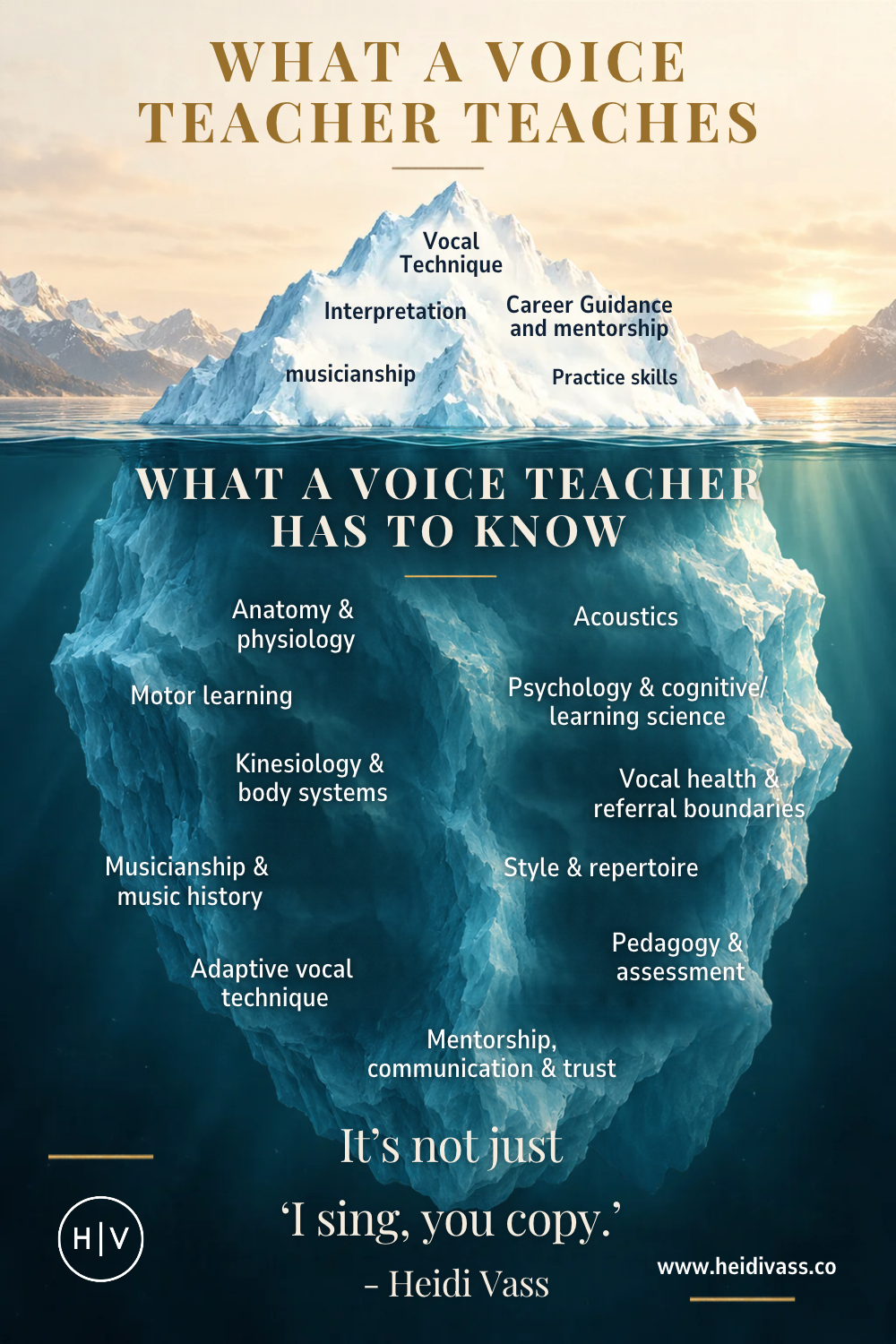
Vocal pedagogy is both an art and a science. It draws on anatomy, physiology, acoustics, motor learning, musicianship, and an understanding of how people learn. The National Association of Teachers of Singing identifies physiology, vocal tract acoustics, and cognitive science as three pillars of its Science-Informed Voice Pedagogy Institute. That breadth is one reason performing experience alone is not the same as preparation to teach. [1]
I recommend looking for formal study in voice that includes vocal pedagogy. A bachelor’s degree with substantial pedagogy coursework can be a useful foundation; a relevant master’s degree can offer further depth. Ask what the teacher studied and how that education informs their work.
Credentials are a starting point, not a guarantee of effective teaching. Consider teaching experience, continuing education, and the ability to explain concepts clearly. Membership in the National Association of Teachers of Singing can be another useful signal of professional engagement, but it does not replace an interview or trial lesson.
The NATS Find-a-Teacher Directory is one resource for beginning your search. Referrals from trusted singers, colleagues, and sacred music organizations can also help you identify candidates.
The directory is a search tool, not a guarantee that every listed teacher will suit your needs. [2]
Rather than committing to the first name you receive, speak with potential teachers and ask about their experience with singers like you.
Choosing a voice teacher for cantors, choir members, and sacred musicians
Your technical training should support your musical responsibilities.
This emphasis on formation belongs within the Church’s own understanding of sacred music. In Sacrosanctum Concilium, paragraph 115, the Second Vatican Council calls for attention to musical education in Catholic institutions and for genuine liturgical training for singers. It does not prescribe private voice lessons; I see individual vocal study as one practical way to support that broader work of formation. [3]
A cantor preparing a psalm, a soprano singing Renaissance polyphony, and a sister singing the Divine Office may share technical needs, but their daily musical demands differ. A useful teacher should be willing to understand those demands.
Can they help you sustain a chant phrase without unnecessary effort? Navigate a passage at a quiet dynamic? Adjust your sound within an ensemble? Plan practice around several rehearsals and services?
For sacred musicians, I would also ask whether the teacher respects the liturgical context of your work. The purpose of developing your voice is to make it more capable of serving the music and the liturgy. Lessons should help you make appropriate musical choices within that context.
Your teacher does not necessarily need to be Catholic or specialize exclusively in sacred music. They do need to respect your goals and understand, or be willing to learn about, the repertoire you sing.
Some lesson repertoire may broaden your skills beyond your weekly responsibilities. That can be valuable. But there should be a clear connection between what you practice in the studio and what you need to do in the choir loft.
For more on connecting vocal technique to liturgical purpose, read 7 Things Every Church Singer Should Know About the Singing Voice.
Ask how the teacher adapts to the individual singer
You may encounter teachers who describe their approach as bel canto, science-informed, or associated with a particular named method. These descriptions can begin a conversation, but a label does not tell you how well someone teaches.
Ask how the teacher decides what you need.
An evidence-based approach should bring relevant research into conversation with teaching expertise, your responses, and your artistic goals. It should also leave room to adjust when an explanation or exercise does not help.
The same cue will not work equally well for every singer. A good teacher can explain the purpose of an exercise, listen to the result, and change direction when needed.
You should be able to ask, “What are we working on, and how will I know when I’m doing it more successfully?”
Adaptive singing vs. static training: Can your teacher help you shift styles?
Before choosing a teacher, consider the instrument you want to build. Do you sing exclusively in one style, or do you want the flexibility to move between chant, choral music, classical solo repertoire, musical theatre, or contemporary music?
I distinguish between adaptive singing and static training. A static approach trains one preferred sound and applies it broadly, regardless of the music. An adaptive approach develops vocal coordination that can respond to different stylistic demands. The goal is an instrument with choices, and a singer who understands when and how to use them.
For a sacred musician, those choices matter even within the Church’s repertoire. Chant, Renaissance polyphony, and a solo in a Mozart Mass do not necessarily call for the same approach to tone color, vibrato, articulation, or projection. A singer who also performs outside church may need an even broader set of skills.
Does the teacher know how to support that kind of training? Being able to teach one style successfully does not automatically mean someone knows how to guide transitions between styles. Ask how they distinguish foundational vocal function from stylistic choices, what experience they have teaching across genres, and how they would help you apply your technique differently in different repertoire.
You might ask: “I want to build an instrument that can shift styles. How would you train that flexibility, and how would we practice moving from one style to another?”
Specialized study in one tradition can be valuable. What matters is whether the teacher’s expertise and approach match the versatility you want to develop. I discuss this further in the “Healthy Technique Adapts to Context” section of 7 Things Every Church Singer Should Know About the Singing Voice.
What should happen in a voice lesson?
A lesson should offer more than an opportunity to sing through your repertoire while someone points out mistakes.
Early lessons should include a conversation about your background, goals, practice habits, and current challenges. The teacher should listen before prescribing solutions.
Over time, you should have a sense of what you are developing and how your exercises connect to your music. A useful lesson might address breath coordination, registration, vowels, or another aspect of vocal function, then apply that work to a phrase from your repertoire.
You should leave knowing what to practice and what to listen or feel for. “Practice this until next week” is less useful than a clear task with an understandable purpose.
Progress will not always be linear, and not every lesson produces a dramatic breakthrough. Still, you and your teacher should be able to discuss what is changing and what needs more attention.
I explore this distinction between doing more and practicing with a clear purpose in Why Some Singers Improve Faster Than Others (And Why More Practice Isn’t Always the Answer).
Online or in-person voice lessons? Consider preference AND access
There is no single format that fits every singer. Your choice should reflect your personal preferences, practical circumstances, and access to a qualified teacher.
If a suitable teacher is available nearby and you enjoy working in the same room, in-person lessons may be an excellent choice. You and your teacher hear each other directly in a shared acoustic space, without microphones or internet connections mediating the sound.
In-person lessons can also be a wonderful way to build musical community. A local studio may offer group classes, studio gatherings, recitals, or introductions to other singers and collaborators. Ask what opportunities exist rather than assuming every studio offers them. For a church singer seeking connection beyond weekly rehearsal, that community can be a meaningful part of the experience.
But access matters. Many singers do not have a suitably qualified voice teacher in their immediate area. The available teachers may specialize in different styles, lack relevant experience, or be too far away for regular lessons. For some singers, online instruction is the only practical route to appropriate teaching.
You do not have to limit your search to driving distance. Online lessons allow you to consider teachers whose expertise better matches your needs, while making regular study possible around work, family, and church responsibilities.
Online teaching does require some adaptation. A survey of voice teachers during the early pandemic, published in the Journal of Voice, documented limitations of online teaching technology, including sound transmission optimized for speech rather than singing. This was a study of teachers’ experiences during an emergency transition, not a controlled test establishing equal learning outcomes between formats. [4]
The practical question is whether a teacher knows how to work effectively within the format. Audio quality and connection reliability matter, and internet delay changes how teacher and student demonstrate and respond to each other. Ask about online teaching experience and the setup they recommend.
A trial lesson can help you assess both the teacher and the format. If both options are available, choose the one that helps you engage consistently. If local access is limited, a good online fit may open a door that would otherwise remain closed.
You are building a relationship, not just booking a voice lesson
Choosing a voice teacher means trusting someone with an instrument that is part of you. You need confidence in their ear, their judgment, and their ability to guide you. You also need to feel safe enough to make an imperfect sound, admit confusion, and try something unfamiliar.
A voice teacher can do more harm than good. The stakes include your instrument, your confidence, and your relationship with singing.
In remarks at the 2025 Voice Foundation Symposium, Dr. Robert Sataloff warned about unqualified teachers outside university settings hanging out a shingle, charging $100 for lessons, and creating voice patients. [6]
That warning is a reason enough to investigate a teacher’s preparation and judgment carefully. A confident sales pitch, a substantial hourly rate, or an impressive performing career does not establish teaching competence. Nor does institutional affiliation alone settle the question. The issue is whether the person has the knowledge, skill, and professional judgment to guide your voice responsibly.
Poor instruction can reinforce unhelpful habits and undermine your confidence. You should take seriously an approach that leaves you afraid to sing, reluctant to ask questions, or pressured to disregard discomfort.
Trust develops through the teaching itself. Does the teacher hear what you are struggling with? Can they explain what they hear and offer a useful next step? Do they listen when you say an instruction feels uncomfortable or does not make sense? Are they willing to reconsider an approach?
Feeling safe does not mean avoiding challenge. Good teaching can be demanding. But correction should be specific, respectful, and directed toward something you can work on. You should be able to say, “I don’t understand,” or “That doesn’t feel right,” without being humiliated or dismissed.
The NATS Code of Ethics makes respect, personal integrity, appropriate boundaries, and professional conduct explicit expectations of the teacher-student relationship. It also recognizes a student’s freedom to choose their teacher. [5]
A trial lesson is therefore more than an audition for the student. It is an opportunity to assess the relationship. Ask yourself: Do I trust this person’s ear? Do I understand what we are working toward? Can I be honest here? Am I being treated as an individual?
You are looking for someone whose expertise you can trust and in whose presence you can learn. Both matter.
Questions to ask a potential voice teacher
A conversation before enrollment can tell you a great deal. Here are a few useful starting points:
What is your education and training in voice and vocal pedagogy?
What experience do you have with singers of my age, background, and goals?
How would you help me prepare for chant, choral singing, or cantoring?
If I want to sing in several styles, how would you help me develop and practice that flexibility?
How do you assess a new student and decide what to work on?
What would you expect me to practice between lessons?
How do you evaluate progress?
How do you respond when a student is confused, uncomfortable, or concerned about an exercise?
What experience do you have teaching online, if that is the format I need?
Listen for thoughtful, specific answers. You are looking for a working relationship in which you can ask questions, understand your assignments, and discuss difficulties honestly.
[Download the free checklist: Questions to Ask a Potential Voice Teacher]
Use this checklist to prepare for a conversation or trial lesson and compare potential teachers before committing.
Choose a teacher who helps you become a more independent singer
A teacher should help you understand your voice well enough to make better decisions between lessons. Over time, you should gain more than a collection of exercises. You should develop clearer listening, more purposeful practice, and a better understanding of how to approach the music you sing.
Listening to recordings can be part of that process. In Why Your Singing Voice Sounds Different on Recordings (And What It Can Teach You), I discuss how an outside perspective can help you make sense of what you hear.
For sacred musicians, vocal formation is part of preparing ourselves for service. We invest in the instrument so that we can bring greater skill and attention to the task entrusted to us.
Choose someone with the knowledge to guide you, the flexibility to teach you as an individual, and the respect to take your musical vocation seriously.
Frequently asked questions about finding a voice teacher
Do church choir singers need voice lessons?
You do not need private lessons to participate in a church choir. Individual study can, however, give you focused help with technical challenges that a conductor may not have time to address in rehearsal. Lessons should support your role in the ensemble.
Does my voice teacher need to be Catholic?
Not necessarily. Look for a teacher who respects the purpose of your singing and can help you apply technique appropriately to chant, polyphony, hymnody, and other repertoire you sing.
What if there are no suitable voice teachers near me?
Include online teachers in your search. Interview them about their experience with your needs and with remote instruction, then try a lesson before making a longer commitment.
Will classical voice lessons make me sound like an opera singer?
Classical training need not impose an operatic sound on every piece. Ask how the teacher distinguishes vocal function from stylistic choices and how they would apply your training to ensemble and liturgical singing.
Not sure what your voice needs first?
Start by reflecting on your experience with my free 10-question singing voice self-assessment. It measures your perception of singing difficulties, rather than diagnosing their cause.
For individual guidance, my Personalized Vocal Assessment includes a questionnaire, review of your singing recordings, a private Zoom consultation, and a written report with a practice plan. It can help you approach further study with clearer priorities.
If you are seeking formation for an entire choir, parish, or religious community, explore my sacred music workshops and retreats.
Finding the right voice teacher is an investment in your voice and the sacred work it serves. Take time to ask questions, consider your goals, and find someone whose expertise you trust and with whom you feel safe learning. Whether you meet online or in person, the relationship should help you grow in understanding, independence, and the freedom to offer your voice more fully in service to God.
Sources and further reading
National Association of Teachers of Singing. “Science-Informed Pedagogy Institute.” NATS. Accessed 16 Oct. 2026. View source.
National Association of Teachers of Singing. “Find-A-Teacher Directory.” NATS. Accessed 16 Oct. 2026. Search the directory.
Second Vatican Council. Sacrosanctum Concilium. 4 Dec. 1963, par. 115. The Holy See. Read the document.
Murdaugh, Kristen, Josipa Bainac Hausknecht, and Christian T. Herbst. “In-Person or Virtual? Assessing the Impact of COVID-19 on the Teaching Habits of Voice Pedagogues.” Journal of Voice, vol. 36, no. 5, 2022, pp. 735.e19–735.e25. doi:10.1016/j.jvoice.2020.08.027. Read the study.
National Association of Teachers of Singing. “Code of Ethics.” Approved June 2018. NATS. Accessed 16 Oct. 2026. Read the code.
Sataloff, Robert T. Remarks in “2025 G. Paul Moore Lecture: Renée Fleming – Music and Mind.” YouTube, uploaded by The Voice Foundation, https://www.youtube.com/watch?v=HqTs17Zi23Q.
