
Why Is Singing So Hard? The Overlooked Tool for Understanding Your Voice and Planning for Progress
Have you ever finished singing and thought, “That was a lot more work than it should have been?”
Perhaps the notes were there. You got through the piece. Someone even told you it sounded beautiful. But you were working hard. You were planning every breath, worrying about the next phrase, and wondering whether your voice would cooperate when you reached that one passage. By the end, you were relieved to be finished. Or perhaps you’ve even started making small accommodations without thinking much about them… You skip the higher notes. Choose easier music. Sing more quietly. Let someone else take the solo. You still love singing. but you just wish it felt easier.
After more than 25 years working with singers, I’ve learned to pay close attention to those conversations. What you experience while singing tells me something that listening to your sound alone cannot.
That’s one reason I believe a good vocal assessment can be so valuable. It gives us a place to begin. It shines a light on what feels difficult, what you want to do, and what deserves our attention first.
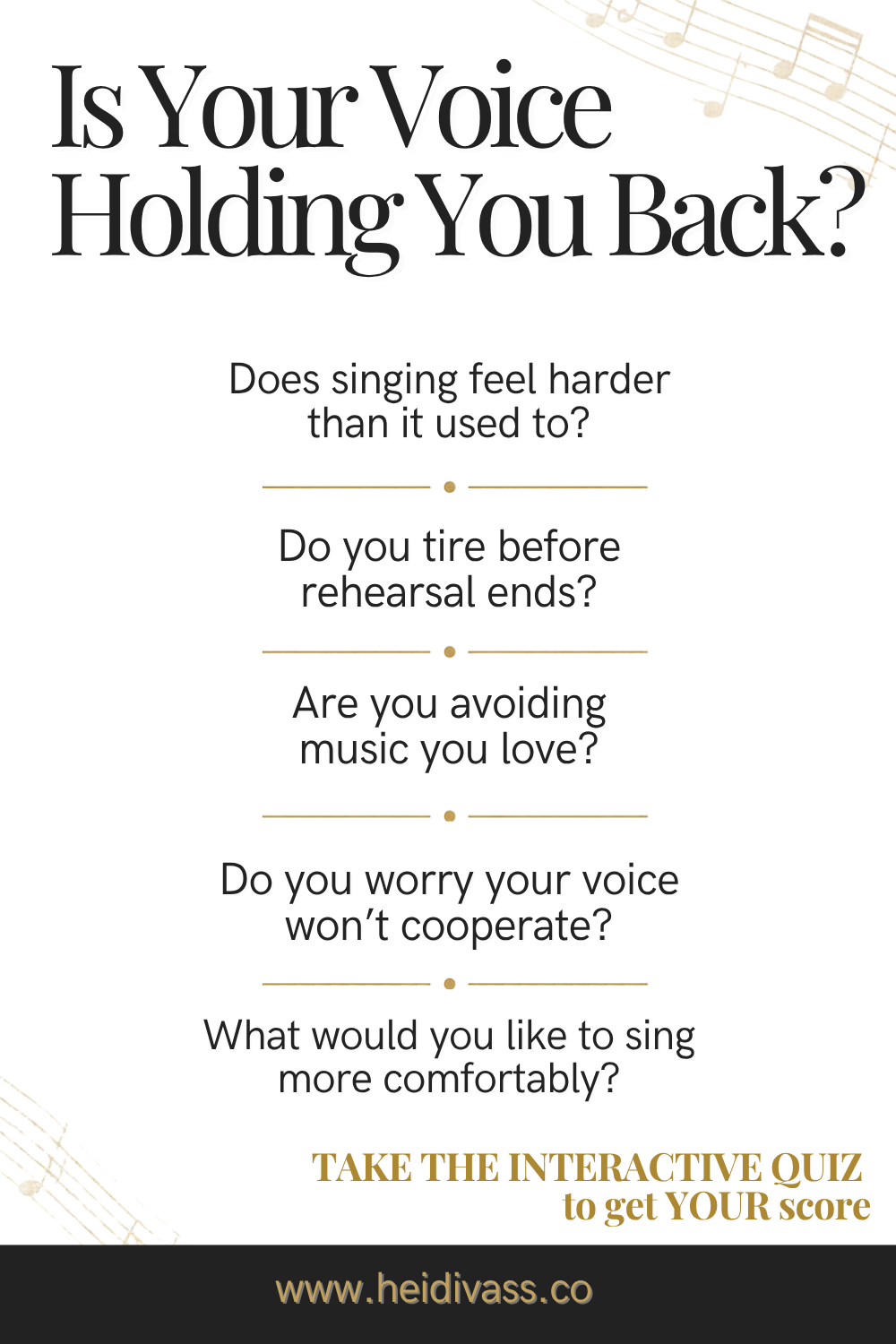
There is even a research-based questionnaire designed to help singers put those experiences into words. It is called the Singing Voice Handicap Index, or SVHI, and its shorter version is the SVHI-10.
The name sounds rather clinical. The question behind it is much more familiar:
How much is your voice getting in the way of the singing you want to do?
You can sound good and still struggle
This is something singers don’t always feel comfortable admitting. If other people like your voice, shouldn’t you be happy with it?
Of course, encouragement matters. But someone listening from the pew or the audience cannot feel the effort you are using. They don’t know that you spent the whole phrase worrying about running out of breath, or that you avoided a piece you love because the middle section feels unreliable.
A performance can sound successful while the singer feels exhausted. The opposite can happen, too. You may be unhappy with your singing even when a recording reveals more consistency than you expected. A useful assessment makes room for that difference between what you hear, what you feel, and what someone else notices.
When I work with a singer, I want to understand both perspectives. What do I hear? And what is it like for you to produce that sound? That second question often opens a much more useful conversation.
Singing is a biopsychosocial event
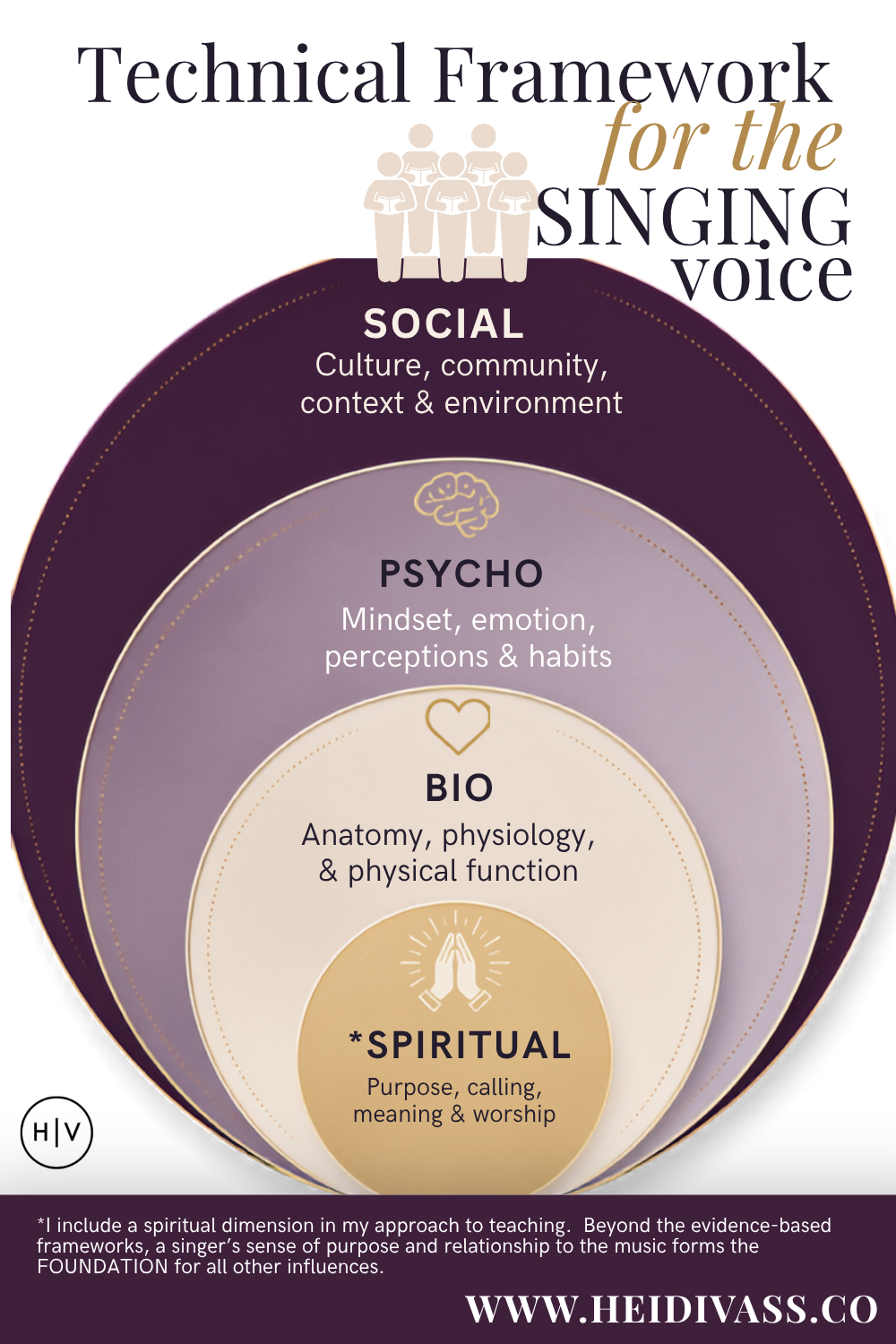
That is a rather academic word for something singers recognize immediately: your body, your thoughts and feelings, and the situation you are singing in all come into the experience.
The biopsychosocial model considers how biological, psychological, and social factors interact.[6] Applied to singing, it gives us a useful way to think about the whole singer. Your physical condition matters. So do your expectations, previous experiences, and whether you are practicing alone, singing with people you trust, or facing an audition panel.
How you perceive your voice can influence how you use it, with consequences for the sound you produce.
Research on singers’ self-efficacy (their belief in their ability to perform a task) illustrates how closely those beliefs connect with bodily sensations, emotions, and feedback from others. In a small study of nine university vocalists, eight identified their physical and emotional state as the strongest influence on their performance belief.[7]
There is evidence that the performance situation can affect the singing itself. A study of 31 music students compared singing in an examination with singing in a less stressful setting. Anxiety and heart rate increased during the examination, and vocal accuracy changed. The direction differed between groups: stress helped some students and hindered others facing a more challenging examination.[8]
The relationship is more nuanced than “nerves make you sing badly.” How demanding the task feels and how you experience the situation matter.
In teaching, I would explore whether a singer who expects a passage to go wrong begins approaching it differently: hesitating at the entrance, changing the breath, or trying to force a note that feels uncertain. Those are possibilities to observe together, rather than assumptions to make from a questionnaire score.
This is why your self-perception belongs in a vocal assessment. We need to understand what you experience and how that may interact with the way you sing. We also need to avoid turning a difficult day into a fixed belief about your ability.
A questionnaire cannot untangle all those relationships. It can help us notice where to begin asking better questions.
What is the Singing Voice Handicap Index?
The Singing Voice Handicap Index is a questionnaire about how singing difficulties affect your life. Seth M. Cohen and colleagues developed the original 36-question version in 2007, working with professional and nonprofessional singers across several musical styles.[1] You respond to statements about your singing, choosing how often each experience applies to you.
The word handicap refers to the ways a vocal difficulty limits you. That might involve effort or fatigue, but it can also involve frustration, confidence, or the musical activities you have begun avoiding.
The questionnaire gives you a way to describe those experiences more clearly.[1]
For a teacher, “My voice isn’t good anymore” is the beginning of a conversation. “I used to finish choir rehearsal comfortably, but now I’m tired halfway through” gives us something more specific to explore. The more clearly we understand the difficulty, the more thoughtfully we can choose the next step.
What is the difference between the SVHI-10 and the longer test?
The SVHI-10 is the shorter version, developed and validated in 2009. It uses ten selected statements from the longer questionnaire.[2]
Both ask about the impact of singing difficulties. The short version gives you a quick starting point. The full version offers more opportunities to describe what you are experiencing.
For both versions, answers run from “never” to “always,” with each response scored from zero to four. Higher totals mean you are reporting more difficulty or limitation.[2,3]
Give yourself permission to answer honestly. Think about your usual experience, including the things you have learned to work around.
What should you do with your score?
Look at your answers as well as the total.
Which statement made you pause? Which difficulty has become so familiar that you barely notice it anymore? What would you like to feel different? A score can help you recognize a concern and describe it to someone who can help. It cannot tell you why that concern is happening. It also says nothing about how much talent you have.
Researchers use scores to study singing-related difficulties and changes over time. For example, a recent study identified a change of about ten points on the SVHI-10 as meaningful.[4] For you, the useful question is more personal: What has changed in the singing I can comfortably do?
Perhaps you are finishing rehearsal with more energy. Perhaps you are singing a phrase you once avoided. Perhaps you feel ready to volunteer for the solo. Keep the number in perspective. Your musical life matters more than chasing a particular score.
The questions I want singers to ask themselves
The longer SVHI looks more broadly at how singing problems affect the singer.[1] That makes it a useful starting point for conversations that go beyond range and tone.
Here are some questions I would encourage you to consider. These are my own reflection questions, rather than the official wording of the questionnaire:
What feels harder than it used to?
When does your voice feel most dependable?
When do you begin to feel tired?
Which pieces or passages do you avoid?
Do you trust your voice in rehearsal or performance?
Are you enjoying the music, or spending most of your attention managing your voice?
What would you sing if you felt more confident?
What is the one change that would make the biggest difference to you?
That last question is especially useful.
Some singers want easier high notes. Others want to get through Sunday morning without feeling worn out. Someone else wants to return to a choir after years of telling themselves they aren’t good enough. Those are different goals. They deserve different plans. For a cantor, the concern might be getting through the psalm comfortably. For a choral singer, it might be maintaining ease through a long rehearsal. For a soloist, it might be trusting a quiet entrance. The musical task helps give the answers context.
Understanding what you want your voice to do helps us decide how to train it.
The same score can tell two different stories
Imagine two singers whose questionnaire totals are similar.
One is frustrated by a passage near the top of her range. Most of her singing feels comfortable, but she worries about that moment every time it approaches. Another gets through the notes without much concern, but finds that rehearsal leaves her unusually tired and needing a long recovery.
These are hypothetical examples, but they illustrate why the total is only part of the story. We would want to ask different follow-up questions.
For the first singer, we might explore whether the difficulty appears in every piece, on certain vowels, or only under performance pressure. For the second, we would want to understand when the fatigue began, how much she is using her voice, and whether speaking has changed too.
A score helps organize the conversation. The details help us understand what needs attention.
Notice what you’ve started working around
One question I find especially useful is: “What have you changed because of your voice?”
Sometimes singers describe their voice as generally fine, then explain that they no longer sing certain pieces, avoid singing alone, or stop before the end of rehearsal.
There may be sensible reasons for those choices. Choosing appropriate repertoire and pacing your singing can be good judgment. But it helps to recognize whether you are making a musical choice or accommodating a difficulty you would like to understand. For example, “I prefer singing alto” and “I moved to alto because my upper notes suddenly became uncomfortable” tell us different things. Neither answer deserves criticism. The second deserves a conversation about what changed.
Think about your answers in relation to the singing you actually do. If you have stopped attempting a task, you may encounter the difficulty less often while still feeling limited by it.
How to describe a vocal difficulty more clearly
You don't need technical vocabulary to give useful information. Ordinary details are often more helpful than deciding you have a “support problem” or a “resonance problem.”
Try completing these sentences:
“I notice it most when…”
“It started…”
“It happens more often after…”
“It feels easier when…”
“Because of it, I have stopped…”
“I run out of breath” is a starting point. “I struggle at the end of long phrases when the melody stays in my upper middle range” gives a teacher more to explore. We can then consider how breath coordination, pacing, and the demands of the passage may contribute to the difficulty.
Likewise, “My voice is tired” becomes more informative when you can explain whether that happens after ten minutes or two hours, whether it affects speaking, and how long it takes to feel comfortable again. You are describing your experience, rather than trying to diagnose yourself. That is precisely the kind of information an assessment needs.
A simple way to keep track
If you are trying to understand a recurring concern, make a few brief notes after singing. You do not need to analyze every note or turn practice into an elaborate tracking project. Record what you sang, approximately how long you sang, what felt comfortable, and what became difficult. Note anything unusual, such as illness or a much heavier day of speaking than normal.
Here is a hypothetical entry:
“Forty-minute rehearsal. Warm-up comfortable. Upper phrases became more effortful in the last piece. Speaking felt normal afterward. Felt comfortable again the following morning.”
Over several entries, you may have a clearer description to share with your teacher or clinician. The notes do not establish a cause. They help you remember the circumstances instead of relying on a general impression that your voice is always unpredictable.
Use the same questionnaire version and instructions when checking in again. Keep track of changes in what you are asking your voice to do, too. An easier week of repertoire and a demanding performance week provide different contexts for interpreting your answers.
What counts as progress?
In teaching, I want progress to have a practical meaning for the singer. If your concern is fatigue, we might discuss whether you can complete familiar singing tasks more comfortably. If you avoid a particular passage, we might look at whether it becomes more dependable in the music. If practice feels confusing, we might ask whether you can identify a priority and work on it independently. Those observations complement a questionnaire score. They do not replace medical evaluation when symptoms call for it.
It is also useful to be specific about what hasn't changed. “The exercise feels easier, but the passage in the song still feels difficult” is valuable feedback. It tells us there is more work to do in applying the skill.
An assessment becomes useful when it gives you a clearer way to describe where you are and recognize what changes over time.
What if your voice has changed?
Tell your teacher. Describe when you noticed the change and what feels different. Avoid the temptation to blame yourself.
Your voice is part of your body. Tell the person evaluating you about relevant health changes, recent illness, or medication changes, including when they occurred. You do not need to know whether they are connected to your singing difficulty to mention them.
A teacher can help with training. Persistent or concerning symptoms need medical evaluation, ideally with a voice specialist familiar with singers.
The National Institute on Deafness and Other Communication Disorders recommends seeing a doctor for hoarseness lasting more than three weeks. Sudden voice loss during strenuous singing needs immediate medical attention and voice rest; pain with speaking or swallowing, difficulty swallowing, or breathing problems also need medical attention.[5]
A questionnaire or teaching assessment cannot diagnose a vocal disorder.
Start with a more useful question
It is easy to turn every difficult day into a judgment about your ability.
A vocal assessment invites you to ask something more specific: What is difficult? How often does it happen? What does it keep me from doing?
You can explore those questions with the interactive ten-question singing voice assessment. Give yourself time to notice your answers, particularly the experiences you have begun accepting as an unavoidable part of singing.
Bring those observations to your teacher or, when symptoms warrant it, a voice clinician. You deserve to have your experience taken seriously, even when other people think you sound beautiful.
If you would like individual help identifying training priorities, information about my personalized vocal assessment is available here.
A few common questions
Is the SVHI-10 a test of whether I’m a good singer?
No. It asks how singing difficulties affect you. It does not grade your voice or your musicianship.
Should I take the short assessment or the longer one?
The ten-question version is a useful first check-in. The full 36-item version explores more of your experience and may be used as part of a fuller evaluation.[1,2]
Can a vocal assessment help if I don’t have a voice problem?
A teaching assessment can help you identify strengths, choose goals, and organize your practice. You may want that guidance even if singing generally feels comfortable.
Understanding your voice begins with listening to your experience, recognizing what is working, and identifying what deserves attention. If you would like guidance along the way, my personalized vocal assessment can help you establish a starting point, individual voice lessons offer ongoing support, and my 90-Day Singer Development Intensive combines assessment, a personalized practice plan, and regular coaching. Wherever you begin, the goal is to help you understand your voice more clearly and develop the skills to sing the music you love with greater freedom and confidence.
Sources
[1] Cohen, Seth M., et al. “Creation and Validation of the Singing Voice Handicap Index.” Annals of Otology, Rhinology & Laryngology, vol. 116, no. 6, 2007, pp. 402–406.
The original study of the 36-item questionnaire. It included professional and nonprofessional singers across several musical styles and established the questionnaire as a useful way to measure the impact singers report from voice difficulties.
[2] Cohen, Seth M., Melissa Statham, Clark A. Rosen, and Thomas Zullo. “Development and Validation of the Singing Voice Handicap-10.” The Laryngoscope, vol. 119, no. 9, 2009, pp. 1864–1869.
The study that developed the shorter, ten-item version. It found that this brief questionnaire could reliably assess singing-related impact. An abstract is also available through Duke University.
[3] “Adaptation and Validation of the Italian Singing Voice Handicap Index-10 (SVHI-10-IT).” Acta Otorhinolaryngologica Italica, vol. 42, 2022, pp. 114–122.
This study describes the questionnaires’ response scale, from zero for “never” to four for “always.” The table above uses raw totals; some reports convert the full SVHI to a 0–100 scale. Scores from different versions or reporting methods should not be compared directly.
[4] Perrin, Claire E., et al. “Singing Voice Handicap Index-10 Minimal Clinically Important Difference: A Prospective Determination.” The Laryngoscope, vol. 135, no. 2, 2025, pp. 752–757.
Researchers assessed 103 adults twice, 30 days apart, and proposed a change of at least ten points as meaningful. This helps interpret changes in reported difficulty; it does not predict how much an individual singer will improve with lessons.
[5] National Institute on Deafness and Other Communication Disorders. “Hoarseness.” National Institutes of Health. Accessed 12 Oct. 2026.
Official guidance on when voice changes need medical attention, including persistent hoarseness and sudden voice loss during strenuous vocal use.
[6] Engel, George L. “The Need for a New Medical Model: A Challenge for Biomedicine.” Science, vol. 196, no. 4286, 1977, pp. 129–136.
The foundational description of the biopsychosocial model. Applying the framework to singing is a pedagogical interpretation; this paper did not study singers.
[7] Lewis, Megan C., and Karin S. Hendricks. “‘It’s Your Body, It’s Part of Who You Are!’: Influences upon Collegiate Vocalists’ Performance Self-Efficacy Beliefs.” International Journal of Music Education, vol. 40, no. 4, 2022.
A study of nine collegiate singers exploring how experience, feedback, and physical and emotional states shaped their beliefs about performing. It supports considering self-perception in teaching, but does not establish that changing a belief directly changes acoustic output.
[8] Larrouy-Maestri, Pauline, and Dominique Morsomme. “The Effects of Stress on Singing Voice Accuracy.” Journal of Voice, vol. 28, no. 1, 2014, pp. 52–58.
This study compared 31 music students in stressful and less stressful singing conditions. Changes in anxiety and heart rate accompanied differing effects on vocal accuracy, highlighting the importance of task demands and context. An author manuscript is available through the University of Liège.
