
Why Some Singers Improve Faster Than Others (And Why More Practice Isn't Always the Answer)
Have you ever noticed that two singers can work equally hard and achieve very different results?
One singer seems to make steady progress - their tone becomes more consistent, their confidence grows, and technical challenges that once felt impossible gradually become manageable. Meanwhile, another singer may spend the same amount of time practicing without seeing any meaningful improvement. It’s tempting to assume the difference is talent.
Talent certainly can play a role, but after spending much of my career working with singers of all ages and experience levels, I’ve become convinced that talent is rarely the deciding factor. More often than not, the difference comes down to how they spend their time.
The singers who improve the fastest are not necessarily the ones who practice the most. They’re often the ones who practice with the greatest clarity and intention. They understand what deserves their attention, what can wait, and how to direct their efforts toward the skills that will have the greatest impact on their singing.
While every singer's journey is unique, I’ve noticed several patterns among singers who make consistent progress. These habits appear again and again.
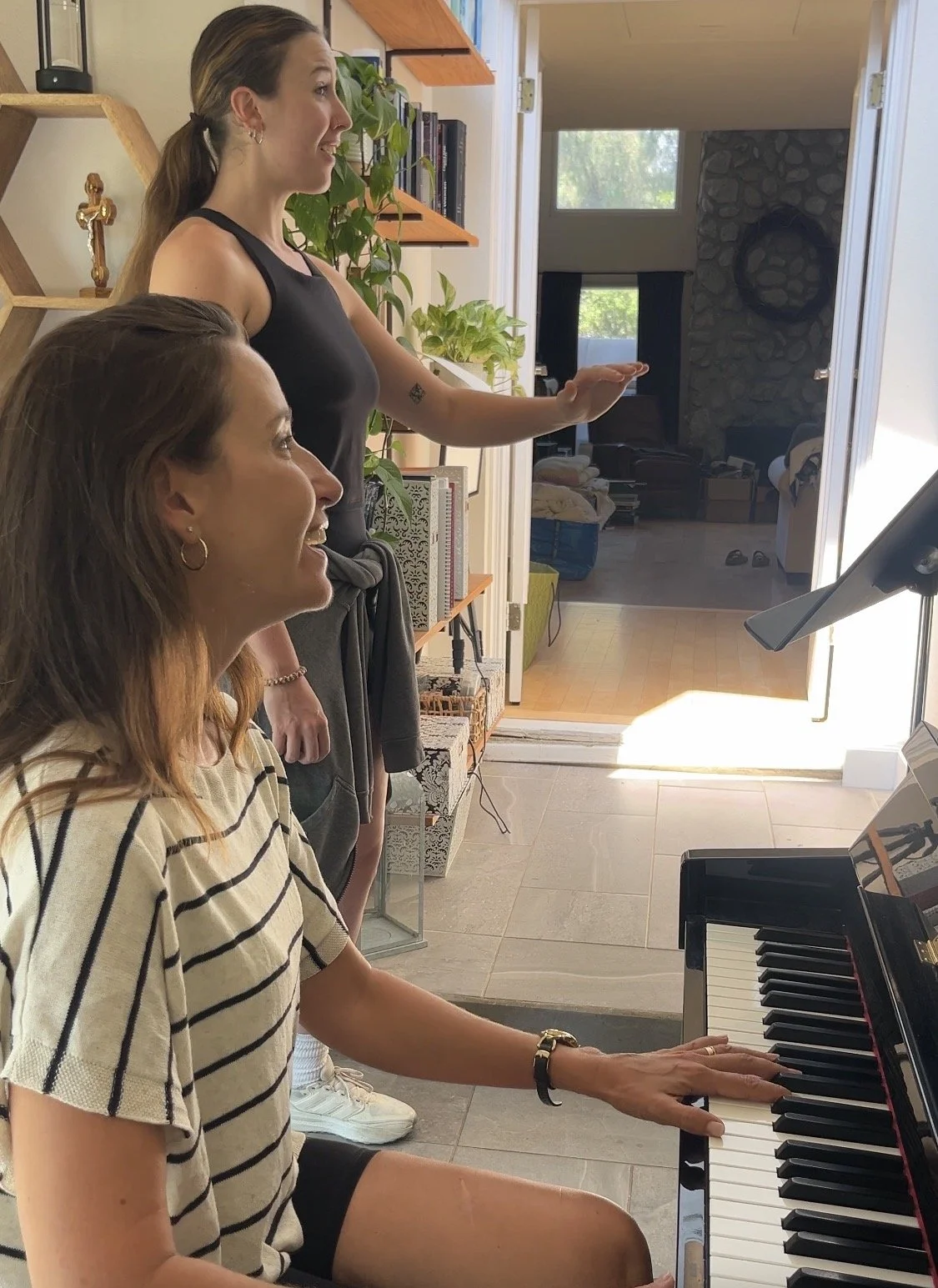
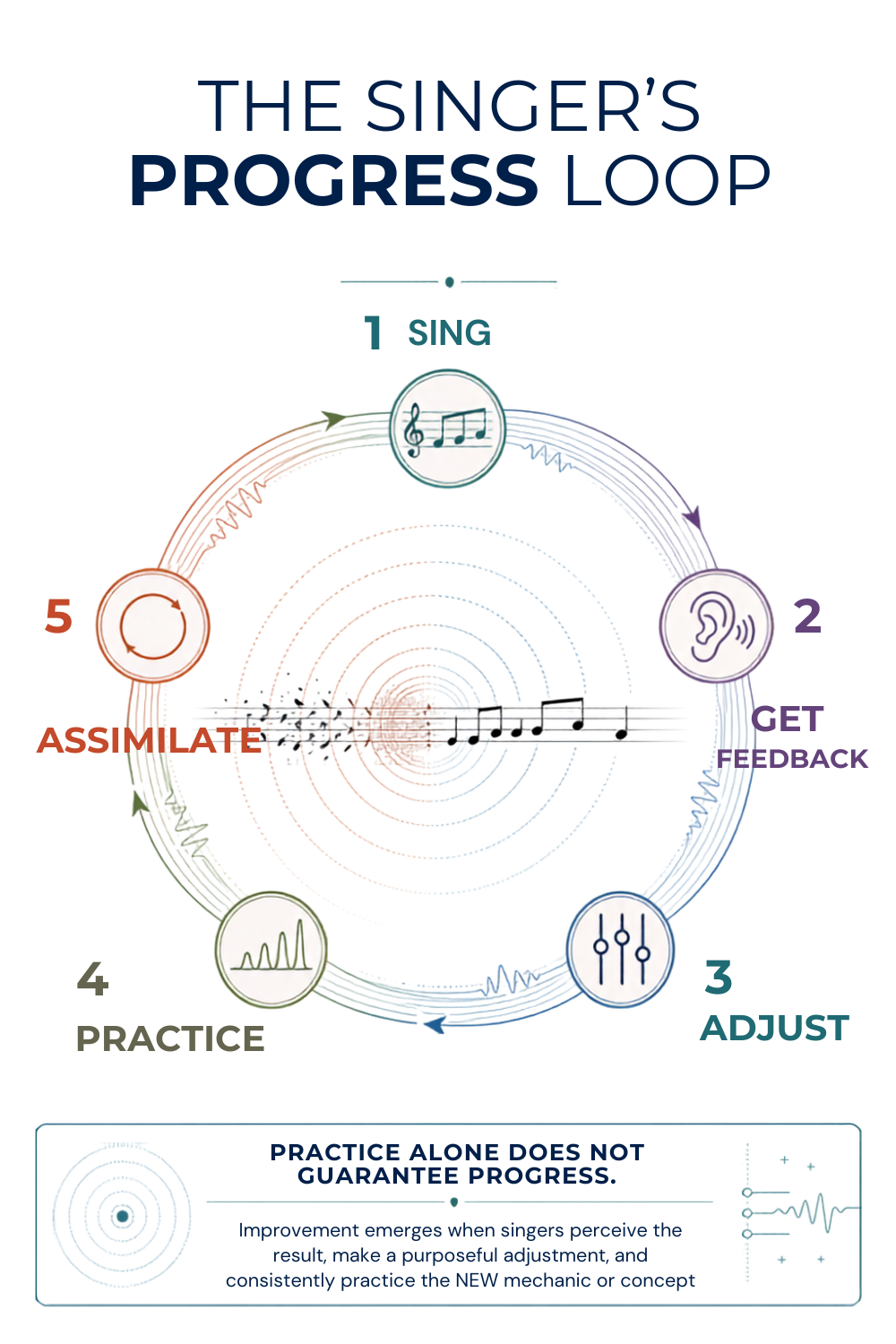
Real progress happens when singers move beyond mindless repetition and use feedback to make purposeful adjustments.
They Spend Less Time Collecting Information and More Time Following a Plan
We live in an age of unlimited information.
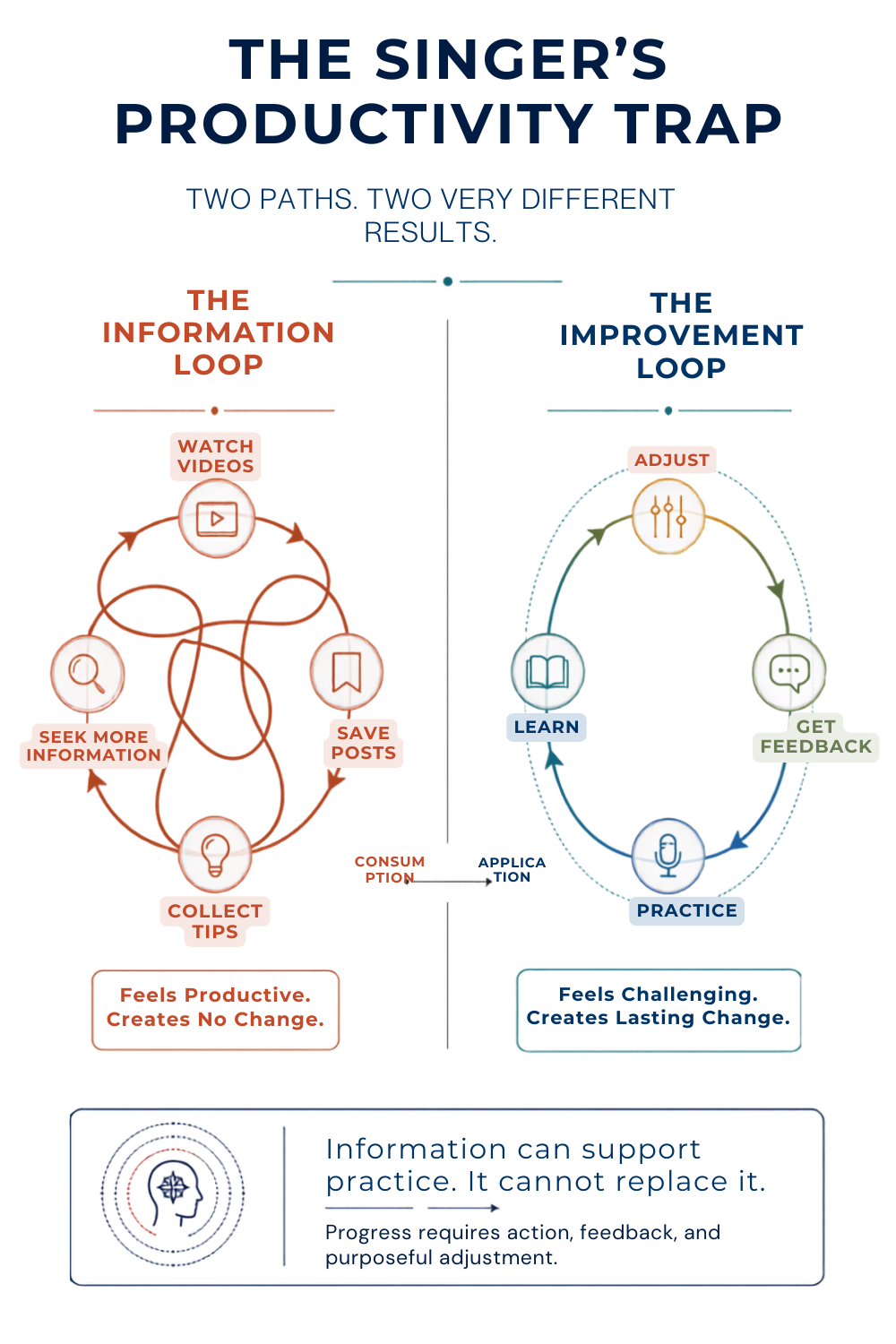
If you want advice about breath support, mixed voice, resonance, vocal health, or range extension, you can find thousands of videos, articles, courses, and social media posts in a matter of minutes. At first glance, this seems like a tremendous advantage. In reality, it can create a new problem.
Many singers assume that more information will automatically lead to more improvement. As a result, they spend their time searching for new exercises, new explanations, and new solutions. The challenge is that even excellent information may not address the problem that is actually holding a singer back.
A singer struggling with breath management can spend weeks learning about resonance. A singer who needs stronger musicianship may become preoccupied with vocal exercises. A singer who would benefit from performance experience may spend months obsessing over technical details.
The issue is not that the information is wrong. The issue is that it may not be relevant to that specific singer.
In many cases, too much information is more harmful than too little because it scatters a singer's attention across dozens of competing priorities. The singers who improve fastest tend to do something different.
Rather than constantly searching for new information, they identify the skill that deserves their attention and focus on it long enough to make meaningful progress. They follow a plan. They understand that improvement is not about doing more things. It is about doing the right things consistently.
Good information is valuable. But information becomes truly useful only when it helps a singer make better decisions about where to focus their time and energy.
They Prioritize the Skills That Matter Most
Another characteristic of fast-improving singers is their ability to focus.
Many singers try to improve everything at once. One day they are concerned about breath support. The next day they are focused on resonance. Then they become worried about range, vibrato, diction, stage presence, or vocal agility. While all of these areas matter, attempting to address them simultaneously often leads to frustration.
Progress tends to accelerate when singers identify the skill that will create the greatest overall improvement.
For example, a singer who struggles to sustain phrases may benefit far more from improving breath management than from learning additional vocal exercises. A singer with strong vocal technique but weak musicianship may see greater gains by focusing on rhythm, score study, or sight-reading. Another singer may discover that confidence and performance experience are the primary barriers preventing growth.
Not every challenge deserves equal attention.
One of the most valuable questions a singer can ask is not, "What should I practice today?" but rather, "What skill would make the biggest difference in my singing right now?"
This shift in thinking helps singers move away from random practice and toward strategic practice. Instead of spreading attention across ten different goals, they concentrate on the one or two areas most likely to produce meaningful results.
They Have a Plan
Many singers approach practice without a clear roadmap. They warm up, sing through a few songs, and work on whatever catches their attention that day. While there is certainly value in exploration, progress tends to happen more consistently when practice has a purpose.
The singers who improve fastest usually have a clear understanding of what they are working on, why they are working on it, and how they will know whether they are improving.
This doesn’t require an elaborate practice schedule. In fact, overly complicated plans often become difficult to maintain. What matters most is having a clear objective.
Imagine two singers preparing for the same performance. One singer spends each practice session doing whatever feels interesting in the moment. The other singer identifies a specific challenge, perhaps maintaining consistent breath flow through long phrases, and spends several weeks addressing that issue systematically. Over time, the second singer is likely to see greater improvement because their efforts are aligned with a clear goal.
Athletes train this way. Professional musicians train this way. Successful singers do as well.
A simple plan practiced consistently is often far more effective than an ambitious plan that changes every day.
They Practice Skills, Not Just Songs
One of the most common misconceptions in singing is the belief that singing songs is the same thing as practicing.
Songs are important. They develop artistry, communication, interpretation, and musical expression. Repertoire is where technique ultimately serves music. However, repertoire is not always the most efficient place to solve technical problems.
Consider a singer who struggles with a difficult passage. They may sing the passage repeatedly, hoping that it eventually improves. Sometimes it does. More often, however, they simply reinforce the same habits over and over again.
A more effective approach is to identify the skill that the passage requires.
Perhaps the challenge involves breath pacing. Perhaps it requires smoother registration transitions, greater agility, more efficient vowel modification, or improved rhythmic accuracy. Once the underlying skill has been identified, the singer can isolate and practice that skill directly before returning to the repertoire.
This approach mirrors how athletes train. A basketball player doesn’t improve free throws solely by playing full games. A pianist doesn’t master a difficult passage simply by performing the entire piece repeatedly. Effective practice often involves breaking complex tasks into smaller components and strengthening those components individually.
When singers learn to separate skill development from performance, practice becomes more efficient, progress becomes easier to measure, and performance becomes
They Seek Feedback
One of the greatest challenges in singing is that we experience our voices from inside the instrument. Because of this, the voice we hear while singing can sound very different on a recording. Because of this, singers can easily develop inaccurate perceptions of their own performance. They may believe a note sounds strained when it doesn’t, or they may overlook habits that are obvious to listeners.
This is why feedback is so valuable and feedback can come from many sources: a trusted teacher, a coach, a collaborative pianist, a choir director, recordings, or even thoughtful self-assessment.
The singers who improve most consistently tend to seek feedback regularly. They are curious about what’s working and what is not. Rather than viewing feedback as criticism, they view it as actionable information. This mindset allows them to make better decisions about how to spend their practice time. Instead of guessing what needs attention, they can focus on areas that genuinely require improvement.
Feedback also helps singers avoid one of the most common traps in learning: practicing the wrong thing for too long. The sooner a singer recognizes an ineffective habit, the sooner they can replace it with a more productive one.
Consistency Matters More Than Intensity
There is one additional concept that deserves mention, and it often separates singers who improve steadily from those who experience repeated cycles of progress and frustration. The fastest-improving singers are remarkably consistent.
They don’t necessarily practice for hours every day. In fact, many successful singers maintain relatively modest practice schedules. What distinguishes them is their ability to show up regularly.
A singer who practices thoughtfully for thirty minutes five days a week will often make greater progress than a singer who practices three hours once every two weeks. Singing is a coordination-based skill, and coordination develops through frequent reinforcement.
Consistency also allows singers to build momentum. Small improvements accumulate over time. A slightly more efficient breath, a slightly more stable registration transition, or a slightly clearer vowel may seem insignificant in isolation. Yet over weeks and months, these small gains compound into substantial growth.
Many singers underestimate the power of steady, incremental improvement because they are looking for dramatic breakthroughs. While breakthroughs certainly happen, they are often the result of many small improvements that have been quietly accumulating beneath the surface.
Final Thoughts
The singers who improve the fastest are not always the most talented. More often, they are the most intentional.
They spend less time consuming information and more time applying it. They focus on the skills that matter most instead of trying to fix everything at once. They practice with a plan, develop specific skills rather than simply repeating songs, seek meaningful feedback, and maintain consistency over time.
None of these habits are particularly glamorous. They don’t promise instant results or dramatic transformations. Yet they are the habits that repeatedly appear in singers who make steady, lasting progress.
If you’re looking for the next step in your own development, consider asking yourself a simple question:
Am I spending my time in a way that supports the singer I want to become?
The answer to that question may reveal more about your future progress than any discussion of talent ever could.
References
Ericsson, K. A., Krampe, R. T., & Tesch-Römer, C. (1993). The role of deliberate practice in the acquisition of expert performance. Psychological Review, 100(3), 363–406.
Li, F., Zhang, Y., Wang, X., et al. (2023). Musical feedback training enhances metacognitive monitoring and learning outcomes. npj Science of Learning, 8(1).
Schmidt, R. A., & Lee, T. D. (2019). Motor Learning and Performance: From Principles to Application (6th ed.). Human Kinetics.
