
Why Your Singing Voice Sounds Different on Recordings (And What It Can Teach You)
One of the most common questions singers ask is surprisingly simple, ‘How do I know what I need to work on?’ At first glance, the answer seems obvious. Listen to yourself. Identify what needs improvement. Fix it… If only it were that easy.
Over the years, I’ve worked with singers at every level, from beginning students to professionals, voice teachers, choir directors, and music educators. What continues to fascinate me is that the challenge is rarely a lack of effort. Most singers are working hard. Many are practicing consistently. Some are consuming enormous amounts of information through lessons, masterclasses, books, podcasts, YouTube videos, and social media.
Yet many still feel stuck. Not because they lack talent. Not because they’re lazy. Not because they’re practicing the wrong exercises. More often than not, singers struggle because they are trying to solve a problem that is much harder than it appears. The challenge is not simply learning how to sing. The challenge is learning how to evaluate your own singing accurately.
Every skill develops through a feedback loop. We attempt a task, receive information about the outcome, make adjustments, and try again. Whether you’re learning a language, developing athletic skills, or mastering a musical instrument, improvement depends on the quality of the feedback you receive.
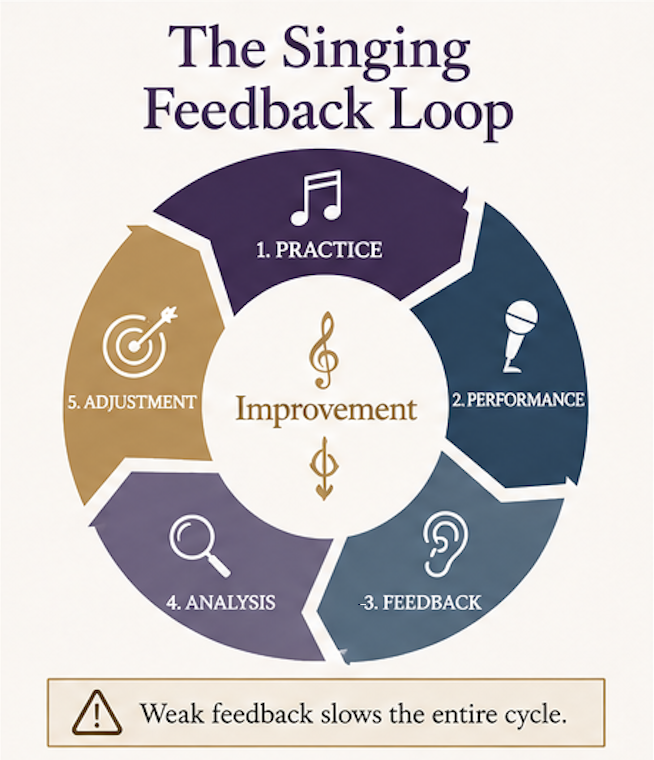
The challenge for singers is that feedback is uniquely complicated. A pianist can watch their hands. A painter can step back from the canvas. A runner can look at a stopwatch. But singers are both the musician and the instrument. We are inside the process while it is happening.
When we sing, we’re simultaneously managing breath, vowels, resonance, rhythm, language, expression, posture, and coordination. Our attention is divided among dozens of tasks at once. It is difficult to objectively evaluate the performance while we are actively engaged in creating it. This creates a challenge that many singers underestimate. The very skills required to perform well are often the same skills required to evaluate the performance.
Why Does My Singing Voice Sound Different on Recordings?
Most people have had the unsettling experience of hearing a recording of themselves for the first time and thinking, "Do I really sound like that?" The answer is both yes and no.
When you speak or sing, you hear your voice differently than everyone else does. The sound reaches your inner ear through two pathways. One pathway travels through the air, just as it does for your listeners. The second pathway travels through the bones and tissues of your head, a phenomenon known as bone conduction.¹
Because of this additional acoustic information, the voice you hear while singing is not exactly the same voice your audience hears. Recordings largely remove the bone-conducted component and present the sound through air conduction, which is much closer to what listeners experience.¹
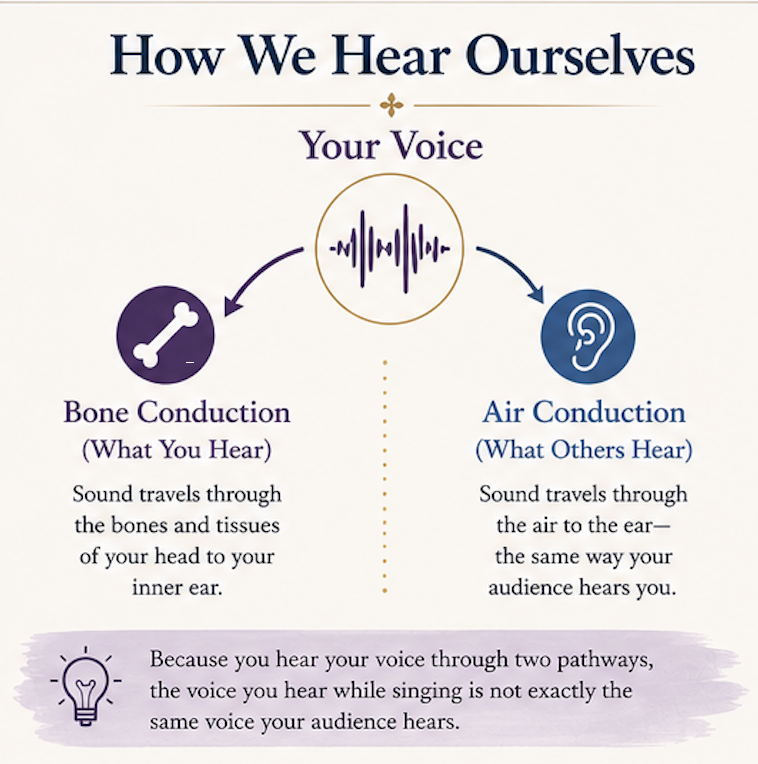
Researchers studying voice perception have noted that this difference between self-perception and recorded playback contributes to the discomfort many people experience when listening to recordings of themselves.² The recording is not wrong. It is simply presenting your voice from the listener's perspective rather than the performer's.
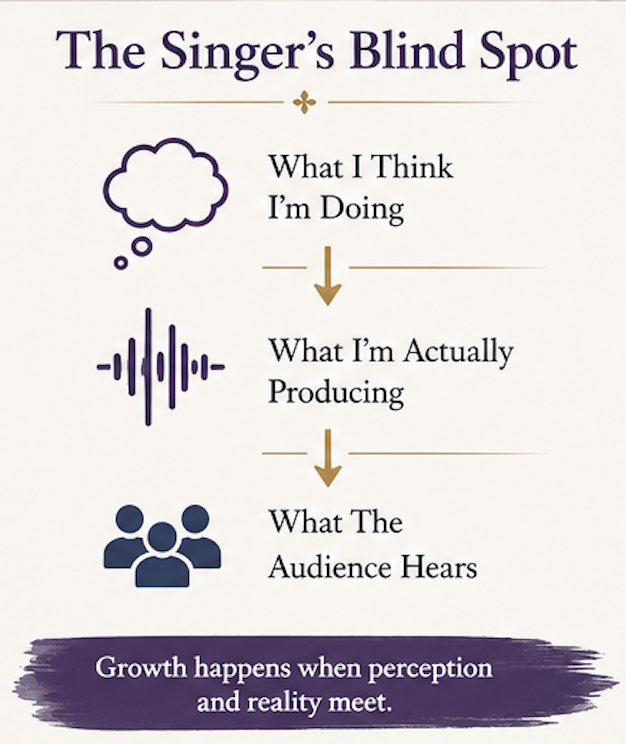
This distinction matters because singers often make decisions based on what they feel and hear internally rather than what is actually reaching the audience. The reality is that our perception while singing is not always an accurate reflection of what listeners experience.
This should feel familiar to most singers. Have you ever walked away from a lesson, rehearsal, or performance feeling fantastic only to hear a recording later and realize it wasn't quite what you thought? Or perhaps the opposite has happened. You felt disappointed after a performance, only to discover that the recording sounded far better than it felt. Both experiences reveal the same truth - self-perception and objective evaluation are not always the same thing.³
The Singer's Blind Spot
Research in music education consistently suggests that self-assessment plays an important role in developing expertise. Musicians who learn to evaluate their own performances become more independent learners and often develop stronger problem-solving skills.⁴˒⁵
At the same time, self-assessment is far from perfect.
One particularly interesting study examined how young musicians evaluated their own performances before and after listening to recordings of themselves. Researchers Jason Silveira and Russell Gavin found significant differences in how students rated pitch accuracy, rhythm, and tone quality once they had the opportunity to listen back to recordings.⁴ Hearing the performance from the perspective of a listener revealed information that many students missed while they were actively performing.
While this study focused on instrumentalists rather than singers, the implications are difficult to ignore. Performance demands occupy our attention. Listening back creates distance. That distance allows us to notice details that were invisible in the moment.
This should feel familiar to most singers. Have you ever walked off stage feeling fantastic only to hear a recording later and realize the performance was not quite what you thought it was? Or perhaps the opposite has happened. You felt disappointed after a performance, only to discover that the recording sounded far better than it felt. Both reveal the same truth: What we experience while singing and what actually reaches the listener can be quite different.
This is where many singers get stuck. Once they become aware of a problem, they naturally want to fix it. They buy another course. Watch another YouTube video. Save another social media post. Learn another exercise. But information is rarely the limiting factor.
More often, the challenge is figuring out what actually deserves attention in the first place.
A recording can reveal things we miss while we are singing. It can help narrow the gap between what we think we are doing and what we are actually producing. In many cases, it shines a light on blind spots that would otherwise go unnoticed.
That awareness is incredibly valuable. But awareness and diagnosis are not the same thing. A recording can tell us that something is happening. It cannot always tell us why.
What Recordings Cannot Tell You
At this point, it may sound like recording yourself is the answer to everything. It isn't. A recording can help you identify a problem.It cannot always tell you why that problem exists. Imagine two singers who both struggle with pitch accuracy. The symptom is identical. The underlying causes may be completely different. One singer may be struggling with breath coordination. Another may have an audiation issue. A third may be experiencing excessive muscular tension. A fourth may be singing repertoire that exceeds their current technical abilities.
From the listener's perspective, all four singers sound out of tune. But the solution is different in every case.
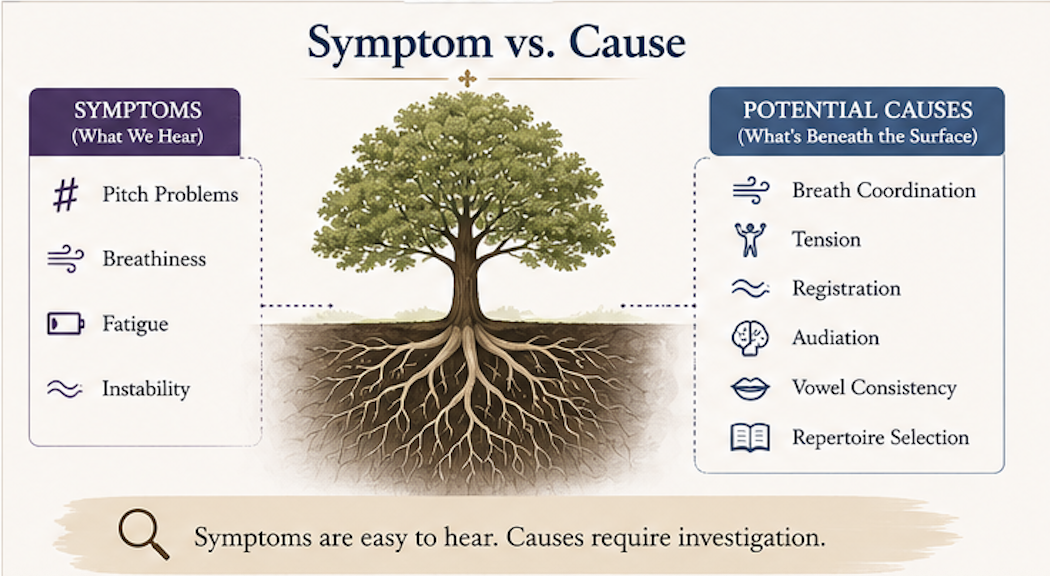
This distinction is important because many singers spend months, or even years, attempting to solve the wrong problem. They focus on the symptom while missing the underlying cause. A singer hears instability and assumes they need more support. Another hears vocal fatigue and concludes they need to build stamina. A third notices inconsistency across registers and immediately begins searching for new exercises. Sometimes they’re right. Sometimes they aren't. The challenge is that symptoms are often easy to hear. Diagnosis is considerably more difficult.
This is true in virtually every field. A fever may indicate dozens of different illnesses. A warning light on your dashboard can be triggered by a variety of mechanical problems. The symptom points us toward the problem. It does not necessarily reveal the cause.Singing works much the same way. A recording can tell us that something is happening. It cannot always tell us why.
This is one of the reasons singers who rely exclusively on self-diagnosis often find themselves stuck in cycles of trial and error. They work hard. They practice diligently. They collect more information. Yet progress remains frustratingly slow because they are solving the wrong problem. The goal is not simply to identify what sounds off. The goal is to understand what is creating the issue in the first place. That distinction often makes the difference between temporary improvement and lasting change.
What Great Teachers Actually Do
Many singers assume that teaching is primarily about providing exercises. Exercises certainly have their place. But in my experience, the most valuable thing a teacher provides is clarity.
A skilled teacher helps identify strengths, blind spots, priorities, and next steps. They help determine which issue is actually limiting progress and which issues are merely symptoms.
In many cases, the greatest gift a teacher offers is not a new exercise but an accurate diagnosis. This should not be surprising. Elite athletes work with coaches. Professional writers work with editors. Surgeons learn from mentors. Even experienced teachers seek feedback from trusted colleagues. Musicians are no different.
In fact, research on expertise consistently suggests that high-level performers benefit from external feedback, reflection, and guided self-assessment throughout their development.⁷˒⁸
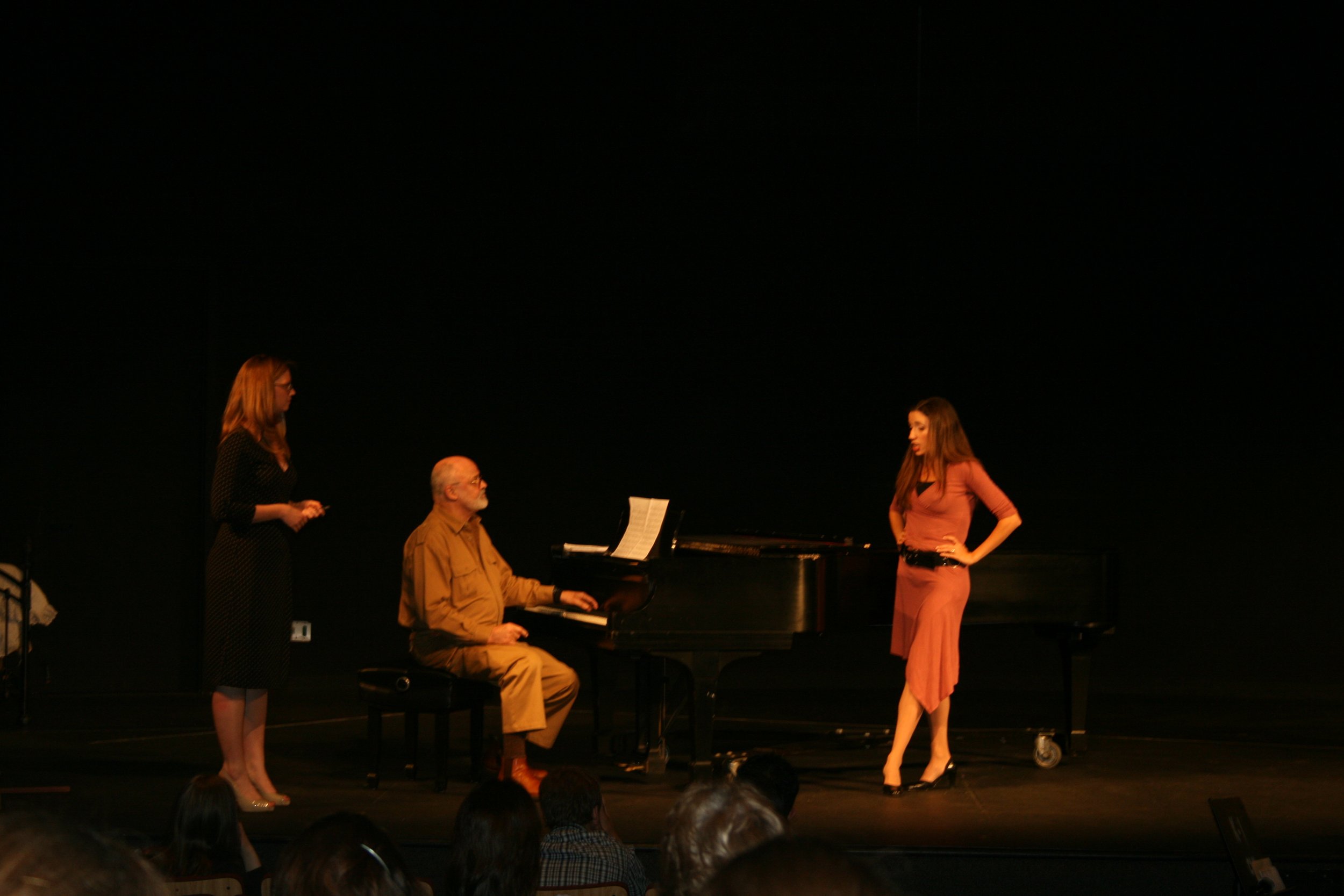
The world’s best singers continue to work with voice teachers throughout their careers.
One of the biggest misconceptions in vocal training is that accomplished singers eventually outgrow the need for guidance. The opposite is actually true. Most of the world's finest singers continue to work with voice teachers and coaches throughout their careers. Like elite athletes, singers must continually train to maintain their instrument while adapting to the realities of life, changing repertoire, evolving artistic goals, and the natural changes that occur over the course of a career. As skills become more refined, the feedback required to continue improving becomes increasingly specific. What may seem insignificant to the singer is often immediately apparent to an experienced teacher, conductor, coach, or colleague.That outside perspective can be invaluable. Not because singers are incapable of learning independently, but because every musician has blind spots.
Throughout my own career, I have benefited enormously from teachers, coaches, conductors, colleagues, and mentors who helped me hear things I could not hear for myself. The goal is not to become dependent on someone else's opinion. The goal is to gradually develop the ability to evaluate yourself more accurately.
Ironically, one of the fastest ways to become an independent singer is to receive high-quality feedback from someone who can help you recognize patterns that might otherwise remain hidden. Over time, many of those blind spots begin to shrink. You learn what to listen for. You learn what to prioritize. You learn how to distinguish symptoms from causes.
And perhaps most importantly, you learn how to become a more reliable observer of your own singing.
References
Asai, T., Sugimori, E., & Tanno, Y. (2012). Why do people dislike the sound of their own voice? Voice-selective self-enhancement in auditory self-recognition. Perception, 41(10), 1254-1258.
Li, F., Zhang, D., Wang, Y., & Wong, P. C. M. (2023). Musical feedback training enhances metacognitive monitoring and learning. npj Science of Learning, 8(1), 20.
McPherson, G. E., & Zimmerman, B. J. (2011). Self-regulation of musical learning. In B. J. Zimmerman & D. H. Schunk (Eds.), Handbook of Self-Regulation of Learning and Performance (pp. 130-145). Routledge.
Silveira, J. M., & Gavin, R. B. (2015). The effect of audio recording and playback on self-assessment among middle school instrumental music students. Psychology of Music, 44(4), 747-764.
Valle, A., Andrade, H., Palma, M., & Hefferen, J. (2016). Applications of peer and self-assessment in music. Music Educators Journal, 102(4), 41-49.
