
7 Things Every Church Singer Should Know About the Singing Voice
Over the past several weeks, I've had the privilege of teaching vocal pedagogy to church musicians from across the country. I recently presented two lectures at the Church Music Association of America's Sacred Music Colloquium, and later this summer I'll continue those conversations as a member of the faculty at the Floriani Collegium.
Preparing those lectures forced me to wrestle with a simple question:
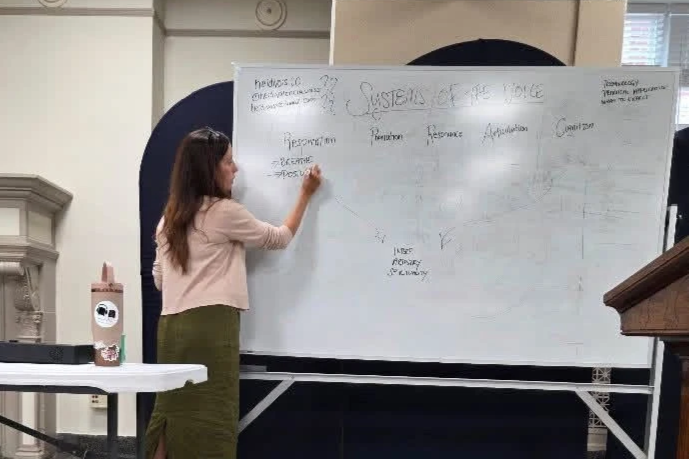
Presenting at the CMAA Sacred Music Colloquium 2026 in Champagne, Ill. Photo Credit: Patrick McGuire
What does every church singer need to understand about the voice?
Not simply how to breathe. Not how to sing higher. Not how to project more. But how to think about the voice itself.
For much of Western history, the Church was the center of musical education. Long before conservatories existed, singers were trained in monasteries, cathedrals, and choir schools.¹ The techniques that eventually became the foundation of Western vocal pedagogy were cultivated in service of the liturgy. Sacred music wasn't a specialty. It was the tradition from which much of our vocal heritage emerged.
Today, however, something has shifted.
Modern voice science has dramatically expanded our understanding of anatomy, acoustics, motor learning, and skill acquisition. Yet much of that knowledge has remained within conservatories, universities, and professional studios. Meanwhile, many church musicians faithfully serve their parishes every week without ever being given a framework for understanding the remarkable instrument God has entrusted to them.
In many ways, I believe we are living in a moment of restoration. Not a restoration that rejects modern science in favor of tradition. Nor one that abandons tradition in pursuit of science. Rather, a restoration that elevates the best of what both can offer and gives us insights on how to best employ all that we know in vocal pedagogy to serve the highest calling in our music making.
The Church gave the Western world its first great tradition of training singers. Modern vocal pedagogy now offers remarkable insight into how the voice actually functions. Together, they invite us to reclaim something that has always belonged at the heart of sacred music: singers whose technique serves both beauty and prayer.
Whether you're a choir member, cantor, conductor, or professional singer serving the Church, these are seven ideas that I believe every church musician should understand about the singing voice.
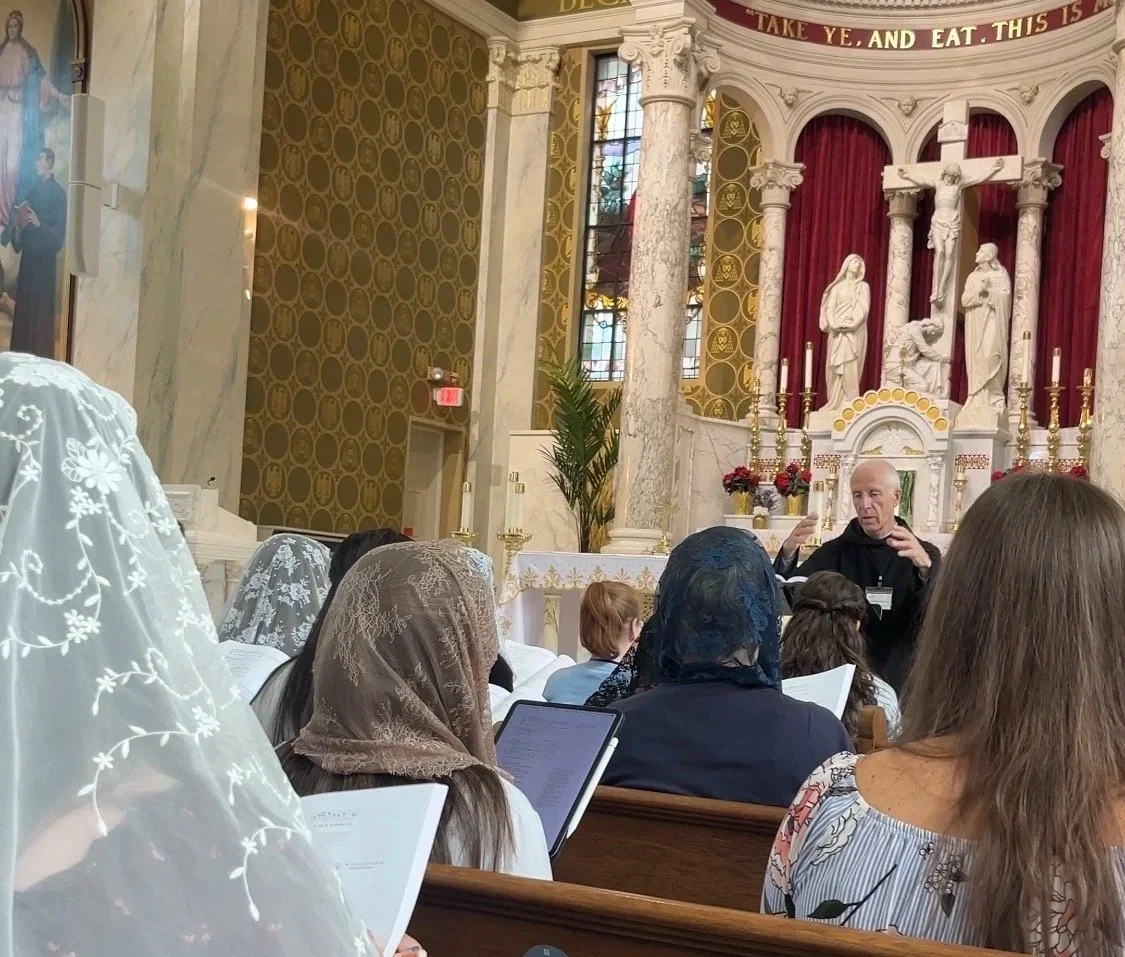
Practicing Gregorian Chant for the Daily Mass at the CMAA Sacred Music Colloquium 2026
1. Before You Sing, Know Where You're Aiming
Every voice lesson I teach begins with the same question: Where are you aiming?
It may seem like an odd place to start. Most singers expect to begin by talking about breathing, posture, resonance, or vocal exercises. Those things certainly matter, but they are not the primary question. Purpose comes first. Before we can decide how to sing, we must first understand why we are singing.
Over the years, "Where am I aiming?" has become the primary heuristic of my teaching. Its a simple mental framework that organizes every technical and artistic decision that follows.
A singer preparing for an opera audition is aiming at something very different from a jazz vocalist. A Broadway performer makes artistic decisions that would be entirely inappropriate for Gregorian chant. Even within sacred music, a cantor proclaiming the Responsorial Psalm has a different role than a choir singing a Renaissance motet or a soloist performing an oratorio. The destination determines the path.
This is one of the reasons I specialize in the differentiation of genre and style. While healthy vocal function is remarkably consistent across styles, the artistic choices we make, the color of the tone, the use of vibrato, the shape of the phrase, the clarity of the text, and even our physical presence must always be informed by the purpose of the music. This is more than an artistic decision. It is a cognitive one.
Research in motor learning and cognitive science suggests that the way we frame a task influences how we perform it.² Our brains don't simply execute movement - they organize movement around a goal. In other words, what we are trying to accomplish changes how the body coordinates itself to accomplish it. I refer the this phenomena as cognitive framing.
When a singer approaches a phrase thinking, I need to support more, I need to lower my larynx, or I need to breathe deeper, the body organizes itself around solving a mechanical problem. But when that same singer asks, Where am I aiming? the brain begins solving an entirely different problem. The desired musical outcome becomes the organizing principle. That shift doesn't simply change our interpretation, it changes the physical organization of the instrument itself. The vocal tract is capable of producing nearly three million different shapes and acoustic configurations. Every artistic intention encourages the body to select a different coordination. Breathing strategy, resonance, muscular activity, articulation, and even posture begin to organize around the sound we intend to create.
Our intention literally changes the physical shape of the instrument. For the church musician, this has profound implications.
If our aim is to proclaim the sacred text with clarity, support the prayer of the congregation, and serve the liturgy with humility, the body begins organizing itself toward those goals. The resulting coordination is fundamentally different than if our objective is applause, dramatic effect, or vocal display.
Joseph Ratzinger reminds us that sacred music reaches its highest purpose when it participates in the liturgy and directs our attention toward the worship of God rather than toward the performer.³ If that is truly our destination, then every technical decision should help us move toward it.
Technique is no longer about producing the biggest sound, the highest note, or the most impressive performance. It becomes the disciplined pursuit of freedom and efficiency - removing the obstacles that prevent the music from communicating clearly, beautifully, and prayerfully.
I often tell my students that the best technique is almost invisible. When we have done our work well, the congregation should leave remembering the beauty of the Psalm, the mystery of the chant, or the power of the sacred text, not the mechanics of our singing. It all comes down to that simple question. Where am I aiming?
2. Your Voice Is More Malleable Than You Think
One of the biggest misconceptions singers have is believing that their sound on any give day is simply “their voice” - It’s what they were born with and how they sound. But that’s not the full picture. Certainly, each of us is born with unique anatomical characteristics. The size and shape of the vocal folds, the dimensions of the vocal tract, our skeletal structure, and countless other biological factors contribute to the instrument we've been given, but the sound we produce is far more adaptable than most people realize.
Modern vocal pedagogy understands singing as a learned neuromuscular skill rather than a fixed trait.⁴ Like walking, handwriting, or throwing a ball, singing develops through repeated experience. Every phrase we sing reinforces patterns of coordination that gradually become automatic. Richard Miller described vocal technique not as the pursuit of isolated muscular movements, but as the development of reliable coordinations that can be reproduced consistently in performance.⁵
This understanding fundamentally changes how we think about the voice. Rather than asking, "What kind of voice do I have?" we begin asking, "What kind of voice am I building and reinforcing?" That question introduces another dimension of vocal pedagogy that is often overlooked - the voice does not develop in isolation. It develops in community.
Human beings are fundamentally social creatures. From the moment we’re born, we learn by observing, imitating, and participating in the world around us. Research in cognitive science suggests that much of our learning occurs through observation, imitation, and repeated interaction with our environment.² Singing is no exception.
Our teachers shape us. Our conductors shape us. The choirs we sing in shape us. The music we listen to shapes us. The traditions we participate in shape us. This is what we refer to as the social dimension of vocal pedagogy.
One of the ways I encourage singers to think about this is through the idea of a listening diet. Just as our nutritional diet provides the building blocks for our physical health, our listening diet provides the building blocks for our musical imagination. Every recording we admire. Every choir we sing with. Every soloist we imitate. Every rehearsal we attend. Every style of music we immerse ourselves in. Each one contributes to the internal model our brain uses to organize vocal coordination. Over time, those experiences shape not only how we think singing should sound, but also how our bodies learn to produce that sound. Our listening literally becomes part of our technique.
In many ways, we become what we repeatedly listen to. This is why so many singers believe they have a "natural voice." What often feels natural is actually the product of years of unconscious adaptation to the musical environments that have surrounded us. The encouraging news is that this process works both ways. If our musical environment helped shape our voice, then intentionally changing that environment can help reshape it. For church musicians, this has profound implications.
If our musical world is formed primarily by commercial styles of singing, those stylistic assumptions will naturally find their way into our voices. If, however, we immerse ourselves in Gregorian chant, Renaissance polyphony, the great choral tradition of the Church, and artists who embody reverence, textual clarity, and humility, those sounds begin shaping our instincts long before we consciously think about technique. Formation always precedes expression.
The communities we belong to, the music we consume, and the voices we admire all become part of the instrument we bring to the liturgy. That is why building a healthy singing voice is about far more than vocal exercises. It is about intentionally shaping the environment that shapes us.
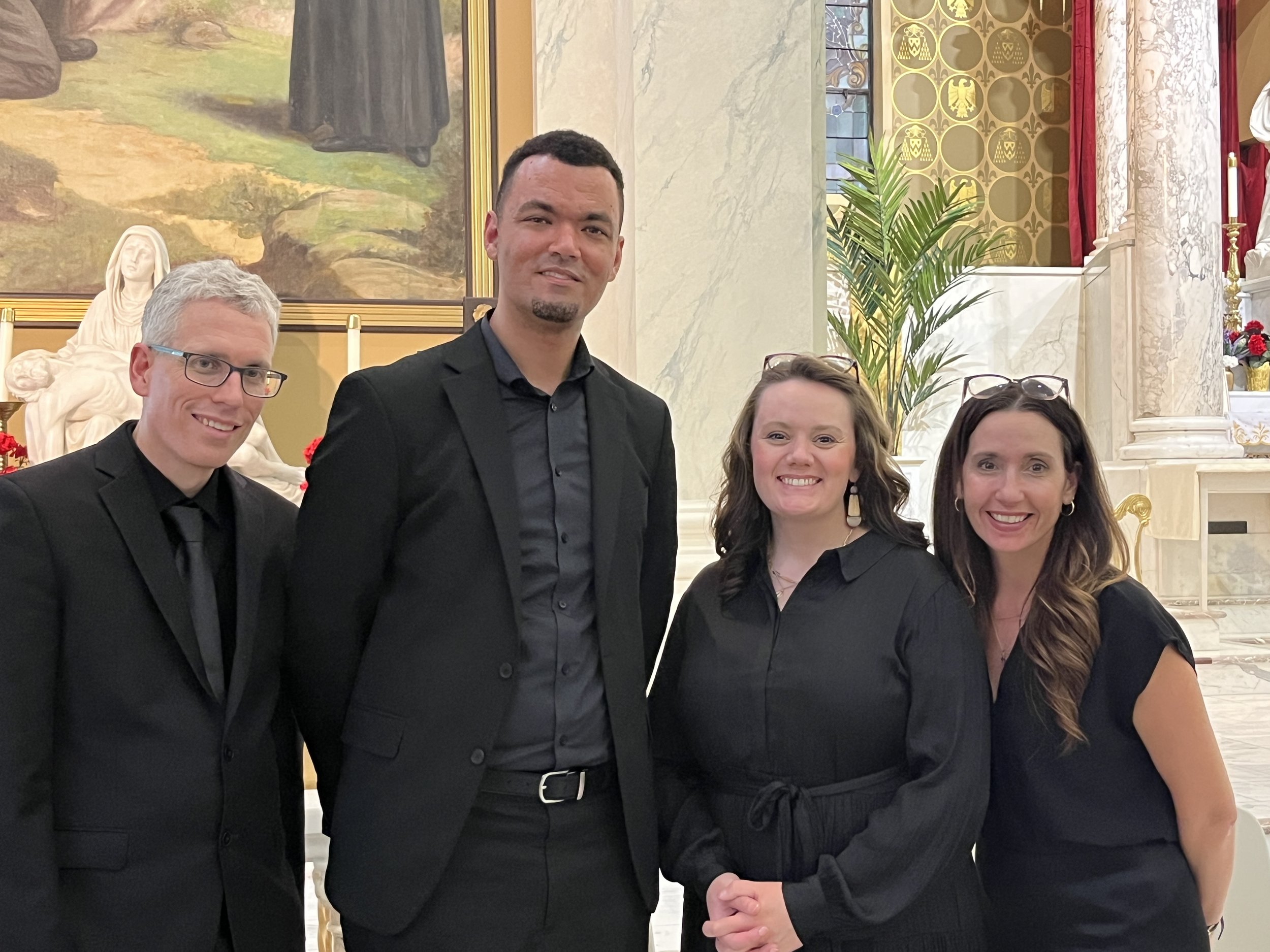
My fellow soloists for the Mozart Requiem. What a joy it was to sing with them!
3. The Voice Is More Than a Larynx
Since Manuel García II first observed the living larynx in 1854, vocal pedagogy has become increasingly focused on the mechanics of singing.⁶ Understandably so. The larynx is the source of the vibrating sound, and understanding how it functions has transformed the way we teach singing.
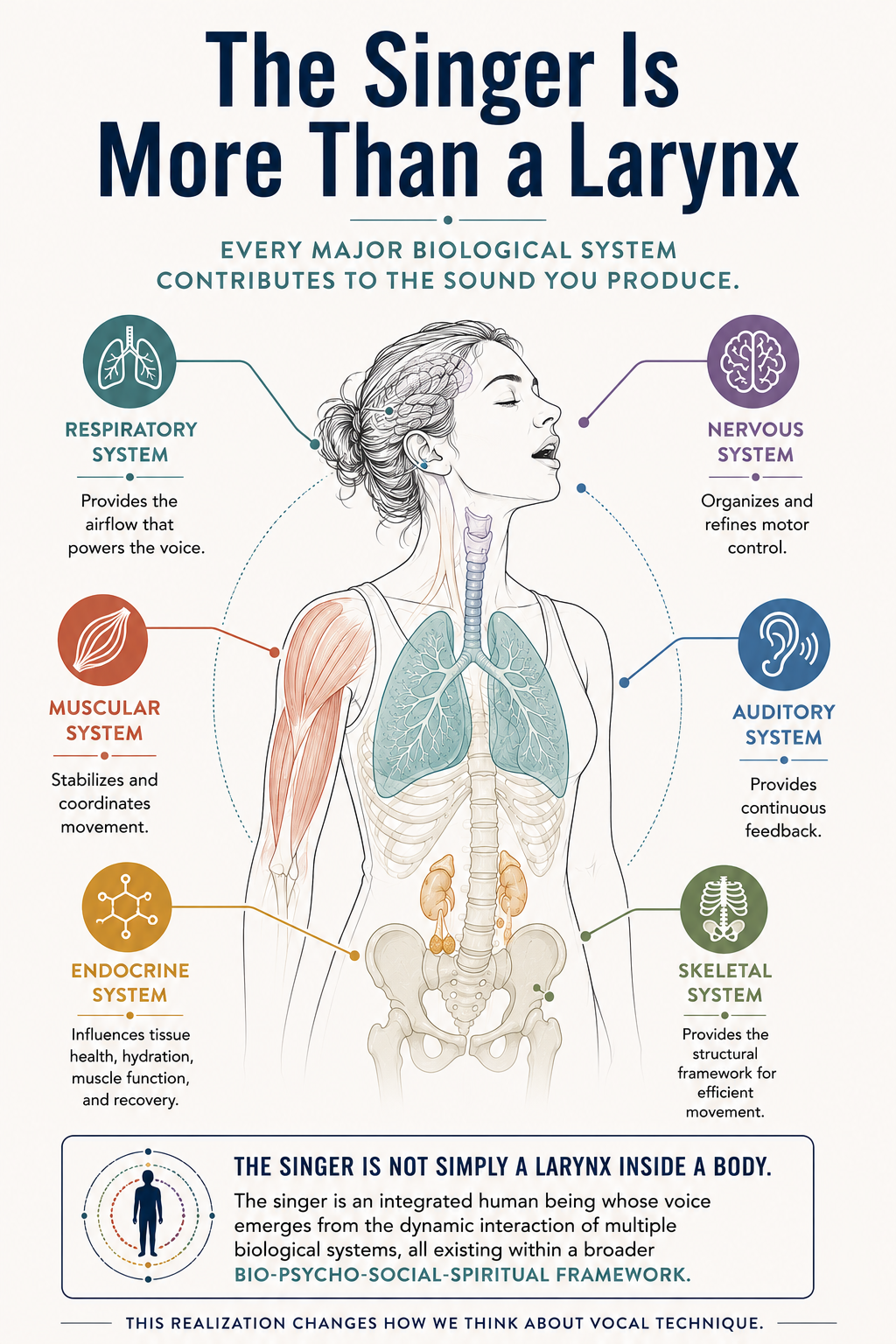
Modern voice science has dramatically expanded that understanding. Efficient singing emerges from the coordinated interaction of the respiratory, phonatory, resonatory, and articulatory systems, not from any single structure acting alone.⁴ But even that picture is incomplete. The voice does not exist independently of the body. It is the body.
Every major physiological system contributes to the sound we produce. Our respiratory system provides the airflow. Our muscular system stabilizes and coordinates movement. Our nervous system organizes and refines motor control. Our auditory system provides constant feedback. Our endocrine system influences tissue health, hydration, muscle function, and recovery. Our skeletal system creates the framework within which all of those systems interact. The singer is not simply a larynx inside a body. The singer is an integrated human being whose voice emerges from the dynamic interaction of multiple biological systems, all existing within a broader bio-psycho-social-spiritual framework.This realization changes how we think about vocal technique.
When a singer experiences increased fatigue, slower recovery, reduced range, or changes in vocal quality, the answer is not always, "I need to practice harder." Sometimes the body is communicating something much larger. Perhaps recovery has been neglected. Perhaps sleep has suffered. Perhaps stress has become chronic. Perhaps illness has altered coordination. Perhaps hormones have changed the instrument itself. One of the greatest gifts modern voice science has given singers is permission to view the voice within the larger context of human physiology.
As singers, we don't simply train vocal folds. We train living tissue. Living tissue responds to sleep, nutrition, hydration, stress, fitness, aging, illness, hormones…. Every decision we make about our health becomes part of our vocal technique.
This is why I encourage singers to stop thinking about voice care as something separate from daily life. Your health habits are your vocal habits. For church musicians, this perspective can be especially freeing. Many volunteer singers assume that vocal struggles are evidence of poor technique or insufficient talent. Sometimes they are. But sometimes the voice is simply reflecting the reality of the body God has entrusted to us. Understanding that relationship replaces frustration with curiosity.
Instead of asking, "What's wrong with my voice?" we begin asking, "What is my body trying to tell me?" That is the beginning of intelligent practice and measurable growth.
4. The First Task of the Church Singer Is to Order the Self
One of the greatest differences between training a secular singer and training a church musician is not the vocal mechanism itself, but how the self is ordered. That ordering doesn't merely change the singer's intentions—it changes the way the singer approaches technique. As we've already seen, the way we frame a task influences how the brain organizes movement. When the aim changes, the coordination changes. The spiritual orientation of the church musician therefore becomes part of vocal technique itself.
When I train opera singers, I want them to develop enormous artistic confidence. They must believe they have something worth saying. They must command the stage, sustain dramatic tension, and invite an audience into their interpretation of the story. The audience has, after all, paid to experience their performance. That requires a healthy sense of artistic ownership. If a singer doesn't believe their voice is worth listening to, why should anyone else?
In many performance settings, individuality, personality, and virtuosity are not distractions, they’re part of the artistic goal. The singer is expected to communicate with conviction, inhabit a character, and draw the audience into the drama.
The liturgy asks something fundamentally different. The church musician is certainly called to sing with beauty, confidence, and technical excellence. But those gifts are ordered toward a different end.
The singer is no longer the center of the drama. Christ is.
Hans Urs von Balthasar describes this distinction as the difference between ego-drama, in which we place ourselves at the center of the story, and Theo-Drama, in which our lives are ordered toward participation in God's saving work.⁷For the church musician, this becomes more than a theological idea. It becomes a pedagogical principle. Our task is not to diminish our artistry. Our task is to rightly order it.
Every technical decision, every interpretive choice, and every moment of vocal expression should ultimately point beyond ourselves to the sacred action taking place in the liturgy. In other words, we do not sing less beautifully. We sing beautifully for a different reason.
5. Healthy Technique Adapts to Context
One of the greatest gifts a singer can develop is adaptability. Many church musicians don't sing exclusively for the liturgy. They sing in community choirs, perform with symphonies, enjoy opera and musical theatre, lead worship, sing jazz, folk, bluegrass, or contemporary commercial music. Some teach. Some record. Some simply enjoy making music wherever opportunities arise That's a wonderful thing. Every musical experience broadens our artistry and deepens our musicianship. The challenge is recognizing that every style of singing exists within a particular artistic context and, in the case of sacred music, a spiritual one.
The liturgy is one context. The concert hall is another. The theatre is another. A recording studio is another. Each asks something different of the singer. Healthy vocal technique provides the foundation for all of them. Style determines how that healthy instrument is used. This is why I distinguish between adaptive technique and static technique.
A static approach assumes there is one ideal vocal aesthetic that should be applied to every piece of music. Once a singer discovers a sound that is healthy and successful, the temptation is to use that same sound everywhere.
Adaptive technique asks a different question. What does this music require? The healthiest singers are not those who can produce only one beautiful sound. They are the singers who have developed an instrument capable of responding intelligently to many different musical demands while maintaining healthy vocal function. Richard Miller reminds us that efficient vocal technique is built upon balanced coordination rather than rigid vocal habits.⁵
For church musicians, this distinction is especially important. Gregorian chant asks something different of the voice than Renaissance polyphony. A Bach Passion asks something different than a spiritual. A Mozart Mass requires different artistic choices than a contemporary worship song. None of those styles require abandoning healthy vocal technique.
They require applying that technique differently. Technique is transferable. Style is contextual. The more adaptable the instrument becomes, the more faithfully it can serve the music placed before it. For the church musician, adaptability is not simply an artistic advantage. It is an act of stewardship.
By developing a healthy, flexible instrument, we become better equipped to respond to the remarkable diversity of the Church's musical tradition - and to serve faithfully wherever our vocation as singers may lead us.
6. Your Voice Can Continue to Grow
One of the most discouraging beliefs I encounter is the idea that a singer's voice is essentially fixed. "This is just the voice I have."… "I'm too old to change."… "If I haven't figured it out by now, I never will."… Fortunately, neither modern voice science nor decades of experience in the teaching studio support that conclusion. The voice is remarkably adaptable.
Throughout this article we've seen that our coordination is shaped by our intentions, our environment, our physical health, and the way we order ourselves toward the music we sing. All of those things can continue to change. That means the voice can continue to change as well.
This doesn't mean the voice is unaffected by age. It is. Hormones change. Muscle mass changes. Recovery changes. Our priorities change. The instrument we sing at twenty is not the same instrument we sing at sixty. But change does not have to mean decline. It can and should mean adaptation. It can mean wisdom. It can mean greater efficiency. It can mean deeper artistry.
One of the great privileges of teaching adult singers has been watching them discover possibilities they assumed had long since passed them by. Sometimes the change is technical. Sometimes it is artistic. Often it is simply the freedom that comes from finally understanding how the instrument actually works.
Growth is not reserved for young singers. It belongs to anyone who remains curious enough to keep learning. This is one reason I encourage church musicians to become lifelong students of the voice. The Church's musical tradition is too rich to ever exhaust. Our understanding of voice science continues to grow. Our bodies continue to change. Our vocation continues to deepen. Healthy vocal pedagogy recognizes all three.
The goal is not to preserve yesterday's voice. It is to steward the voice God has entrusted to us today.
7. Steward the Instrument You've Been Given
Every singer receives an instrument and no two are exactly alike. Some voices are naturally large. Others are light. Some mature early. Others continue to develop for decades. Some encounter illness. Others navigate aging, hormonal change, or injury. No singer chooses every aspect of the instrument they receive. But every singer chooses how faithfully they will care for it.
Throughout this article, we've explored the singing voice through a bio-psycho-social-spiritual framework. We've seen that our voices are shaped by our bodies, our thoughts, our communities, and our spiritual lives.
We've seen that technique is influenced by purpose, that formation matters, and that healthy singing is adaptive rather than rigid. All of those ideas point toward one conclusion. The voice is not merely an ability. It is a gift entrusted to our care. Stewardship means caring for the whole person who sings.
It means sleeping enough to recover. Learning continually. Practicing thoughtfully. Listening intentionally. Caring for our physical and mental health. Remaining open to correction. Growing in humility. Growing in artistry. Growing in prayer. For the church musician, these things are not separate from ministry. They are part of ministry.
The better we understand the remarkable instrument God has entrusted to us, the more freely that instrument can serve the Church.
That, ultimately, is the purpose of vocal pedagogy for the sacred music singer - not simply to produce stronger voices, nor merely to extend range or improve breath management, but to remove the obstacles that prevent singers from offering their voices fully in the service of the Good, the True, and the Beautiful. There is no greater use of your talents, and no better argument for musical excellence.
John 3:30
Acknowledgment:This article grew out of lectures on vocal pedagogy presented at the Church Music Association of America's Sacred Music Colloquium (2026) and further developed for the Floriani Collegium (2026).
References
1. Hoppin, Richard H. Medieval Music. New York: W. W. Norton & Company, 1978.
2. Helding, Lynn. The Musician's Mind: Teaching, Learning, and Performance in the Age of Brain Science. Lanham, MD: Rowman & Littlefield, 2020.
3. Ratzinger, Joseph. The Spirit of the Liturgy. San Francisco: Ignatius Press, 2000.
4. McCoy, Scott. Your Voice: An Inside View. 3rd ed. Princeton, NJ: Inside View Press, 2019.
5. Miller, Richard. The Structure of Singing: System and Art in Vocal Technique. New York: Schirmer Books, 1996.
6. García II, Manuel. "Observations on the Human Voice." Proceedings of the Royal Society of London 7 (1855): 397–410.
7. Balthasar, Hans Urs von. Theo-Drama: Theological Dramatic Theory. Vol. I: Prolegomena. San Francisco: Ignatius Press, 1988.
