
Menopause and the Singing Voice: What Singers Should Know About HRT and Testosterone
Menopause conversations often focus on hot flashes, sleep, mood, bone density, libido, and body composition. For singers, however, another question may carry enormous personal and professional significance - Can menopause change the singing voice?
The short answer is yes. Hormonal changes during perimenopause and menopause may affect vocal pitch, range, stamina, flexibility, dryness, recovery, and perceived effort. But the research is not nearly as definitive as many online claims suggest.
Some singers experience noticeable changes. Others experience few or none. Hormone therapy may mitigate certain changes, but it is not a guaranteed method of preserving the singing voice. Testosterone requires its own careful discussion because its potential effects on pitch and vocal function differ from those associated with estrogen-based therapy.
As a vocal pedagogue who has worked with singers for more than 25 years, I am particularly interested in the gap between what researchers consider a functional speaking voice and what a trained singer considers a fully functional instrument.
A relatively small change in pitch, range, registration, flexibility, or recovery may be insignificant in ordinary conversation but profoundly important to a singer.
This article explains what the evidence tells us, what remains uncertain, and what singers may want to discuss with their healthcare providers before beginning or changing hormone therapy.
NOTE: This article is for educational purposes and is not a substitute for individualized medical care. Decisions about hormone therapy should be made with a qualified healthcare professional.
Can menopause change your singing voice?
Menopause can affect the voice, but vocal change is neither inevitable nor uniform. A survey of professional female singers from the International Congress of Voice Teachers found that among respondents who had reached menopause, 63% reported experiencing voice changes during their menopausal transition. The most commonly reported changes included:
Loss of higher notes: 42%
Faster vocal fatigue: 38%
Reduced vocal flexibility: 37%
Reduced vocal resilience: 31%
Importantly, not every perceived change had a negative effect on singing. The survey reflects singers’ reported experiences rather than the results of a controlled clinical trial, but it highlights how frequently professional singers notice changes that may escape ordinary speaking-voice assessments. The survey also found that 96% of participants wanted more education about hormones and the female singing voice. [1] Possible menopause-related vocal changes include:
Reduced access to high notes
A lower speaking or singing pitch
Increased vocal fatigue
Dryness or throat discomfort
A heavier or darker vocal quality
Changes in registration
Reduced flexibility or agility
Greater perceived effort
Slower recovery after demanding singing
Increased inconsistency from day to day
Note: These symptoms are not proof that menopause is the cause. Reflux, thyroid disorders, allergies, medication effects, respiratory illness, vocal overuse, sleep disruption, age-related tissue changes, and other conditions can produce similar symptoms. This is why a systemic view is essential: persistent or unexplained vocal changes should be evaluated in the context of the whole person, not automatically attributed to hormones alone.
Why can hormones affect the voice?
The voice is not separate from the rest of the body. Vocal function depends on the interaction of the respiratory, muscular, skeletal, nervous, auditory, and endocrine systems. The vocal folds are living and responsive tissue. Their ability to vibrate efficiently depends on tissue structure, surface moisture, muscle function, vascular behavior, and neuromotor coordination. Changes in hormonal conditions can affect how the voice feels and functions.
Researchers have found evidence that vocal-fold tissue may respond to estrogen, progesterone, and androgens, but the findings are inconsistent. We know hormones can influence the voice, although the exact mechanisms are not yet fully understood. [2]
The most responsible conclusion is not that each hormone has one simple, predictable effect. It is that the larynx appears responsive to changing hormonal conditions. Hormonal changes may influence the fluid balance, surface hydration, mass, and flexibility of vocal-fold tissue, as well as vascular behavior, laryngeal muscle function, and neuromuscular coordination. Together, these effects may alter the pitch at which the vocal folds vibrate, how much effort singing requires, and how well the voice sustains repeated or prolonged use. For a broader explanation of hormonal effects throughout the female lifespan, read Hormones and the Singing Voice: What Every Female Singer Should Know.
The whole instrument changes: bone, cartilage, sleep, and cognition
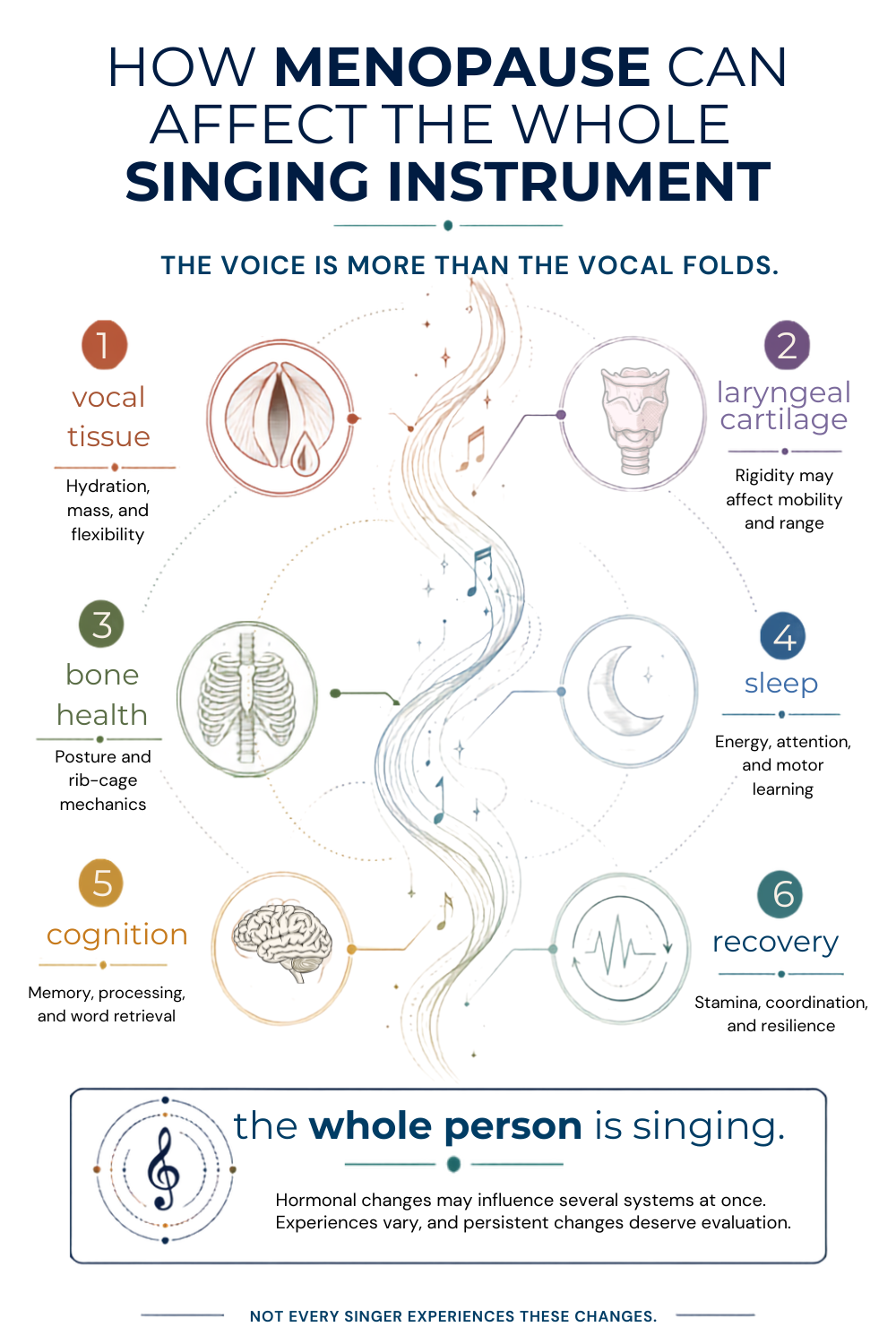
The effects of menopause on singing cannot be understood by examining the vocal folds alone. Singing depends on the coordinated function of the skeletal, respiratory, muscular, nervous, auditory, cognitive, and endocrine systems. Hormonal changes may influence several of these systems simultaneously, which helps explain why a singer may experience changes even when no obvious abnormality is visible on the vocal folds themselves.
The larynx also changes throughout life. Although its framework is mostly cartilage, the thyroid, cricoid, and arytenoid cartilages gradually calcify and become more bone-like with age. Hormones may influence this process, but researchers have not yet determined menopause’s specific role. At the same time, the laryngeal joints may become less flexible, the muscles may atrophy, and the vocal folds themselves may change. Together, these changes may affect vocal-fold movement, flexibility, range, and overall function.. [3]
Bone health matters as well. As estrogen declines, bone loss can accelerate, especially during the first few years after menopause. Osteoporosis and compression fractures in the spine may increase thoracic kyphosis (the forward rounding of the upper back) and reduce pulmonary function, or the lungs’ ability to move air effectively. These changes can affect posture, rib-cage movement, breathing, and the physical coordination required for singing. For singers, this may affect rib-cage mobility, postural organization, physical endurance, and the coordination of breath with phonation. This does not mean that osteoporosis directly damages the vocal folds. It means that changes to the skeletal framework can alter the larger physical system supporting the voice. [4]
Sleep disruption and cognitive symptoms can also affect singing. Night sweats, insomnia, and fragmented sleep may reduce energy, concentration, motor learning, emotional regulation, and physical recovery. The cognitive symptoms often described as “brain fog” may affect attention, memory, word retrieval, and the processing of complex musical or technical information. Poor sleep may intensify these difficulties, making practice and performance feel less reliable even when the larynx itself appears healthy. The Mayo Clinic notes that changes in memory and concentration are common during perimenopause and may be compounded by inadequate sleep. [5]
HRT may play a role in some of these systemic changes, but the evidence differs by outcome. Menopausal hormone therapy has been shown to prevent bone loss and reduce fracture risk. It may also improve sleep in women whose sleep disruption is associated with hot flashes and night sweats. However, hormone therapy is not currently recommended for the purpose of preventing or treating cognitive decline or dementia. Its possible effect on age-related calcification and ossification of the laryngeal cartilages remains unclear. [6, 7]
For singers, the essential point is that the whole person is singing. Hormonal fluctuation, laryngeal aging, skeletal support, sleep, cognition, muscle function, and emotional health may all influence how the voice coordinates, learns, performs, and recovers. These relationships deserve more detailed treatment in their own article, but they cannot be excluded from a meaningful discussion of menopause, HRT, and the singing voice.
Perimenopause may be especially confusing for singers
Menopause is defined retrospectively after 12 consecutive months without menstruation. Perimenopause is the transition leading up to that point, during which hormone levels can fluctuate wildly and unpredictably. The Mayo Clinic’s overview of perimenopause describes a transition that may begin at different ages and last for several years. That variability really matters when we discuss the voice. [8]
Wide hormonal fluctuations can result in reliable access to the upper range one day and reduced access the next. Singers may also notice increased fatigue, changes in registration or onset, greater dryness, and longer recovery after rehearsals or performances. Perhaps most frustratingly, familiar technical strategies may no longer produce familiar results. This unpredictability can be psychologically disruptive. Singers may interpret a changing voice as evidence that their technique has failed or that they are losing their ability. But a fluctuating physiological pattern is not necessarily a technical failure.
Technique may need to become more adaptive. The goal is not always to force the voice to reproduce yesterday’s coordination. It may be to identify what the instrument needs today while continuing to monitor broader patterns over time.
Does menopause make your voice deeper?
Some studies have found a lower habitual speaking fundamental frequency after menopause. In practical terms, the average speaking voice may become slightly lower.
A 2020 systematic review and meta-analysis found that hormone replacement therapy was associated with a higher speaking fundamental frequency in postmenopausal women. The apparent effect was more evident in women within a normal BMI range. [9]
This does not mean that every postmenopausal woman’s voice becomes dramatically deeper. Nor does the research tell us precisely what happens to a trained singer’s highest usable pitch, registration transitions, pianissimo, agility, dynamic control, resonance strategies, vocal color, or recovery. These are refined aspects of singing that are rarely captured by studies measuring habitual speaking pitch. Most of the research measures speech, sustained vowels, or relatively broad acoustic outcomes. A singer’s artistic function is far more complex.
Can menopause reduce your upper singing range?
Loss of high notes is one of the most commonly reported concerns among menopausal singers. In the professional-singer survey described above, 42% of menopausal respondents reported losing higher notes.
There are several possible reasons a singer might temporarily or persistently lose upper-range access. These include, but are not limited to:
Changes in tissue mass or flexibility
Dryness or mucosal irritation
Changes in laryngeal muscle coordination
Increased compensatory tension
Reduced stamina
Changes in respiratory function
General aging
Inadequate recovery
A medical condition unrelated to menopause
It is important not to assume that every missing note represents permanent tissue change. Sometimes the coordination that once worked automatically must be retrained under new physiological conditions. At the same time, singers should not be told that every menopause-related difficulty can be solved by better breath support, vowel modification, or increased practice. Technique is important, but it cannot replace an appropriate medical evaluation.
Does HRT help the singing voice?
Hormone replacement therapy, more commonly called menopausal hormone therapy, may help some aspects of voice function, but the evidence is mixed.
In one study comparing postmenopausal women who did and did not use hormone therapy, both groups demonstrated generally good vocal quality. Hormone therapy appeared to help postmenopausal women maintain a slightly higher speaking pitch, particularly among women with a normal BMI. [10]
The 2020 meta-analysis reached a similar conclusion: postmenopausal women who used HRT tended to have slightly higher speaking voices than women who did not. However, this does not demonstrate that HRT preserves a soprano’s highest notes, restores a previous singing range, prevents registration changes, improves agility, eliminates fatigue, or protects every singer from age-related vocal changes. The research is further complicated by the wide variation in hormones, formulations, doses, and delivery methods grouped under the term “HRT.” For now, its effects on the singing voice remain neither uniform nor predictable. [9] The evidence is therefore better summarized this way:
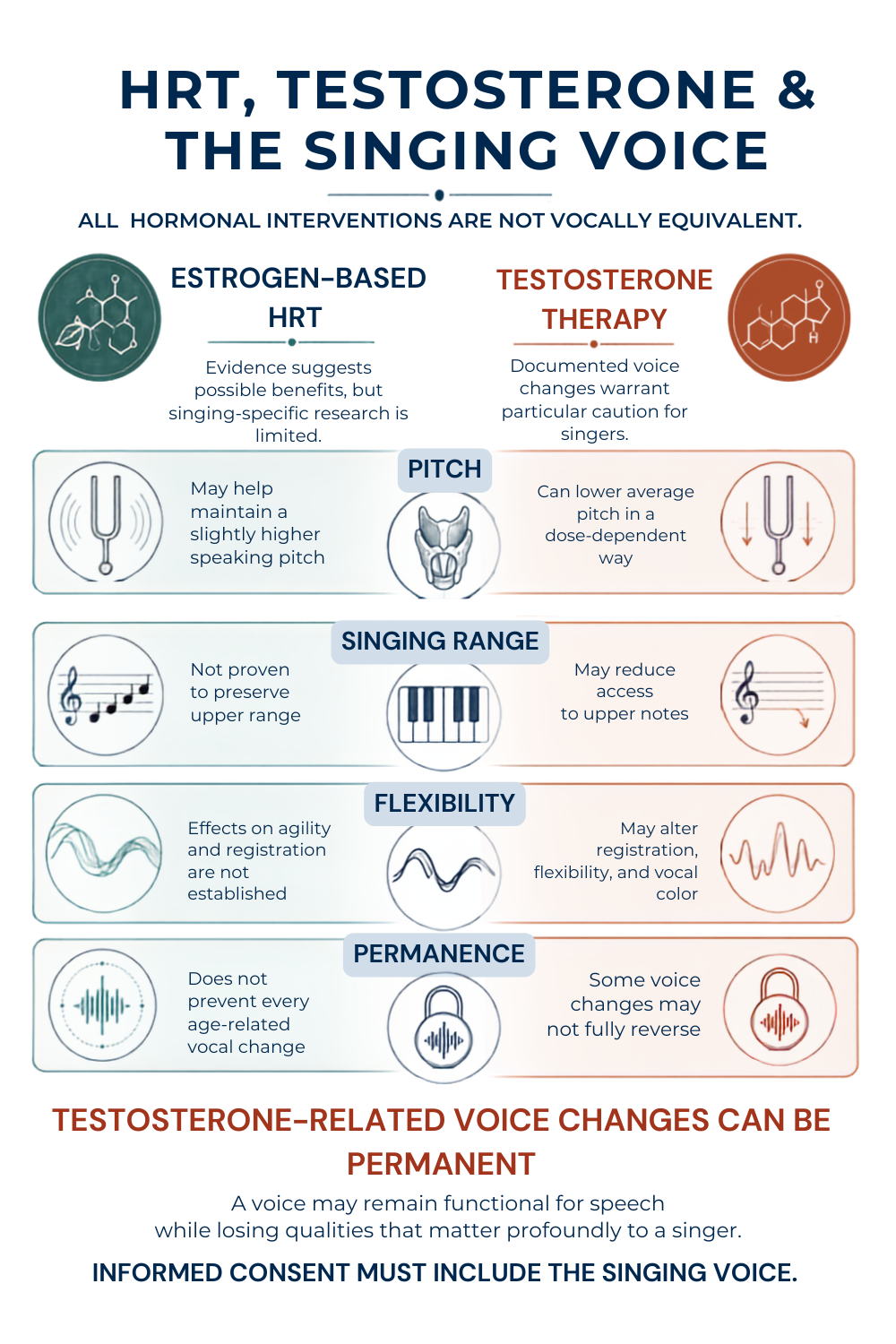
Estrogen-based hormone therapy may mitigate certain menopause-associated voice changes for some women, particularly changes in speaking pitch. It has not been proven to preserve every aspect of the singing voice.
Hormone therapy should not be used solely as a vocal intervention without considering the individual’s complete medical history, symptoms, goals, risks, and potential benefits. [11]
Estrogen and progesterone are not interchangeable
Online discussions often use “female hormones” as though estrogen and progesterone have identical effects. They do not.
Estrogen is frequently discussed in relation to mucosal health, tissue maintenance, and vocal-fold function. Progesterone has been associated with changes in mucus production, fluid balance, and vascular behavior. But it would be misleading to assign each hormone one universal vocal outcome. Voice effects may depend on:
The hormone being used
Dose
Delivery method
Duration
The balance between hormones
Individual sensitivity
Age and stage of menopause
Other medications
General health
Baseline vocal function
This is one reason singers need to know exactly what their treatment contains. “I’m taking HRT” is not enough information to predict a possible vocal response.
Why testosterone requires a separate conversation
Testosterone requires particular caution because its effects on the female voice may be permanent. Unlike the modest changes in speaking pitch associated with estrogen-based therapy, androgen exposure can lower vocal pitch and alter other aspects of vocal function. Research shows that higher doses of testosterone can lower a woman’s voice. It also documents cases of hoarseness and voice deepening that did not fully reverse after the women stopped taking testosterone. [12–14]
This matters enormously for singers. A woman may retain a functional speaking voice while losing upper range, flexibility, registration options, timbral control, or other capabilities essential to her singing.
For a professional singer, the loss of these specialized functions may be more than consequential. It can be artistically, professionally, and personally catastrophic, even when her speaking voice continues to sound normal.
Current studies do not tell us how frequently lasting voice changes occur in all women using appropriately prescribed testosterone. Formulation, dose, blood concentration, duration, and individual sensitivity may all affect the outcome. Nevertheless, the evidence clearly demonstrates that clinically meaningful and potentially irreversible changes can occur. [12–14]
Singers considering testosterone should approach this hormonal intervention with particular care. Before beginning treatment, they should discuss the possibility of permanent vocal effects with the prescribing clinician, document their baseline speaking and singing function, and consider consulting a voice-specialized laryngologist who understands the specific physical demands of singers.
A functional speaking voice is not the same as a fully functional singing voice
Many voice studies focus on average speaking pitch, sustained vowels, patient-reported voice handicap, broad measures of vocal quality, and whether the voice remains adequate for daily communication. Singers rely on much more specialized functions.
Losing several upper notes, developing a less reliable passaggio, experiencing changes in vibrato, or losing flexibility, pianissimo, stamina, recovery, or timbral control may profoundly affect a singer even when her speaking voice sounds normal. The voice may continue to function perfectly well for conversation while no longer meeting the artistic or professional demands placed upon it.
This distinction matters to professional singers, voice teachers, cantors, choir members, and serious avocational singers. Research on women who experienced voice changes after testosterone supplementation demonstrates why ordinary measures of speaking function may not capture the full impact on a trained voice. [13] That difference must be part of meaningful informed consent.
What singers should document before beginning or changing hormone therapy
Before beginning or substantially changing hormone therapy, singers may benefit from establishing a baseline. This is not a medical test and cannot predict exactly how the voice will respond. It simply creates a useful point of comparison.
Consider recording:
A short sample of conversational speech
Comfortable sustained vowels
A representative song or aria
Upper-range singing
Lower-range singing
Registration transitions
Soft sustained singing
A passage requiring agility or flexibility
A demanding passage that is normally reliable
Also document:
Comfortable speaking pitch
Current usable range
Perceived vocal effort
Recovery after rehearsals
Dryness or throat discomfort
Registration difficulties
Vocal fatigue
Date, medication, dose, and formulation
Record under reasonably consistent conditions. One difficult recording proves very little. Patterns across time are more informative.
Questions singers can discuss with their healthcare providers
Before starting or changing treatment, consider asking:
Which hormones are included in this therapy?
Does it contain testosterone or another androgen?
What dose and delivery method are being recommended?
What benefits is this particular treatment intended to address?
What vocal effects have been reported?
How will hormone levels and side effects be monitored?
What should I do if I notice a change in pitch, range, quality, or stamina?
Could the dose or formulation be adjusted if vocal symptoms appear?
Would a baseline evaluation with a voice-specialized laryngologist be appropriate?
Should my voice teacher or singing-voice specialist be part of the monitoring process?
Do not alter or discontinue prescribed treatment without consulting the clinician managing it.
When should a singer seek medical evaluation?
Consult a qualified healthcare professional when a voice change is:
Sudden
Persistent
Progressive
Accompanied by pain
Associated with speaking or swallowing difficulty
Causing a significant loss of range
Producing ongoing hoarseness
Interfering with professional or daily voice use
Temporally associated with beginning or changing medication
A voice-specialized laryngologist can examine the vocal folds and help distinguish possible hormonal effects from inflammation, lesions, paresis, reflux-related irritation, muscle-tension dysphonia, age-related changes, or other conditions.
A voice teacher can help with coordination and adaptation, but a teacher cannot diagnose vocal-fold pathology.
What can singers do during perimenopause and menopause?
There is no single menopause vocal exercise that works for everyone. Helpful strategies depend on what has changed and why. In general:
Track patterns.
Note changes in range, fatigue, effort, dryness, registration, medication, sleep, and recovery.Stop treating every difficult day as a technical emergency.
A fluctuating instrument may require adaptable practice.Avoid forcing unavailable function.
More pressure is rarely the best response to reduced flexibility or fatigue.Maintain regular, responsive practice.
Consistency can help preserve coordination, but practice should respond to the instrument rather than punish it.Prioritize recovery.
Sleep disruption, stress, illness, and heavy vocal use may compound hormonal changes.Seek assessment when changes persist.
Do not assume that menopause explains every symptom.Build a collaborative team.
Depending on the situation, that may include a menopause clinician, laryngologist, speech-language pathologist, and voice teacher.
What the research still cannot tell us
Despite growing interest, major questions remain unanswered:
Which singers are most likely to experience menopause-related changes?
How does perimenopause affect trained singing across multiple years?
Does the timing of hormone therapy matter for vocal outcomes?
Which formulations and doses have the greatest vocal effects?
Can HRT preserve upper singing range or flexibility?
How often does low-dose testosterone affect singers?
Which testosterone-related changes are reversible?
Which vocal interventions are most effective?
How do genre, training history, age, and baseline voice type affect outcomes?
There are still too few longitudinal studies of trained singers. We should be suspicious of anyone offering absolute certainty where the research does not.
Menopause does not mean the end of vocal growth
The voice changes throughout life. Menopause is one part of that continuing development, not an automatic endpoint.
Some singers experience disruption. Some discover new colors, greater efficiency, or a richer relationship with their instruments. Many benefit from updated technical strategies, more responsive practice, and better collaboration between voice and medical professionals.
HRT may help certain women and certain aspects of voice function, but it cannot guarantee vocal preservation. Testosterone may offer benefits for appropriately selected patients, but singers deserve clear information about its potential vocal effects before making treatment decisions.
Most importantly, singers deserve more than fear, dismissal, or simplistic online advice. They deserve evidence, individualized care, and a meaningful place for the voice in conversations about their health.
Frequently Asked Questions
Can menopause change your singing voice?
Yes. Some singers report changes in range, pitch, fatigue, dryness, flexibility, registration, and recovery during perimenopause or menopause. Not every singer experiences these changes, and similar symptoms can have other causes.
Does menopause make your voice deeper?
Research suggests that average speaking pitch may decrease after menopause, but the amount and significance vary. Singing-specific outcomes are less well studied.
Can menopause cause hoarseness?
Menopause may be associated with dryness, tissue changes, and altered vocal quality, but persistent hoarseness should be medically evaluated rather than automatically blamed on hormones.
Can HRT improve the singing voice?
Hormone therapy may mitigate certain menopause-associated voice changes, particularly changes in speaking pitch. It has not been proven to preserve every aspect of singing range, flexibility, or stamina.
Does estrogen affect the vocal folds?
Research supports an association between changing estrogen conditions and voice function, but receptor studies and proposed mechanisms are complex. Estrogen should not be described as a guaranteed vocal-fold lubricant or voice-preservation treatment.
Can testosterone lower a woman’s voice?
Yes. Controlled research and clinical case series have documented pitch lowering and dysphonia in some women receiving testosterone. Risk appears related at least partly to dose and resulting testosterone concentration, but individual responses vary.
Are testosterone-related voice changes permanent?
Some testosterone-related pitch changes may persist after treatment ends. The likelihood of permanence at different doses and formulations is not yet well established.
Can lost high notes return after menopause?
Sometimes upper-range access improves with recovery, treatment of contributing conditions, voice therapy, or technical retraining. No universal outcome can be promised.
Should singers see a laryngologist before beginning HRT?
Not every singer requires a laryngeal examination before HRT. However, professional voice users, singers with existing symptoms, and singers considering testosterone may benefit from baseline documentation or consultation with a voice-specialized laryngologist.
References and Further Reading
Runggaldier, Isabella, and Katharina Rössner. “Hormonal Changes During and After Pregnancy and Climacteric: An Insight into the Practical Experience and Perception of Voice Professionals.” International Congress of Voice Teachers Proceedings, 2022. https://www.nats.org/_Library/ICVT_2022_Vienna_/Runggaldier_DS_AH_final.pdf
Zamponi, Virginia, et al. “Effect of Sex Hormones on Human Voice Physiology: From Childhood to Senescence.” Hormones, vol. 20, no. 4, 2021, pp. 691–696. https://pmc.ncbi.nlm.nih.gov/articles/PMC8594207/
Beton, Süha, et al. “The Elderly Voice: Mechanisms, Disorders and Treatment Methods.” Turkish Archives of Otorhinolaryngology, vol. 60, no. 4, 2022, pp. 220–226. https://pmc.ncbi.nlm.nih.gov/articles/PMC10339270/
Harrison, R. A., et al. “Osteoporosis-Related Kyphosis and Impairments in Pulmonary Function: A Systematic Review.” Osteoporosis International, vol. 18, no. 4, 2007, pp. 449–457. https://pubmed.ncbi.nlm.nih.gov/17181402/
Mayo Clinic News Network. “Perimenopause Transitions and Concerns.” 20 July 2023. https://newsnetwork.mayoclinic.org/discussion/mayo-clinic-q-and-a-perimenopause-transitions-and-concerns/
Cintron, Dario, et al. “Efficacy of Menopausal Hormone Therapy on Sleep Quality: Systematic Review and Meta-analysis.” Endocrine, vol. 55, no. 3, 2017, pp. 702–711. https://pubmed.ncbi.nlm.nih.gov/27515805/
North American Menopause Society Advisory Panel. “The 2022 Hormone Therapy Position Statement of The North American Menopause Society.” Menopause, vol. 29, no. 7, 2022, pp. 767–794. https://pubmed.ncbi.nlm.nih.gov/35797481/
Mayo Clinic. “Perimenopause: Symptoms and Causes.” https://www.mayoclinic.org/diseases-conditions/perimenopause/symptoms-causes/syc-20354666
Lin, R. Jun, and Tianyue Wang. “Comparison of Fundamental Frequency in Postmenopausal Women Who Are Treated With Hormone Replacement Therapy vs Those Who Are Not: A Systematic Review and Meta-analysis.” JAMA Otolaryngology–Head & Neck Surgery, vol. 146, no. 11, 2020, pp. 1045–1053. https://pubmed.ncbi.nlm.nih.gov/32790826/
D’haeseleer, Evelien, et al. “The Impact of Menopause and Hormone Therapy on Voice and Nasal Resonance.” Facts, Views & Vision in ObGyn, vol. 4, no. 1, 2012, pp. 38–41. https://pubmed.ncbi.nlm.nih.gov/24753887/
Mayo Clinic. “Hormone Therapy: Is It Right for You?” https://www.mayoclinic.org/diseases-conditions/menopause/in-depth/hormone-therapy/art-20046372
Huang, Grace, et al. “Functional Voice Testing Detects Early Changes in Vocal Pitch in Women During Testosterone Administration.” The Journal of Clinical Endocrinology & Metabolism, vol. 100, no. 6, 2015, pp. 2254–2260. https://pubmed.ncbi.nlm.nih.gov/25875779/
Chadwick, Keith A., et al. “Voice Change Following Testosterone Supplementation in Women: A Multi-Institutional Case Series.” Journal of Voice, vol. 35, no. 6, 2021, pp. 936.e1–936.e7. https://pubmed.ncbi.nlm.nih.gov/32386906/
Kryzsko, Violet, et al. “Dysphonia in Cisgender-Females Secondary to Testosterone Therapy.” Journal of Voice, published online 18 February 2026. https://pubmed.ncbi.nlm.nih.gov/41714209/
