
Have you ever finished your vocal warm-up and felt as though you had already done your practicing?
You worked through your favorite exercises, tested your highest notes, and repeated a difficult pattern until it finally cooperated. By the time you opened your music, your voice had already done quite a bit of work.
As a voice teacher, I often ask singers to consider a simple question: Are you warming up, or are you working out?
Both activities matter. But understanding their different purposes can help you build a routine that prepares your voice without using up the energy you need for singing.
An effective vocal warm-up gives you a chance to assess your instrument, establish familiar coordinations, and prepare for the music ahead. To build one, you need to understand what each exercise contributes and how your voice responds.
What is the purpose of a vocal warm-up?
I describe warming up as a chance to “say hello” to your instrument.
How does your voice feel today? Does your middle range respond easily? Can you begin a tone comfortably? How readily can you move between registers?
Your warm-up gives you information about your voice while gradually preparing it for the demands ahead.
Those demands matter. Preparing for a choir rehearsal, a solo performance, and a technical practice session may call for different choices. Even within the same style, an evening of sustained legato singing asks something different from a program filled with quick articulation and agility.
Before beginning, ask yourself:
What am I preparing to sing?
What will that music require?
How is my voice responding today?
Your answers give the warm-up a purpose.
Warming up versus working out
A warm-up prepares you to use skills you already have. A technical workout deliberately develops those skills, expands your options, or builds stamina over time.
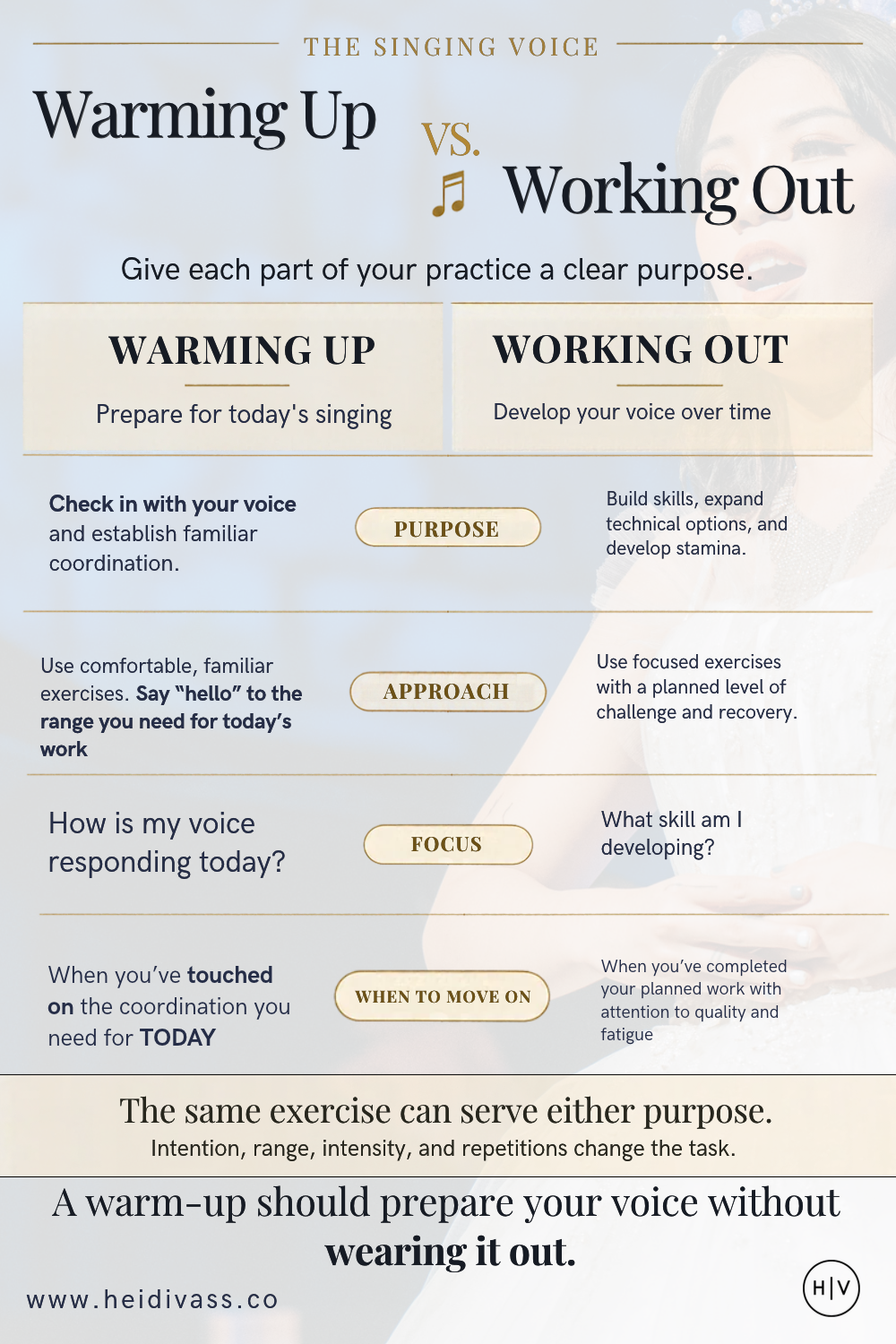
The distinction can be easy to miss because both activities use vocal exercises. The same scale or arpeggio might appear in either one. What changes is your intention and how you use it: the range, intensity, repetitions, and degree of challenge.
For example, gently moving through a familiar pattern to check your registration is preparation. Repeating that pattern while systematically developing a new registration strategy is technical training.
In their discussion of exercise science principles and the vocal warm-up, Matthew Hoch and Mary Sandage examine the different roles of skill acquisition, conditioning, and fatigue management in singing pedagogy. Their work offers a useful reason to think more carefully about what we are asking our vocal exercises to accomplish.
A warm-up does not have to solve every technical problem before you are allowed to sing.
It can reveal something that deserves attention during your practice session or in a lesson. Recognizing that need is useful; trying to resolve it through twenty additional repetitions may turn your preparation into a workout.
This is closely related to why more practice is not always the answer. The purpose of the work matters as much as the amount.
Should you use the same vocal warm-up every day?
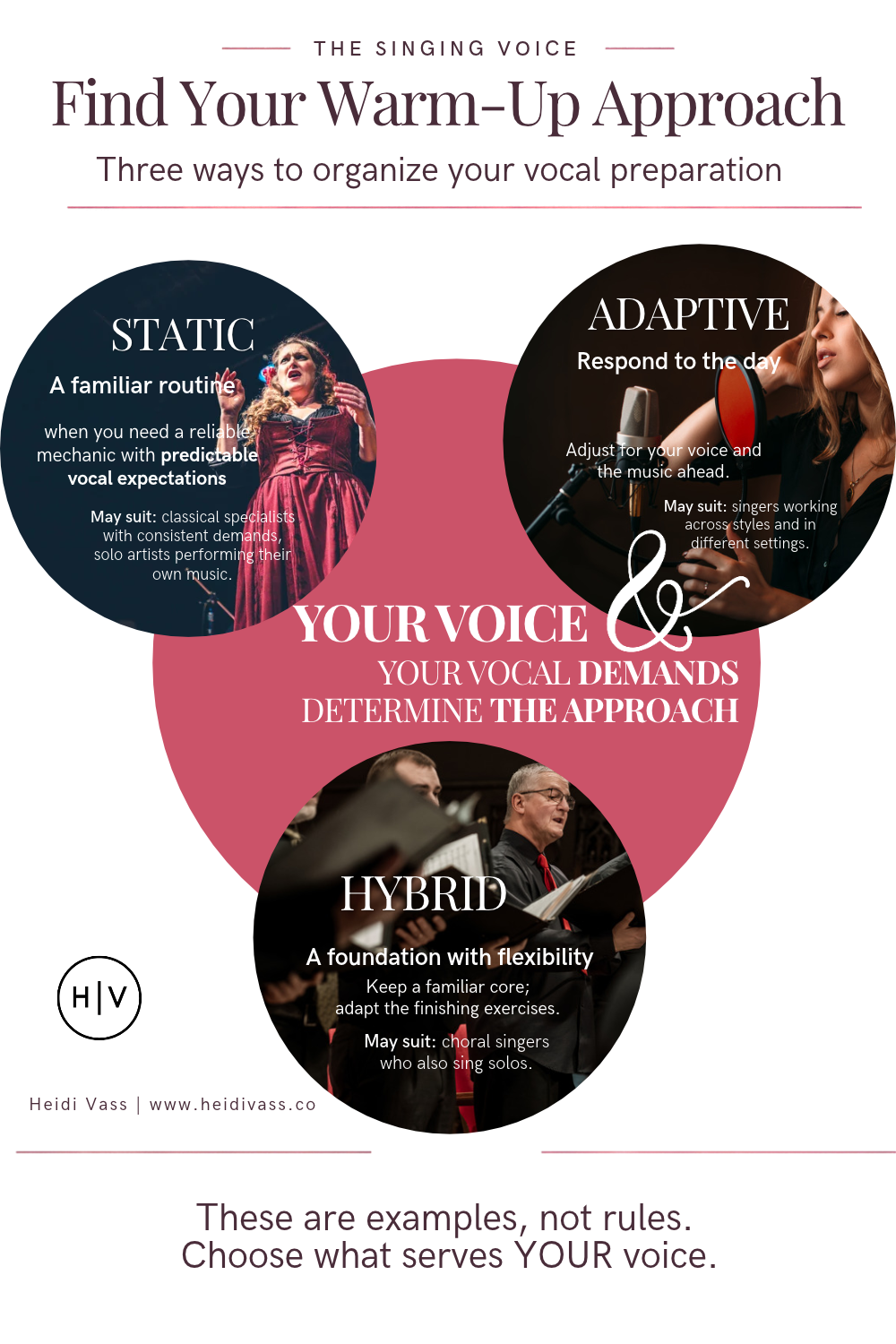
There are two useful ways to organize a routine: static and flexible.
A static warm-up provides a familiar structure
A static routine follows the same general sequence each day.
Familiarity can help you notice changes. You know how a particular exercise usually feels and sounds, so you have a reference point for assessing your voice.
This approach can suit singers whose repertoire and vocal demands remain relatively consistent, or anyone who benefits from a predictable starting place.
A fixed sequence still requires attention. You can adjust the starting pitch, number of repetitions, or extent of the range according to your response.
A flexible warm-up adapts to the day
A flexible routine changes according to your vocal condition and the music ahead.
You might choose different vowels, patterns, or additional exercises depending on whether you are preparing for classical repertoire, musical theatre, chant, or another style.
The flexibility should be purposeful. You are choosing exercises because they help prepare a particular coordination.
You can combine the two
Many singers benefit from a familiar foundation followed by a few adaptable elements.
You might begin with body preparation, a lip trill, and a comfortable middle-range exercise every day. Then you adjust the final portion to prepare for the range, articulation, or sustained singing your music requires.
Consistency and adaptability can work together.
The building blocks of a useful vocal warm-up
You do not need a long collection of exercises. You need a sequence in which each part contributes something useful.
I like to build gradually from body awareness to breath and sound, then explore the voice from a comfortable middle range.
1. Prepare your body
Take a moment to notice your physical readiness.
Gentle movement, shoulder rolls, comfortable side bends, or a familiar body scan may help you recognize unnecessary holding. If you already use Alexander Technique or Feldenkrais, you might draw on that work.
Pay attention to how you are standing or sitting and how easily your body responds to breathing. Aim for a position that allows movement and responsiveness rather than holding yourself in a rigid idea of “good posture.”
Choose a brief sequence that helps you feel physically available and mentally present.
2. Connect breath to sound
Begin with comfortable breathing, then introduce an easy sound.
A gentle hiss may help you notice the release of air. A lip trill, tongue trill, or familiar straw exercise can provide a transition into voicing.
These are examples of semi-occluded vocal tract exercises, often abbreviated as SOVT exercises. They involve a partial narrowing or closure of the vocal tract during sound production.
Ingo Titze’s research on SOVT exercises explains how this partial closure changes the interaction between the vocal folds and vocal tract, creating conditions that can support efficient phonation.
For warm-up purposes, begin in a comfortable range and notice what happens when you return to an open vowel. If you are curious about using a straw, I discuss the tool and its place in training in my Voice Straw review.
Breath coordination also deserves its own development outside the warm-up. That is a subject I explore more fully in Two Weeks to Better Breath Management.
3. Say hello to your middle range
Begin in the “middle of your middle”: an area where your voice feels relatively comfortable and familiar.
Use a simple pattern you know well. Listen for a responsive onset and notice how readily you can move between pitches.
From that starting point, gradually explore downward and upward. Give yourself time to establish coordination before adding greater range or complexity.
Your middle range is a useful reference point to revisit throughout the routine.
4. Explore your lower and upper ranges
Expand outward from the middle into the range comfortably available to you that day.
In the lower voice, notice whether you begin pressing or trying to manufacture a larger sound. In the upper voice, notice whether you carry more weight than you need or increase effort simply because the pitches are higher.
Vowels can help you explore different options. Their usefulness depends on your voice, the pitch, and the coordination you are seeking, so treat them as choices to test.
Work in both directions. After ascending, come back down. After exploring the lower range, return to the middle.
The goal is access and connection. Range extension belongs in a more deliberate training process.
5. Prepare for the music ahead
Once the foundation is in place, consider whether you need a brief addition.
That might be an agility pattern, an articulation exercise, or a sustained phrase. Choose something that prepares a skill the music will require.
Ask yourself: “What will this help me do when I begin singing my repertoire?”
Keep this portion focused. If you need to spend substantial time learning or rebuilding the coordination, give it a separate place in your technical practice.
6. Finish with an easy check-in
A gentle siren through your comfortably available range can help you notice how the different parts of your voice are connecting.
Listen for where the movement feels easy and where you need to make an adjustment. You do not need to reach your absolute highest or lowest note.
This is feedback about your voice at that moment. Use it to guide your next step.
How long should you warm up your voice?
A useful warm-up lasts just long enough to prepare you for the task ahead. Setting a timer can help you understand your habits, but the number of minutes alone will not tell you whether the routine is effective.
Ask:
Can I begin a tone comfortably?
Can I access the range and registration choices my music requires?
Does my voice respond without repeated attempts to force it into place?
Do I have energy available for rehearsal, practice, or performance?
Some days you may feel ready relatively quickly. Other days may call for a more gradual transition into singing, a lighter workload, or a change of plan.
Be careful about assuming that every warm-up must immediately make singing feel easier. In a study by Susanna Whitling and colleagues, 26 healthy participants completed either a five-minute reading task or SOVT warm-up. Self-reported vocal effort increased immediately afterward in both groups.
That finding does not establish that warming up is harmful or that increased effort means fatigue. It reminds us to distinguish between different sensations and evaluate what a routine actually accomplishes.
My practical aim is for singers to finish their preparation ready to sing. Repeated strain or accumulating fatigue is a reason to reassess the demands.
How to personalize your routine
Start with a small number of familiar exercises and identify the purpose of each one.
Then test the routine before your actual singing. Make a few brief notes:
What helped me feel ready?
What felt redundant?
Was anything missing?
Did the routine prepare me for the music I sang afterward?
Change one element at a time so you can recognize what makes a difference.
A teacher can help you interpret those observations and distinguish preparation from technical work. It is one of the practical skills I help singers develop through voice lessons and coaching: understanding what to do, why you are doing it, and when to adjust.
Over time, your routine should become easier to explain and use. You should know why an exercise belongs, recognize when it has served its purpose, and feel comfortable adapting it when your needs change.
Before adding another exercise, ask what you are preparing your voice to do. That question is the starting point for a warm-up that works for you.
References
Hoch, Matthew, and Mary J. Sandage. “Exercise Science Principles and the Vocal Warm-up: Implications for Singing Voice Pedagogy.” Journal of Voice, vol. 32, no. 1, 2018, pp. 79–84. https://doi.org/10.1016/j.jvoice.2017.03.018.
Titze, Ingo R. “Voice Training and Therapy With a Semi-Occluded Vocal Tract: Rationale and Scientific Underpinnings.” Journal of Speech, Language, and Hearing Research, 2006. https://doi.org/10.1044/1092-4388(2006/035).
Whitling, Susanna, et al. “Effects of Warm-Up Exercises on Self-assessed Vocal Effort.” Logopedics Phoniatrics Vocology, vol. 48, no. 4, 2023, pp. 172–179. https://doi.org/10.1080/14015439.2022.2075459.
