
You sustain a familiar note, and something sounds different. The pitch seems to travel farther. The movement feels slower or less predictable. A phrase that once felt easy now takes more concentration.
Whether you call it a wobble, a warble or a shake, an increasingly unsteady vibrato is often one of a singer’s biggest fears. Over the years, I have worked with many singers navigating an aging instrument, and this concern comes up again and again.
That change can feel deeply personal. You may wonder whether your technique has deteriorated, whether your voice is aging, or whether you should be singing differently.
A wider vibrato describes something you hear. It does not, by itself, explain why it is happening.

Vibrato can change in speed, width and regularity. Aging, the demands of a particular passage and the way you coordinate your singing may all play a role. Some changes also warrant medical evaluation. Understanding the pattern is the first step toward finding a useful path forward.
What is the difference between vibrato and vocal wobble?
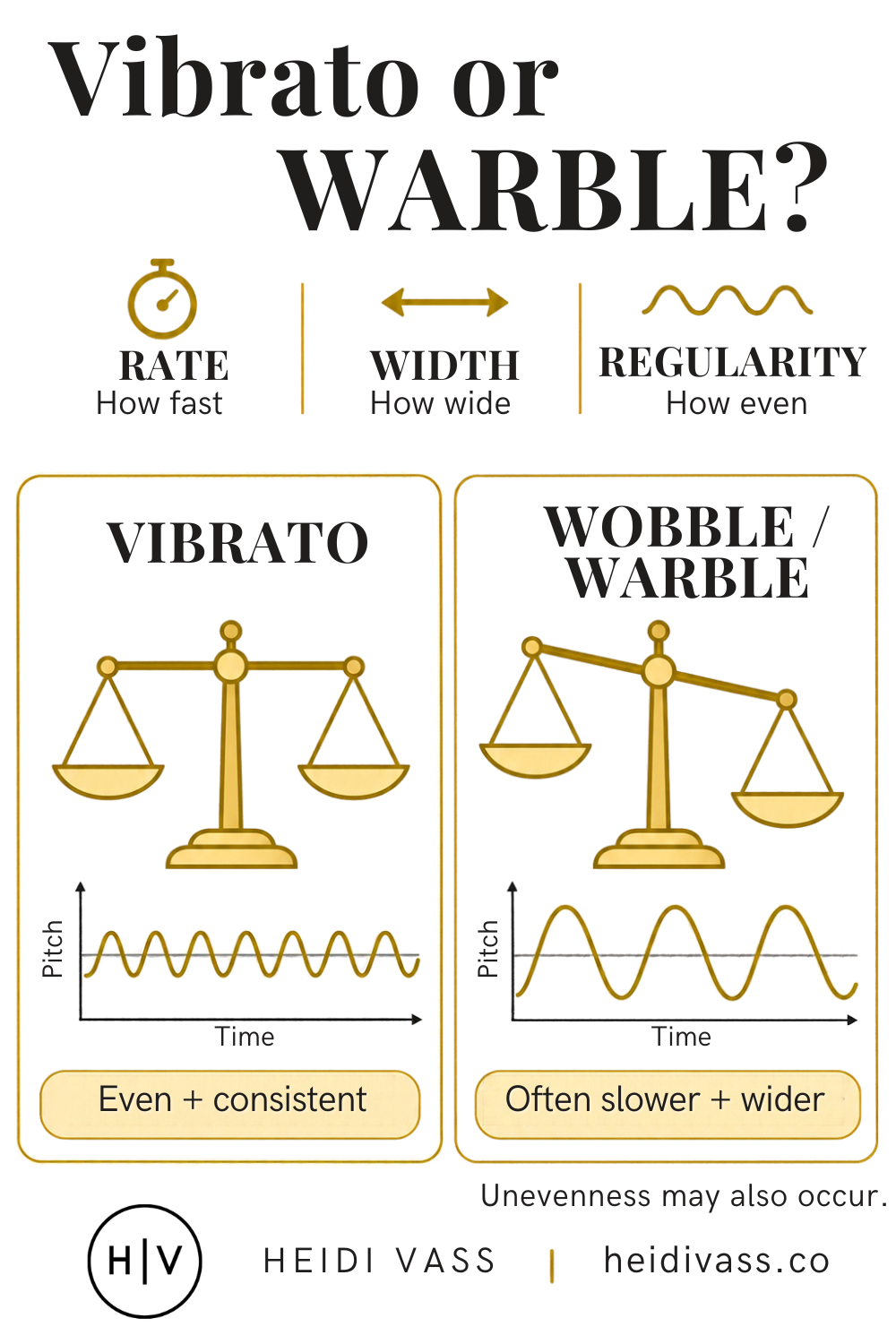
Vibrato is a recurring fluctuation in pitch around a sung note. Researchers describe several characteristics, including its rate, extent and regularity. [1]
Rate: How quickly the pitch fluctuates.
Extent, or width: How far the pitch moves above and below its central pitch.
Regularity: How consistently those fluctuations repeat.
A vibrato can become wider without becoming slower. It can become slower while remaining relatively consistent. It can also become irregular. Those differences matter when we listen to a singer and decide what to investigate.
In teaching, “vocal wobble” often describes a conspicuously slow, wide vibrato. “Shaky,” “wobbly” and “unstable” can refer to different experiences, so I want to hear what the singer means before deciding what to address.
Musical context matters, too. The degree of vibrato that serves an operatic phrase may differ from what a singer chooses for chant or an exposed ensemble passage. Greater stylistic choice and a new loss of vocal reliability deserve separate consideration.
Does vibrato get wider with age?
Research gives us a more nuanced answer than “older singers develop a wobble.”
One study compared earlier and later recordings of 10 performing classical singers. Their average ages at the two recordings were 39 and 64. Overall, vibrato became slower, with little change in width or consistency. [2]
That finding matters: a slower vibrato does not necessarily mean a substantially wider or less regular vibrato.
These findings come from a small group of singers who were still performing, but they offer an encouraging example of continued professional singing alongside changes in vibrato.
Age is useful context. It is not a complete explanation for an individual singer’s difficulty.
Can menopause affect vibrato or vocal stability?
Hormones can affect the singing voice, and changes in vibrato may be part of that experience. During the transition into menopause, singers may notice differences in range, tone color, stamina and how the vocal folds function. A review of research on menopausal singers documented changes across these areas. [3] When the instrument changes, the coordination you have relied on may need to adapt.
For some singers, that may mean a vibrato that feels wider, less steady or harder to manage. Hormonal changes belong in the conversation when we assess a changing voice. Understanding how menopause and hormone therapy can affect singing helps us make informed decisions about training, recovery and medical care.
If changes in vibrato appear alongside changes in range, stamina or recovery, consider the pattern as a whole with your voice teacher and healthcare team.
Why does my vibrato change in certain passages?
Before treating a changing vibrato as a problem across the entire voice, ask where it happens. Does it appear only on long notes? In one part of your range? At a particular volume? Near the end of a demanding rehearsal? Does it change when you move between solo and choral singing?
Research has documented these differences. A study of 29 healthy classical singers found that vibrato width and regularity changed at different volumes. [1] Another study comparing five sopranos singing in solo and choral settings found that the same singers used slightly more vibrato when singing as soloists. [11] How we use the voice matters when we evaluate the sound.
A sustained note sung softly within a choir is a different task from a long, climactic solo note after several demanding phrases. As a teacher, I want to understand how the singer adjusts to those musical demands and whether the change reflects a comfortable artistic choice or a loss of control.
If the change appears mainly after prolonged singing, I would also look at vocal effort, fatigue and recovery. Understanding when the voice becomes less reliable helps us decide what to address in technique, repertoire and practice.
Will better breath support fix a vocal wobble?
More breath is not automatically better breath management. More is not better, more is simply more. In my teaching, increasing the amount of air a singer takes in is rarely the first answer to an unstable sound.
Repeatedly breathing more deeply or rapidly than the body requires can lead to hyperventilation, or overbreathing. This can lower carbon dioxide levels and contribute to dizziness, tingling and a feeling of breathlessness. [8]
Singing depends on how breathing, the vocal folds and the spaces in your throat and mouth work together. Breath support makes more sense when we consider how these parts influence one another. [4]
In teaching, I want to understand what the singer is doing. Is the inhalation comfortable? Does the phrase begin with unnecessary effort? What changes as the breath runs out? What happens when the singer changes the vowel, pitch or volume?
These are the kinds of questions we explore in Two Weeks to Better Breath Management. The goal is to develop options: learning how much air a phrase calls for and how to coordinate it with the sound you intend to make. An unstable note calls for a closer look at that coordination, rather than simply taking a bigger breath.
Can warming up improve vibrato?
There is some encouraging research, with an important distinction.
One study examined 12 classically trained female singers before and after 25 minutes of vocal warm-up. After warming up, vibrato became more regular in speed, more consistent between sustained notes, and less extreme when it was initially particularly fast or slow. BUT, vibrato width did not change significantly. [5]
This suggests that preparation can influence aspects of vibrato. But the right warm-up and its length depend on your voice and the singing ahead. Building a warm-up routine that works for you starts with knowing what you are preparing for and distinguishing that preparation from a more demanding vocal workout. Notice whether your routine leaves familiar phrases feeling easier and more reliable, and adjust accordingly.
Can I train my vibrato?
Yes. Vibrato can respond to training, because singing is a skill coordinated by the brain and nervous system.
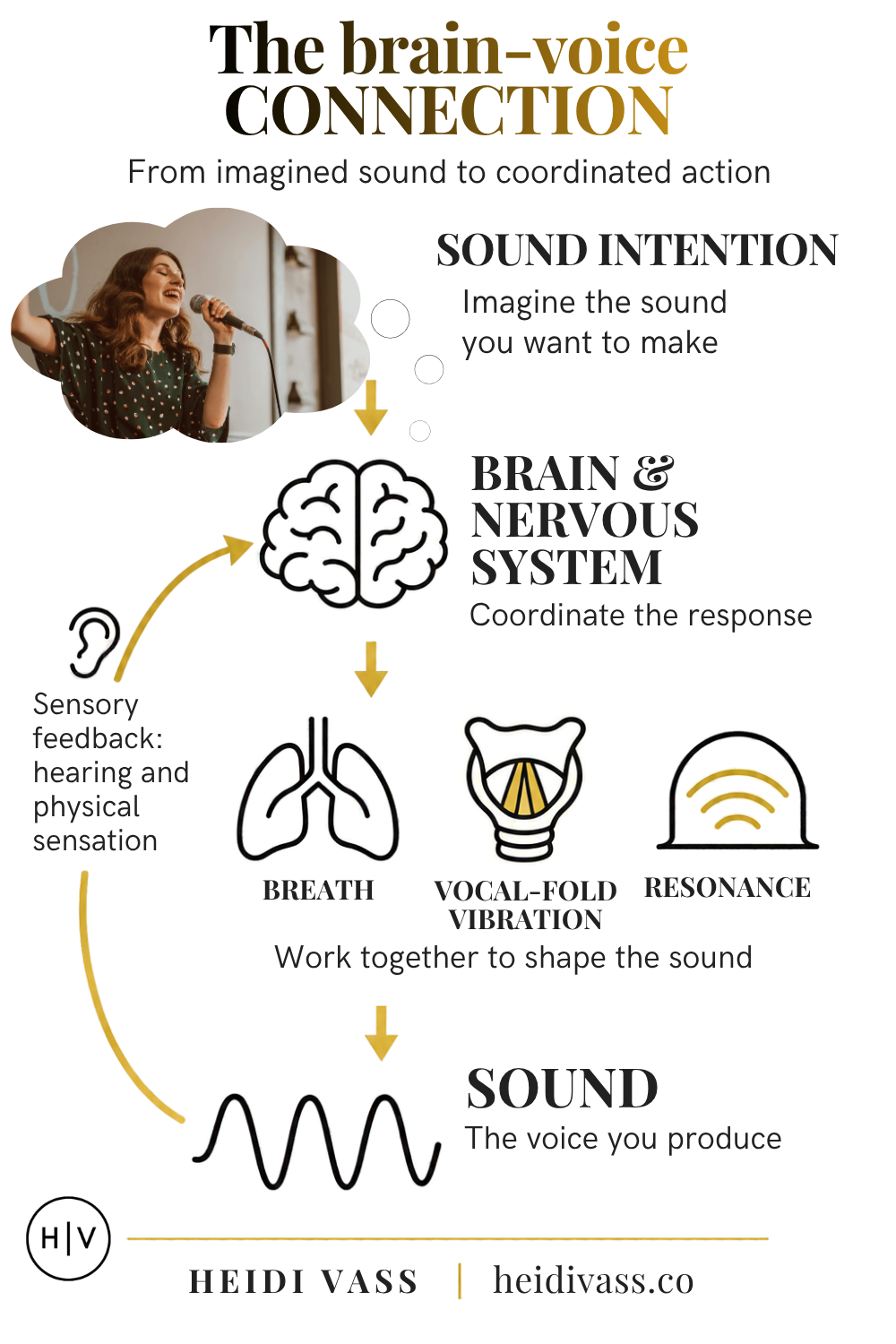
Your brain sends signals to the muscles that control pitch and uses information from hearing and physical sensation to guide the voice. Vibrato involves that ongoing communication between the nervous system and the singing instrument. Research models describe how nerve signals, muscle responses and feedback can interact to produce its rhythmic movement. [9]
This is why I approach vibrato as part of the singer’s overall coordination. Breath management matters, but it is one part of a larger process.
There is evidence that vibrato can change with sustained instruction. A study following 22 singing students over three years found that initially slower vibratos became faster, initially faster vibratos became slower, and less regular vibratos became more consistent. The study measured speed and regularity, so it gives us evidence for those changes rather than a direct answer about narrowing vibrato width. [10]
In lessons, I begin by helping you hear and feel the differences between sounds. We might compare a short, comfortable note with a longer one, explore different vowels or volumes, or work on moving between a straighter tone and vibrato when that fits your goals. These comparisons help us find where you have flexibility and where the task becomes more demanding.
From there, practice should reinforce the coordination that produces the sound you want with manageable effort. Short, focused attempts, time to recover and useful feedback give you a clearer task than repeatedly trying to “fix” a difficult note.
The goal is greater choice: a voice that responds more reliably to your musical intention, whether you are sustaining an operatic phrase, blending in a choir, singing chant or belting out your favorite pop tune.
What should you do if your vibrato is getting wider?
Start by gathering useful information. Repeatedly testing the same difficult note tells you less than a thoughtful comparison.
1. Describe what has changed
Is the movement wider, slower, less regular, or some combination? Has your effort changed, too? You do not need specialized software to begin describing the experience.
2. Notice the conditions
Keep brief notes about range, vowel, volume, phrase length and when the change appears. Include whether your speaking voice feels different and whether the pattern persists across several days.
3. Use recordings thoughtfully
A short recording of the same comfortable phrase under similar conditions can help you and your teacher compare patterns. Keep the microphone position and room reasonably consistent.
Listening to recordings can help you notice changes in your voice, but hearing a difference does not explain its cause.
4. Choose the next step from the findings
Depending on the singer, technical work might explore how breathing supports the phrase, how the voice moves between registers, how vowels are shaped, how heavy the vocal load is, what the music requires, or how much and how often the singer practices. The priorities will depend on what that individual singer needs.
I would be cautious about making “hold the pitch still” your only goal. A successful adjustment should be assessed through the singer’s comfort, effort, reliability and musical options as well as the sound.
When should you see a voice specialist?
A new or persistent change deserves attention, particularly when it comes with hoarseness, discomfort, loss of range or changes in the speaking voice.
Dysphonia is the medical term for a problem with the voice, such as persistent hoarseness, strain or an unexpected change in vocal quality. Clinical guidance recommends an examination of the larynx and vocal folds if that problem does not resolve or improve within four weeks, or sooner if a serious cause is suspected. Four weeks is not a requirement to wait before seeking help. [6]
A vocal tremor is an involuntary shaking of the voice. It requires a different assessment from vibrato used as part of a musical style. The National Institute on Deafness and Other Communication Disorders describes vocal tremor as shaking involving the larynx, and the vocal folds. [7]
A laryngologist or an ENT with experience caring for singers can evaluate vocal health and help determine whether medical treatment or voice therapy with a speech-language pathologist is needed. Singing instruction can support appropriate technical development alongside that care.
Persistent changes in your voice deserve attention as part of your overall health. Research linking voice disorders and cognitive health gives us yet one more reason to notice changes and seek care when needed.
Building a more reliable voice
A changing vibrato can raise questions about your voice and your future as a singer. You deserve a clear explanation of what is known, what needs further investigation and what you can work on next.
That is the approach I bring to my 90-Day Singer Development Intensive: individualized assessment, weekly private coaching and a practice plan shaped around your voice, repertoire and goals.
If you would like support understanding your singing and planning your next steps, you are welcome to book a complimentary discovery call. We can talk about what you are noticing, what you hope to improve and whether working together would be a good fit.
Singing doesn’t have an expiration date. Your voice may change over time, but there is still room to learn, develop your skills and find greater ease in the music you love. Working with the instrument you have today can open new possibilities for expression and connection. Your voice deserves that continued attention, and you deserve to keep singing.
Sources
Guzman, M. A., et al. (2012). “Influence of emotional expression, loudness, and gender on the acoustic parameters of vibrato in classical singers.” Journal of Voice, 26(5), 675.e5–675.e11. https://doi.org/10.1016/j.jvoice.2012.02.006
McHenry, M. A., & Evans, J. (2022; published online 2020). “Maintaining Professional Performance Viability With Age.” Journal of Voice, 36(5), 668–672. https://doi.org/10.1016/j.jvoice.2020.08.012
Fiuza, M. B., Sevillano, M. L., & Lã, F. M. B. (2023; published online 2021). “Singing at menopause: A systematic review with pedagogical implications.” Musicae Scientiae, 27(1). https://doi.org/10.1177/10298649211047884
Herbst, C. T. (2017). “A Review of Singing Voice Subsystem Interactions: Toward an Extended Physiological Model of ‘Support.’” Journal of Voice, 31(2), 249.e13–249.e19. https://doi.org/10.1016/j.jvoice.2016.07.019
Moorcroft, L., & Kenny, D. T. (2012). “Vocal warm-up produces acoustic change in singers’ vibrato rate.” Journal of Voice, 26(5), 667.e13–667.e18. https://doi.org/10.1016/j.jvoice.2011.10.007
Stachler, R. J., et al. (2018). “Clinical Practice Guideline: Hoarseness (Dysphonia) (Update).” Otolaryngology–Head and Neck Surgery, 158(1_suppl), S1–S42. https://doi.org/10.1177/0194599817751030
National Institute on Deafness and Other Communication Disorders. “Spasmodic Dysphonia.” Includes information on vocal tremor and specialist evaluation. https://www.nidcd.nih.gov/health/spasmodic-dysphonia
MedlinePlus, U.S. National Library of Medicine. “Hyperventilation.” https://medlineplus.gov/ency/article/003071.htm
Titze, I. R., Story, B., Smith, M., & Long, R. (2002). “A reflex resonance model of vocal vibrato.” The Journal of the Acoustical Society of America, 111(5), 2272–2282. https://doi.org/10.1121/1.1434945
Mürbe, D., Zahnert, T., Kuhlisch, E., & Sundberg, J. (2007). “Effects of professional singing education on vocal vibrato: A longitudinal study.” Journal of Voice, 21(6), 683–688. https://doi.org/10.1016/j.jvoice.2006.06.002
Rossing, T. D., Sundberg, J., & Ternström, S. (1987). “Acoustic comparison of soprano solo and choir singing.” The Journal of the Acoustical Society of America, 82(3), 830–836. https://doi.org/10.1121/1.395281
This article is for informational purposes only and does not replace individualized medical advice.
