
Holiday singing can be some of the most meaningful singing we do all year.
There are concerts, Christmas services, familiar carols, and opportunities to make music with people we love. There are also extra rehearsals, crowded parties, travel days, and late nights.

Christmas concerts, caroling and church services make the season merry and bright, but can also leave singers tired and worn out.
For choir members, cantors, soloists, and voice teachers, the calendar can fill up before we’ve considered what all those commitments will ask of our voices.
Taking care of your voice during the holidays starts with looking at the whole picture. How much are you singing? How much are you talking? Are you making time to eat well, sleep, prepare, and recover?
These holiday vocal health tips will help you make a practical plan for enjoying the season and your singing.
1. Count the conversations, too
When you look at a demanding singing week, include everything else you do with your voice.
Teaching all afternoon, talking through a family dinner, and catching up with friends after rehearsal all contribute to your vocal workload.
Note both singing and speaking commitments on your calendar. Then look for places to simplify: a shorter call, an email instead of a meeting, or a quiet interval before an evening service.
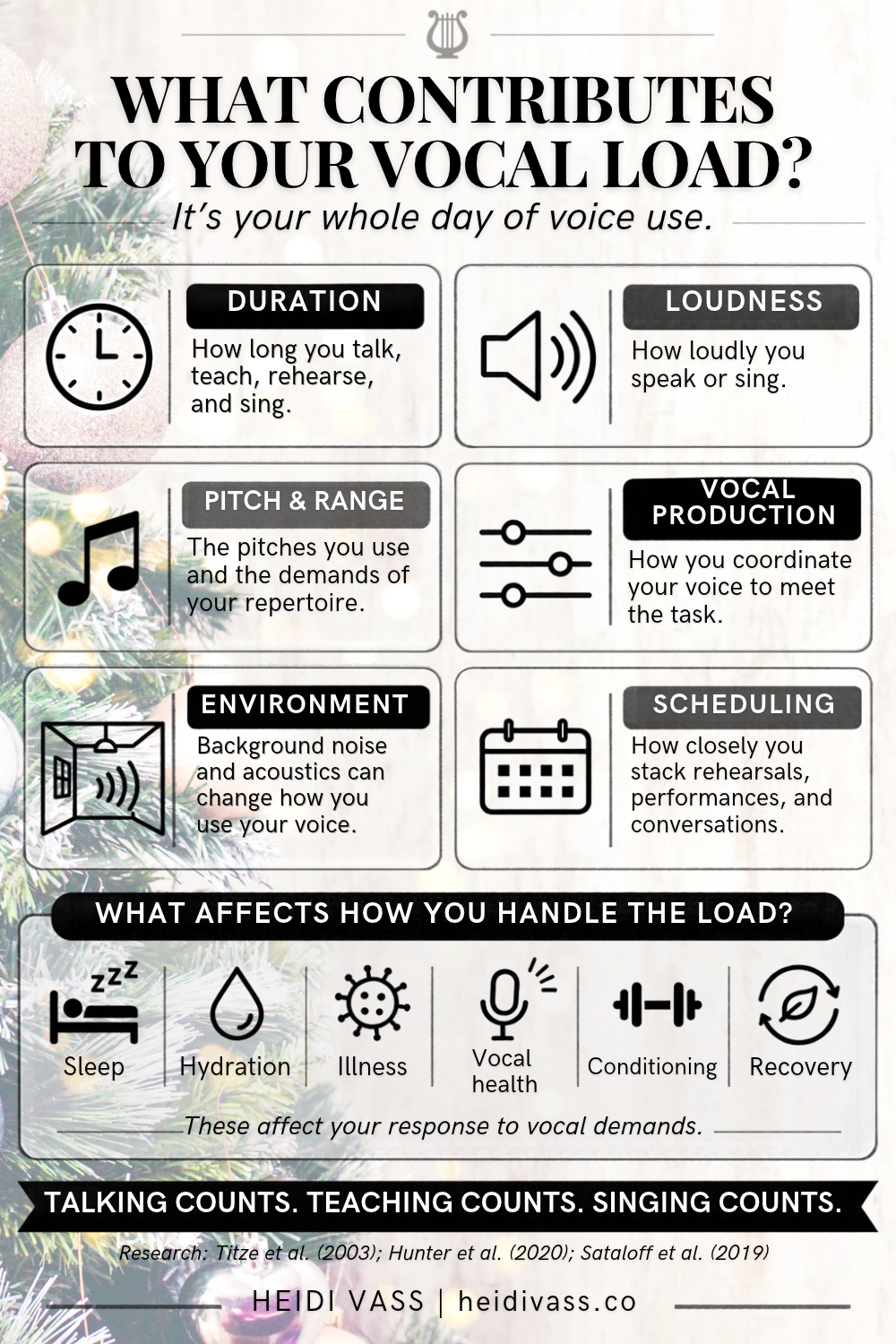
Your speaking voice deserves the same awareness you give your singing voice.¹
2. Enjoy the party without competing with it
At a noisy gathering, notice when conversation starts to feel like a contest with the room.
Move away from the speakers. Step into a quieter space. Sit closer to the person you’re speaking with.
If you’re hosting, turn the music down enough that people can comfortably hear one another. Background noise encourages louder, more effortful speaking, often without our realizing it.¹
You can stay connected without delivering every conversation to the back row.
3. Make hydration a habit
Keep water where you’ll remember it: in your rehearsal bag, beside your teaching chair, and with your meals.
Adequate hydration supports voice function. Dehydration can affect how efficiently the voice works and how much effort producing sound requires.²
There isn’t one perfect amount of water for every singer. Your needs depend on your health, activity, environment, and any medical guidance you’ve received.
Aim for consistency rather than last-minute catch-up. Water is part of your preparation, but it cannot compensate for every other demand you place on your voice.
4. Pay attention to dry indoor air
Heating systems, dry climates, and travel can expose you to air that leaves your throat feeling parched - especially after a night’s sleep. Moisture at the vocal fold surface contributes to efficient vibration, and dry-air exposure can increase vocal effort.²
If the air is dry, whether I’m sick or not, I always sleep with a humidifier. That little extra hydration while I’m sleeping often means the difference between an easy morning warm up or a little extra effort.
Of course, be sure to follow the manufacturer’s instructions for cleaning and water use, to keep mold and excessive humidity at bay.
5. Warm up for the voice you have today
Give yourself a gradual transition into rehearsal or performance.
Begin with comfortable, familiar exercises, then move toward the range and demands of your music. Vocal warm-ups and appropriate training belong in a thoughtful voice-care routine.³
Let your warm-up answer a question: What does my voice need today?
Listen for ease, consistency, and how your voice responds. Avoid spending too much of your vocal load budget on your warm up. You should spend just enough time to get things going but not so much that you
If you’re unsure where to begin, my guide to building a singing warm-up routine that works for you can help you approach that preparation with more purpose.
If you find yourself pushing harder to get your usual response, reassess. Your warm-up should help you prepare, not become an endurance test.
6. Make your practice more specific
A busy season is a good time to stop measuring practice by how many times you sing a piece from beginning to end.
Before repeating something, identify the task:
Is the rhythm secure?
Do you understand the text?
Is one vowel making the phrase difficult?
Are you uncertain about an entrance?
Have you decided what you want the listener to hear?
Some preparation can happen through score study, listening, translation, or writing interpretive notes.
For ordinary practice, I recommend using those tools to reduce unnecessary repetitions. You can continue developing your musicianship without singing every time you open the score and keeping that vocal load down in very busy seasons is your priority here. As the saying goes - an ounce of prevention is worth a pound of cure.
7. Learn how to mark without creating new tension
Marking means modifying your singing to reduce demand during rehearsal. It still requires coordination and attention.
Discuss with your teacher or director which passages need full singing and where you can reduce your intensity. Often in the choral setting you may be using that lighter mechanism all the time - even in performance. That gentle approach can literally save your voice if you have hours upon hours of singing in a day.
But remember, softer singing still requires good technique. Letting your coordination collapse because you are “only marking” defeats the purpose. Singing down the octave or in an alternative register (in rehearsal) should not be assumed to provide laryngeal rest, either.¹
Learning to adjust intensity while maintaining coordination is a useful skill to explore in private voice lessons, particularly when preparing for a demanding performance season. The goal is to rehearse purposefully while managing what you ask of your voice.
8. Put recovery on the calendar
When you accept a late concert or an additional service, consider what happens afterward and the following morning.
Could someone else handle the announcements? Could you shorten the post-concert conversation? Could tomorrow’s practice focus on text and interpretation?
Sleep, nutrition, and hydration are part of voice conservation.¹
During the holidays, recovery is often the first thing we squeeze out of the schedule. Give it a place alongside rehearsal, travel, and performance.
Some of your most useful preparation may happen when you close the music and go to bed.
9. Watch the steady stream of holiday sugar
Student gifts, homemade cookies, and post-concert receptions can turn an occasional treat into an all-day habit.
Enjoy your favorites, but be intentional. Have a proper meal before rehearsal rather than relying on the reception afterward. Consider saving or sharing some of those thoughtful student gifts.
You can appreciate the gift without eating everything the day it arrives.
My practical recommendation is to keep regular meals and water in your routine, even when holiday treats are everywhere. Pack something satisfying for a long rehearsal day so the cookie tray doesn’t become your dinner.
10. Be thoughtful about alcohol and protect your sleep
A post-concert toast can be lovely. But when performances, parties, and family gatherings overlap, pace yourself across the week.
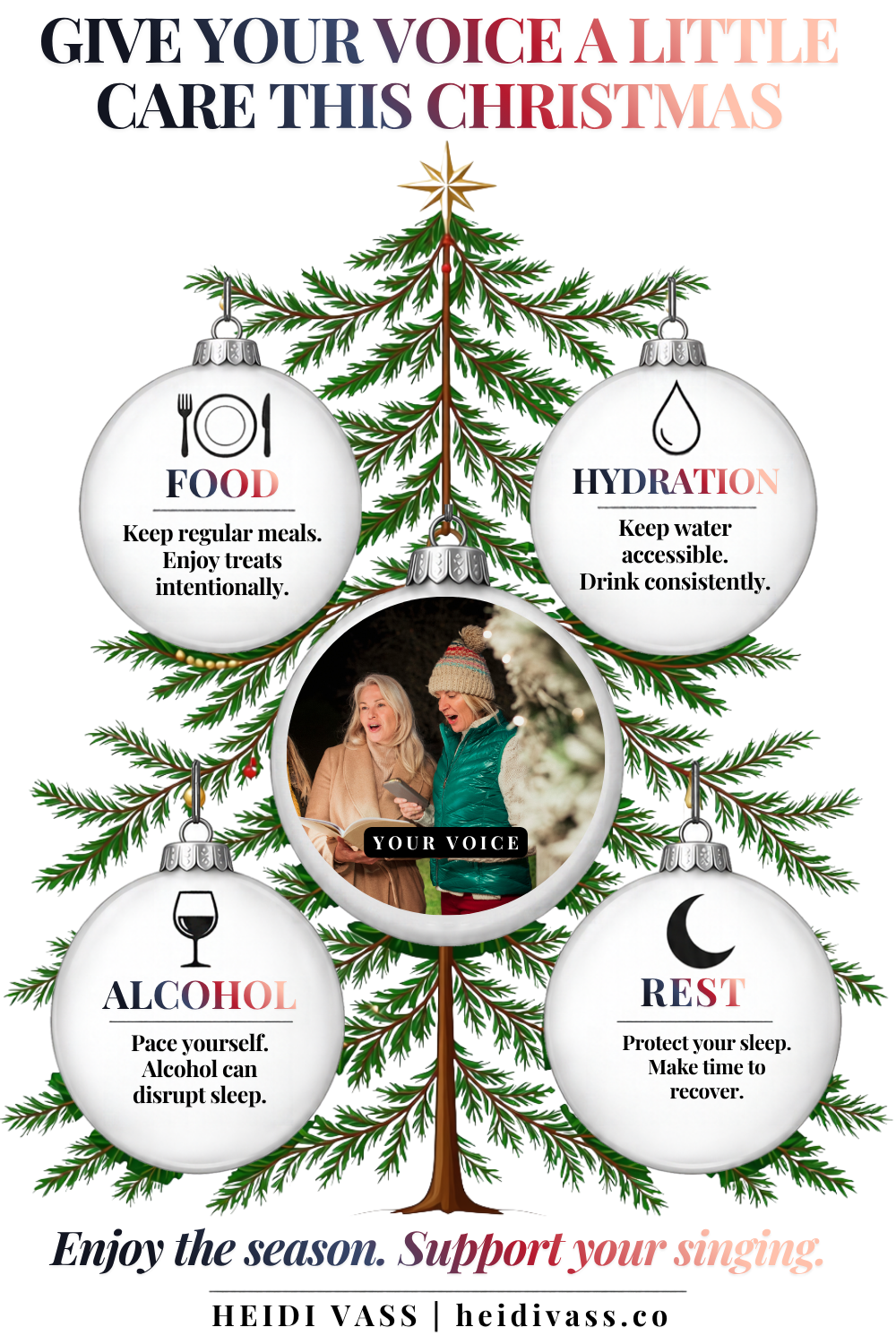
Alcohol may make you feel sleepy initially, but it can disrupt normal sleep patterns and reduce REM sleep.⁷ That matters when you’re counting on a good night’s recovery before another rehearsal or service.
Decide ahead of time whether you’ll drink and how much. Choose an alcohol-free option when you want to prioritize sleep, especially before a demanding singing day.
Plan for tomorrow’s voice while enjoying tonight’s celebration.
11. Enjoy holiday food with awareness of your own symptoms
Singers don’t need a universal holiday menu, but they do need to be mindful of their personal health and wellness.
If you experience reflux, pay attention to your own triggers and meal timing. For people with nighttime reflux symptoms, finishing meals at least three hours before lying down may help.⁴
You may find that an earlier dinner or a smaller meal before a service is more helpful than avoiding a long list of foods.
Of course, if you are experiencing persistent symptoms, a conversation with your clinician is warranted - holiday season or not.
12. Respond to voice changes early
A rough, painful, or unusually effortful voice needs attention, not repeated testing and forcing. Reduce unnecessary voice use and communicate with your teacher or director. Don’t try to sing your way through persistent hoarseness.
Hoarseness that has not improved within four weeks warrants examination of the larynx. Singers may need evaluation sooner, especially when changes interfere with their work or other concerning symptoms are present.⁵
Sudden voice loss during or after strenuous singing or shouting warrants prompt ENT evaluation. Stop singing while seeking care. Difficulty breathing requires immediate medical attention.⁶
A voice teacher can help with technique and practice planning. A laryngologist and a speech-language pathologist specializing in voice can evaluate and treat medical voice problems.
Help your voice thrive this holiday season
Before your next busy singing day, ask:
What needs my voice most?
Where can I reduce unnecessary demand?
What can I prepare more efficiently?
Have I planned for meals, water, and sleep?
When will I recover?
If your voice is healthy but you’re unsure which technical habits or practice priorities need attention, a personalized vocal assessment can help you establish a clearer starting point.
For church singers especially, this season carries music and texts that deserve our attention. Preparing well gives us more room to communicate their meaning and participate fully in the liturgy.
Let the holidays be a time to flow rather than grow. Enjoy the season, enjoy your voice, and let the preparation you’ve already done support your singing.
When you’re ready to hit the ground running in January, consider giving your training more structure and support through a program like my 90-Day Singer Development Intensive. For now, make music, be present, and enjoy the people and traditions that make this season special.
Let the holidays be a time to flow rather than grow. Enjoy the season, enjoy your voice, and let the preparation you’ve already done support your singing.
References
Sataloff, R. T., Cline, S. E., Lyons, K. M., Skeffington, J., & Rubin, A. D. “Voice Rest.” Journal of Singing, 75(5), 2019, pp. 557–563. Read through NATS.
Alves, M., Krüger, E., Pillay, B., van Lierde, K., & van der Linde, J. “The Effect of Hydration on Voice Quality in Adults: A Systematic Review.” Journal of Voice, 33(1), 2019, pp. 125.e13–125.e28. PubMed.
The Voice Foundation. “Voice Disorder Prevention.” Read the resource.
National Institute of Diabetes and Digestive and Kidney Diseases. “Eating, Diet, & Nutrition for GER & GERD.” Read the resource.
Stachler, R. J., et al. “Clinical Practice Guideline: Hoarseness (Dysphonia) (Update).” Otolaryngology–Head and Neck Surgery, 158(1_suppl), 2018, pp. S1–S42. Read the guideline.
American Academy of Otolaryngology–Head and Neck Surgery Foundation. “Hoarseness.” ENT Health. Read the resource.
“Altered sleep architecture following consecutive nights of presleep alcohol.” Sleep, 47(4), 2024. PubMed.
This article provides general education about singing and vocal wellness. Persistent hoarseness, pain, or sudden voice changes require medical evaluation.
Affiliate disclosure: This post contains an affiliate link. As an Amazon Associate, I earn from qualifying purchases.
