
As a vocal pedagogue, working soprano, and former Catholic school music director, I have spent plenty of time planning liturgies. Eighteen years, to be exact. I know how much work goes into finding the music, preparing the singers, and making sure everyone has what they need before rehearsal.
When Conejo Young Catholics approached me about planning liturgies to support their new ministry, I had to take a fresh look at what young people were asking for. In conversations with young Catholics, I kept hearing a desire for silence, beauty, and reverence. I wanted to plan Masses that actually responded to that desire.
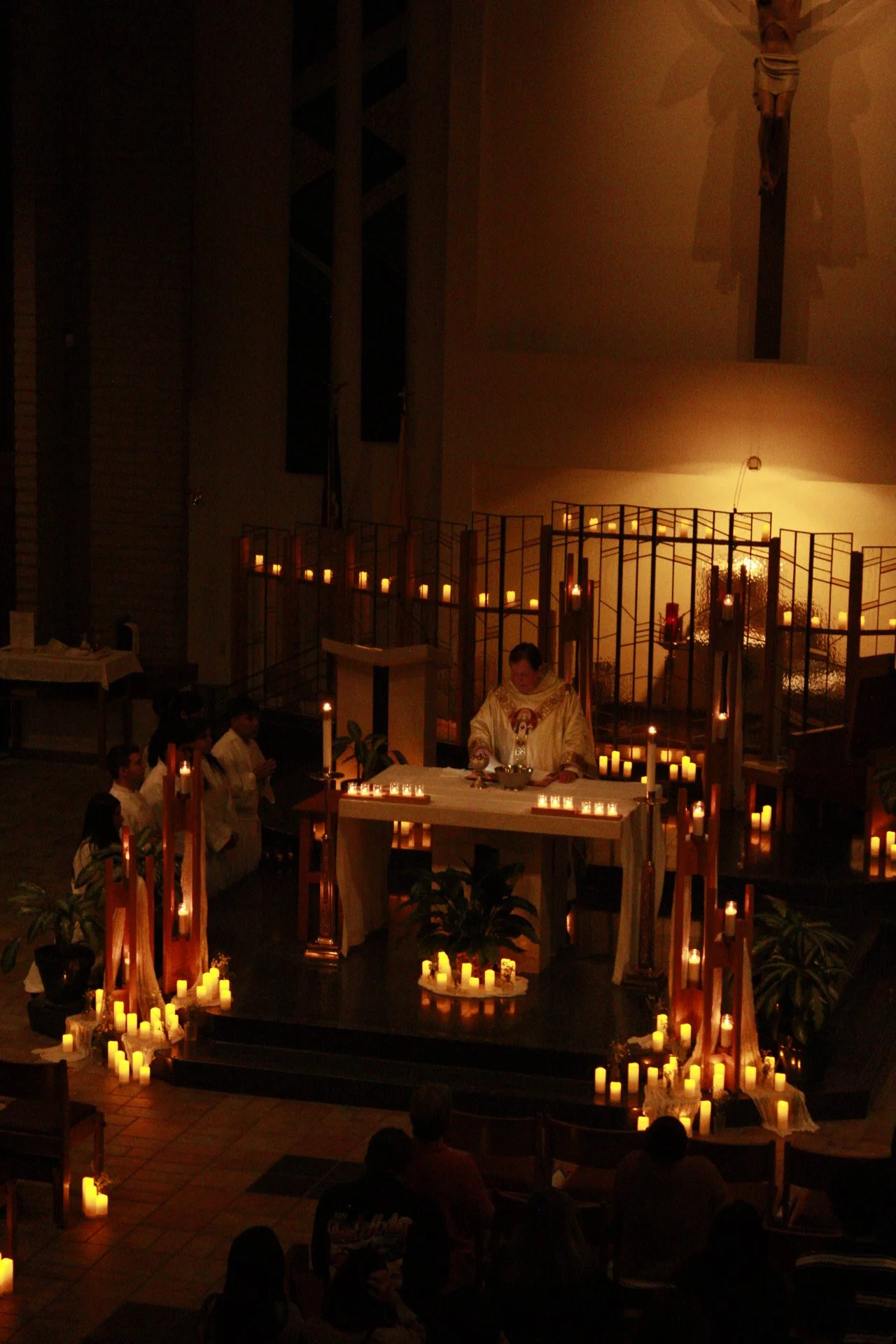
Our candlelight Mass with Conejo Young Catholics. Planning the music for this new ministry is what first led me to try Source & Summit.
This was a considerable change from the Life Teen-style Masses we had been doing at La Reina, where I had spent 18 years directing music. I was familiar with that repertoire and that approach to youth liturgy. But these conversations were pointing me toward chant, Catholic hymnody, and a different musical approach.
I did not want to assume that the music I had programmed for young people in the past was what these young adults were looking for now. I wanted to listen to them and put what I was hearing into practice.
And the Church has given us plenty of guidance here. Sacrosanctum Concilium, Vatican II’s document on the liturgy, reminds us that sacred music should serve what is happening in the Mass. It even gives Gregorian chant “pride of place,” other things being equal, while welcoming other sacred music, especially polyphony.¹ So there was good reason to open the chant books and see what we had been missing.
That gave me a clear musical direction. Chant and polyphony belong to the Church’s living musical tradition, and I wanted our young adults to have an opportunity to encounter them.
Ratzinger’s (AKA Pope Benedict) The Spirit of the Liturgy gets at why this matters. He describes liturgical music as a response to God, rooted in Scripture and the liturgy itself.² After years of searching for songs to fit a theme, I wanted to spend more time with the texts the Church had already given us to sing.
And I was hearing a similar desire from the young Catholics around me. They were drawn to the silence, beauty, and reverence I wanted to make room for. I could see that I was not alone in wanting to explore this direction. What if we actually gave them the opportunity?
That meant I needed new resources. I knew how to plan a liturgy, but I wanted guidance in choosing and preparing music for this direction. You can have years of experience and still need to open a different book.
So I signed up for a free trial of Source & Summit and started working through the music for our young adult Mass.
I will admit that I was looking for help with the repertoire. I was not expecting it to change quite so much of my preparation.
There is no substitute for knowing your singers, choosing appropriate music, and doing the work in rehearsal. That said, there is certainly a place for a resource that keeps you from spending an entire day gathering scores and making rehearsal tracks. Source & Summit has done that for me.
The Source & Summit Missal: music for congregational singing
The Source & Summit Missal is beautifully designed. Clean typography, classic graphics, and music that is actually easy to read. No awkward line breaks that leave you wondering where the rest of the phrase went.
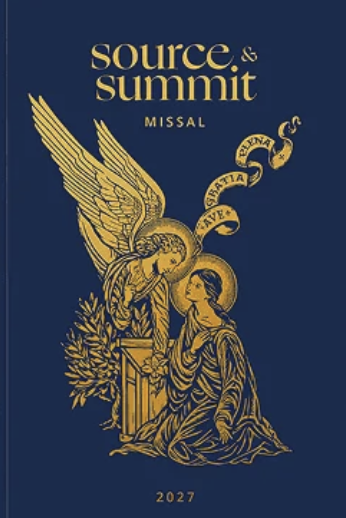
The 2027 Source & Summit Missal. The classic artwork and clean design were among the first things that caught my attention.
That may sound like a small thing. Try following an unfamiliar hymn from a pew and it becomes a fairly important thing.
More importantly, the music feels intended for CONGREGATIONAL singing. The texts express Catholic theology clearly, and the melodies serve the words. I appreciate opening a missal without finding lyrics that leave me scratching my head about what we are actually saying.
As a voice teacher, I also pay attention to the ranges. A melody can look perfectly reasonable on the page and still sit awkwardly in the voice. The repertoire here is, in my assessment, well suited to congregational singing. I am not asking a cantor to belt over a register transition just to get through the hymn.
The Standard Edition includes readings, hymns, antiphons, Mass settings, and devotional prayers. It gives the congregation a way to follow and sing the liturgy, including accessible settings of the antiphons.
My old liturgy-planning workflow
But if the missal caught my attention, the online platform is what really won me over. Let me walk you through my normal preparation as a music director.
Planning the music could take me a solid day. Here is what that involved:
Research music appropriate to the day and celebration.
Select hymns, the Responsorial Psalm, Gospel Acclamation, and Mass setting.
Gather scores and accompaniments.
Create rehearsal tracks.
Print music or organize files in Google Drive.
Check licensing and permissions.
Build a worship aid.
Share everything with my musicians.
And if I changed my mind about a selection? Back through the files, tracks, and worship aid to make sure everything matched.
I wish I could say I was also looking for antiphons. In fairness, when I was elbow-deep in Spirit & Song, I honestly did not yet understand what those were or how to incorporate them.
So if you are a music director who wants to introduce chant but does not quite know where to start, I understand. I have been there.
My workflow with the Source & Summit digital platform
With Source & Summit, I can pull together the liturgy plan and supporting materials in about 15 minutes. Yes, really. The musical decisions and rehearsals still take work, of course. But gathering and organizing everything no longer eats up my day.
The platform calls its liturgy plan an Ordo. This is where I put the celebration together. The liturgical texts are there, and I can work through the music selections, add scores, and prepare the materials my musicians will need.
Much like having a well-organized score library, it gives me somewhere to start and somewhere to keep everything. Only this one also helps me get the music into my singers’ hands.
Do singers need to read square notation?
Source & Summit lets you choose modern or square notation for chant settings, alongside text-based formats. The available formats depend on the music; hymns, for example, are offered in modern notation or text formats.
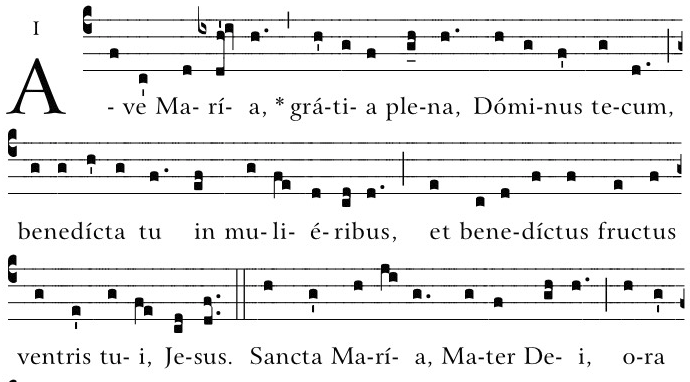
Ave Maria in traditional square notation. Source & Summit also offers modern notation for chant, so singers can begin with the format they know.
I love that you do not have to learn a whole new notation system before you can begin. If your singers read modern notation, start there. You can introduce square notation as they become more comfortable with chant.
There is plenty to learn without making the first rehearsal more intimidating than it needs to be.
Built-in rehearsal playback lets singers practice their parts
This is a big one for me. The music in Source & Summit’s library has built-in playback, so my singers can practice their parts BEFORE rehearsal.
Through a shared Source & Summit Ordo, singers can listen to the music, adjust playback speed, and isolate individual choral parts where available. For interactive selections, the notes light up as the music plays, allowing singers to follow the score while listening. Selected chant melodies also have vocal recordings.
One of my singers sent me this message:
“thank you!! These are so great I love that you follow along with the background music too!”
That is a pretty good endorsement from the person who actually has to use the materials.
Much like practice videos, these tools give singers something to work with when I am not in the room. They still need rehearsal. They still need someone listening to the sound they are making. But if they can arrive already knowing something about their part, we can get to the interesting work much sooner.
Can you upload your own choral scores and rehearsal recordings?
Yes. You can also bring music from outside the Source & Summit library into your Ordo.
I like using the Church Music Association of America website to find polyphony for my schola. I can upload a score and add a link to a rehearsal recording, putting it alongside the other music for the liturgy.
Source & Summit lets me upload scores and add reference audio. External scores do not automatically gain the interactive playback or transposition features of its native music. For those pieces, I supply the preparation materials I want my singers to use.
So the motet I found for my schola can live right alongside the antiphons, psalm, and Mass setting. Score and rehearsal recording together. No separate email explaining which folder to open.
Everything my singers need is in one place
Most of my singers use iPads. They can open the shared Ordo on their devices, download the music they need, or print it at home.
They click, listen, follow the music, and practice. That is the end of my file-distribution project.
Anyone who has spent time hunting through Google Drive for the right version of a score will understand why I appreciate this.
Creating a worship aid from the same liturgy plan
When I am ready to prepare a worship aid, I use Create Resource to turn the prepared Ordo into a congregational booklet or music packet.
The Source & Summit Resource Editor lets me choose a format, adjust the layout, and download a PDF. I still review the finished pages before printing, but I am working from the plan I have already prepared rather than rebuilding the document in another program.
I still check the layout before I print. But I am no longer spending my afternoon trying to make a separate document agree with the music I just sent everyone.
What about copyright licensing and reporting?
I will admit that copyright reporting has never been my favorite part of directing music. Source & Summit’s Hassle-Free Licensing policy takes a good deal of that work off my plate. For music from its own library, a subscription covers ordinary parish activities such as rehearsal copies, worship aids, practice recordings, and community livestreaming without additional music licensing or reporting.
There are important distinctions:
Uploaded music from elsewhere: You remain responsible for the necessary permissions and licenses.
Lectionary readings reproduced in a worship aid: Source & Summit directs users to obtain permission from the USCCB.
Uses beyond ordinary worship-site activities: Additional permissions may be required.
For the music in their own library, though, I can prepare our materials without adding another reporting job to the week. I appreciate that.
Can I change the key for my singers?
For supported music, yes. Source & Summit’s customization tools let you adjust keys, accompaniment settings, and the way verses appear. The options depend on the music and your plan.
As a voice teacher, I appreciate being able to put the music where it makes sense for the people singing it. Listen to your singers and consider the whole phrase. Sometimes a small adjustment makes a considerable difference.
Do you need to buy the Source & Summit Missal?
The digital platform is available separately from the printed missal. If your parish is also considering a pew resource, Source & Summit offers two annual missal editions:
EditionMain distinctionStandard EditionIncludes a hymn section alongside readings, antiphons, Mass settings, and other liturgical content.Companion EditionOmits the hymn section for communities using a separate hymn resource; includes priestly orations and an expanded devotional section.
The Standard and Companion missals serve different needs. Both subscriptions include digital support, with Basic and Complete digital add-ons providing different levels of access. Compare the included features when choosing your subscription.
How much does Source & Summit cost?
Source & Summit offers several digital plans, and its pricing calculator asks about the number of registered families and the billing cycle. Printed missal costs also depend on the edition and quantity ordered. You can compare Source & Summit subscription options or request a quote for your community.
The plan comparison is especially important if you need resources for Daily Mass, weddings, funerals, a larger hymn library, or multiple users. Schools, seminaries, religious communities, and certain other organizations may qualify for the Source & Summit Educational Plan. That plan does not cover parish use.
Source & Summit currently advertises a 30-day free trial. Use that time to prepare a real liturgy and test the materials with the people who will use them.
Would I recommend Source & Summit?
Yes. I heartily endorse both the missal and the online platform.
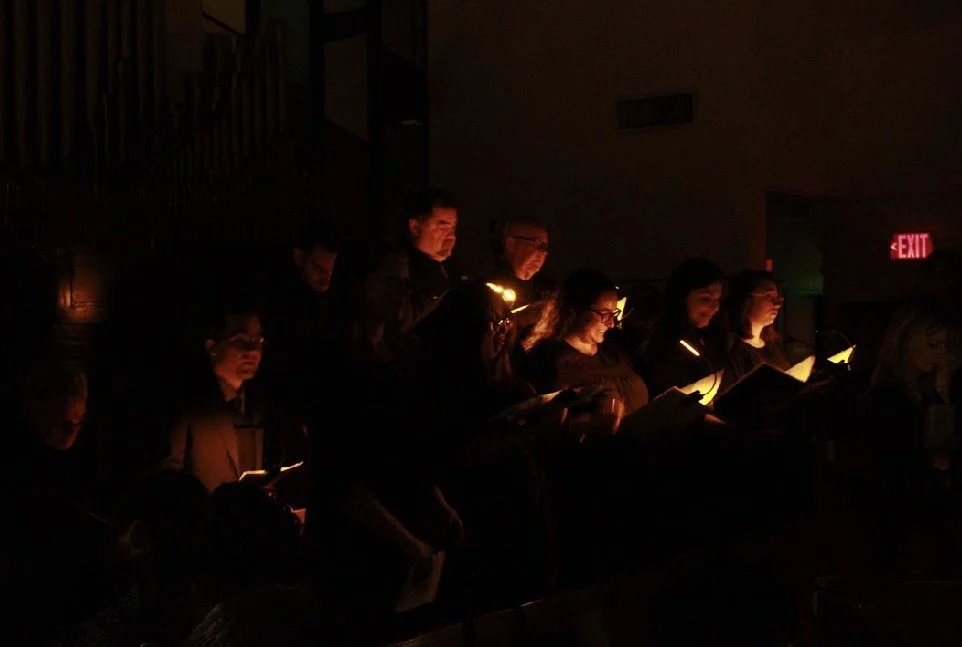
Our schola singing at the candlelight Mass. Having the scores and rehearsal tracks together gives everyone a way to prepare before we gather.
I started with a free trial because I needed help planning our young adult Mass. What I found was music that fit the liturgy I wanted to prepare, along with tools that made the preparation much easier.
Would a well-organized collection of scores and recordings get the job done? For sure. That is how I worked for years. But having the music, rehearsal playback, and worship aid connected saves me a great deal of time.
There are still things to check. Your plan needs to include the collections and tools you want to use. Outside scores need their own permissions. And uploading a PDF does not magically turn it into an interactive score.
But for my work with my singers, Source & Summit has been a very useful resource. If you want to begin bringing chant into your music program and feel a bit overwhelmed by where to start, the free trial gives you a way to try it with an actual liturgy. That is what I did.
A note about my affiliate link
If you decide to try it, my Source & Summit referral link provides a free trial and, when you subscribe through the referral, $50 off Source & Summit. I also offer those subscribers 15% off my parish or community workshops or voice lesson/coaching packages.
Begin the trial through the link so the referral is associated with your account. Source & Summit has advised that it applies if you subscribe to a missal or digital plan within 12 months of starting the trial. Contact me if you would like to use the workshop or coaching discount.
Affiliate disclosure: I am a Source & Summit Teaching Affiliate and receive complimentary access to the Standard digital plan. This article includes affiliate links, and I may receive compensation if you subscribe through them.
REFERENCES:
Second Vatican Council, Sacrosanctum Concilium (Constitution on the Sacred Liturgy), December 4, 1963, nos. 112 and 116. Vatican text.
Joseph Cardinal Ratzinger, The Spirit of the Liturgy, trans. John Saward (San Francisco: Ignatius Press, 2000), part III, chapter 2, “Music and Liturgy.” Excerpt reprinted with permission in Adoremus, November 15, 2001. The discussion in this article paraphrases Ratzinger.
