
Hormones and the Singing Voice: What Every Female Singer Should Know
If you’ve ever had a day where your voice suddenly felt heavier, less responsive, unstable, breathy, or just different… you are not imagining it.
And you are not a “bad singer.”
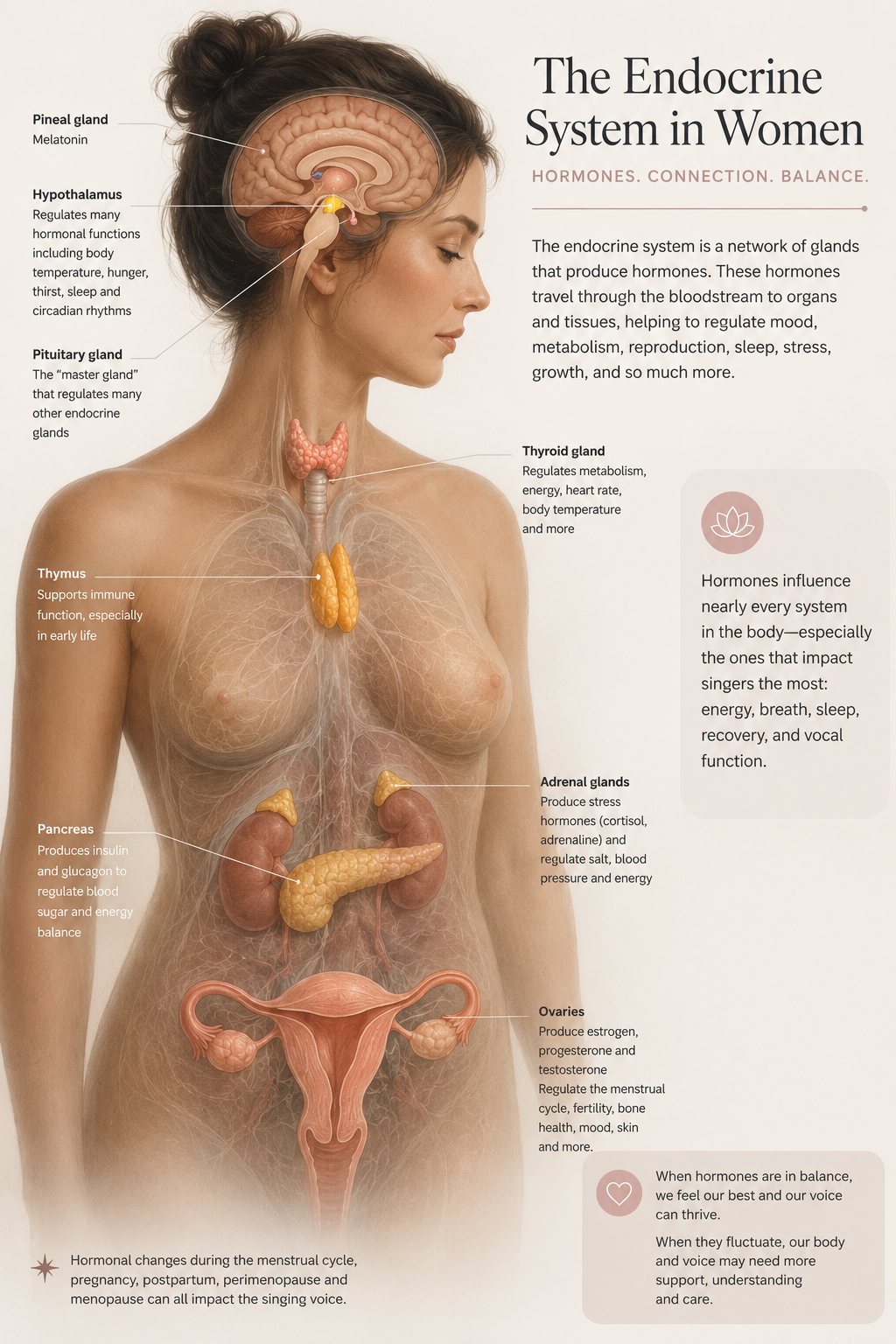
One of the biggest blind spots in vocal pedagogy is that we often talk about the singing voice as though it exists in isolation from the rest of the body. But singers are not disembodied instruments. The voice is deeply connected to every major system in the body, including one that is rarely discussed openly in voice training: the endocrine system.
Hormones impact the voice.
In fact, the larynx itself contains hormone receptors for estrogen, progesterone, and androgens, meaning hormonal fluctuations can directly affect the vocal folds and the surrounding tissues.[1]
For many singers, these changes are subtle. For others, especially professional voice users, they can be significant enough to impact range, stamina, flexibility, recovery, registration, and even confidence.
The good news? Understanding these changes helps singers work with the body instead of constantly fighting against it.
We need to talk more openly about the endocrine system, menopause, perimenopause, and the realities of singing in a changing body.
Why Hormones Affect the Voice
The vocal folds are living tissue. They rely on healthy hydration, elasticity, coordination, and efficient neuromuscular function in order to vibrate freely.
Hormones influence all of those things.
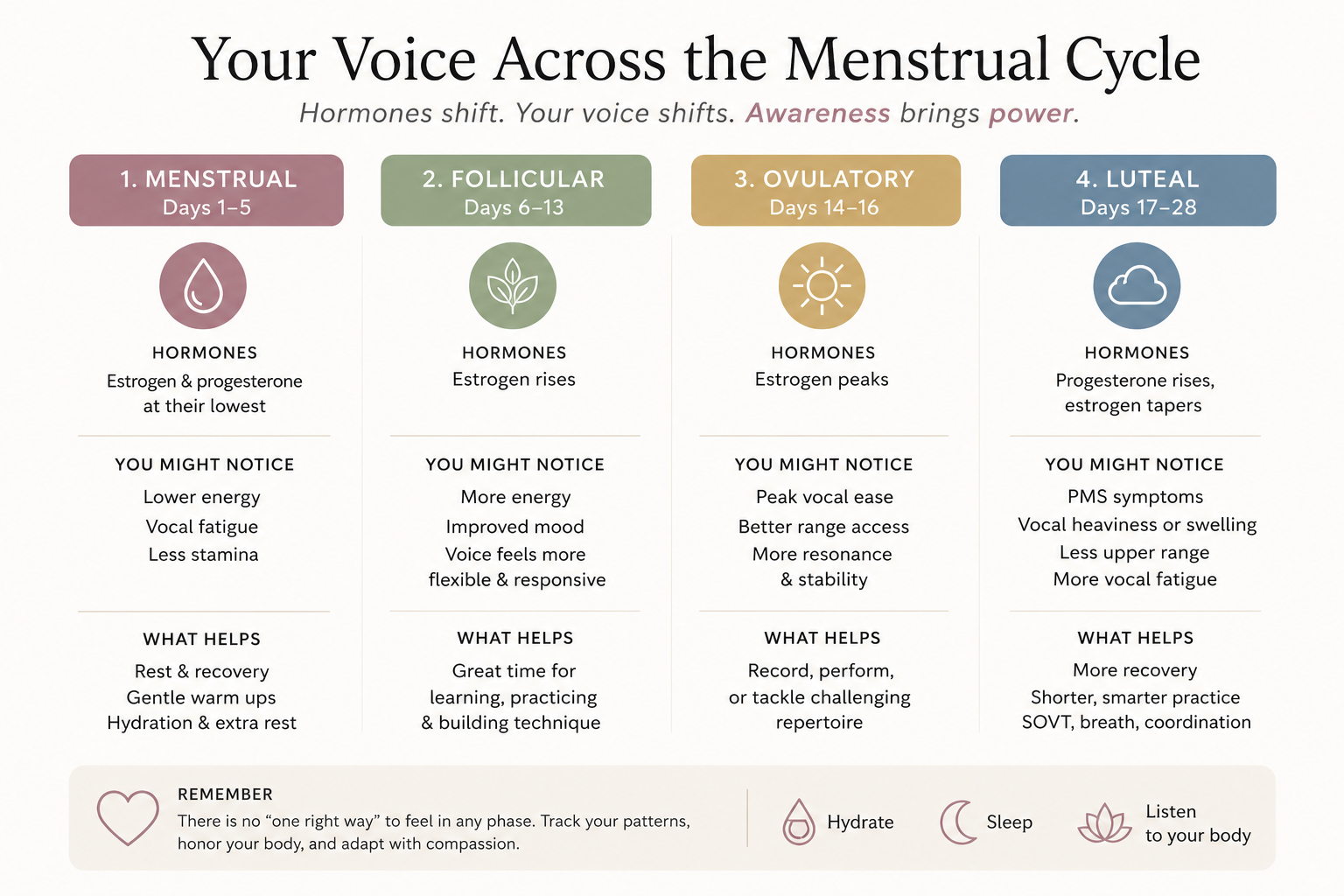
Research suggests that estrogen helps support vocal fold hydration and tissue flexibility, while progesterone may contribute to dryness and fluid retention.[2] This is one reason many singers notice vocal changes at certain points in the menstrual cycle, especially during the premenstrual phase.
Some commonly reported symptoms include:
Vocal fatigue
Reduced upper range
Loss of flexibility
Heavier vocal quality
Increased breathiness
Slower recovery
Difficulty with registration transitions
A feeling that the voice is “less reliable”
Professional singers often notice these changes more intensely simply because the demands placed on the instrument are so refined.[3]
Your Voice Across the Menstrual Cycle
Many singers discover that their voice follows predictable patterns throughout the month.
Some feel their best vocally around ovulation, when estrogen levels are elevated and the folds may feel more flexible and responsive. Others notice increased instability or swelling in the days leading up to menstruation.
This does not mean your technique has suddenly disappeared.
It means your instrument is changing.
Elite athletes modify training based on recovery, inflammation, and hormonal fluctuations. Singers should be allowed to think this way too.
One of the most helpful things a singer can do is begin tracking:
Energy levels
Vocal stamina
Range access
Registration shifts
Recovery time
Sensations of swelling or dryness
Awareness reduces panic. Patterns create clarity.
Perimenopause and the Singing Voice
Perimenopause can feel especially confusing for singers because the hormonal shifts become far less predictable.
A singer who previously felt vocally stable may suddenly experience:
Greater inconsistency
Fatigue
Slower recovery
Loss of upper extension
Increased vocal effort
Difficulty accessing resonance
Changes in speaking pitch
Increased dryness or vocal heaviness
For many women, this can feel emotionally destabilizing because the voice no longer behaves in the way it always has.
But this is also where a deeper level of musicianship and self-awareness begins.
Perimenopause is often not a time to “push harder.” It is a time to refine coordination, improve efficiency, prioritize recovery, and build a more sustainable relationship with the instrument.
And honestly? This process often begins before symptoms become severe.
One of the most important things singers can do is prepare proactively:
Optimize sleep
Build strength and muscle mass
Support bone density
Improve stress regulation
Prioritize nutrition and protein intake
Develop sustainable vocal habits
Learn how your body actually functions
At this stage of life, recovery is no longer optional. It becomes part of the technique.
In my experience, singers navigating perimenopause often benefit enormously from:
Slower warm-ups
Semi-occluded vocal tract exercises (SOVTs)
Improved breath coordination
Reduced vocal overloading
Nervous system regulation
More intentional pacing
Greater technical efficiency
The goal shifts from brute-force production to responsive, coordinated singing.
And that is good pedagogy for everyone.
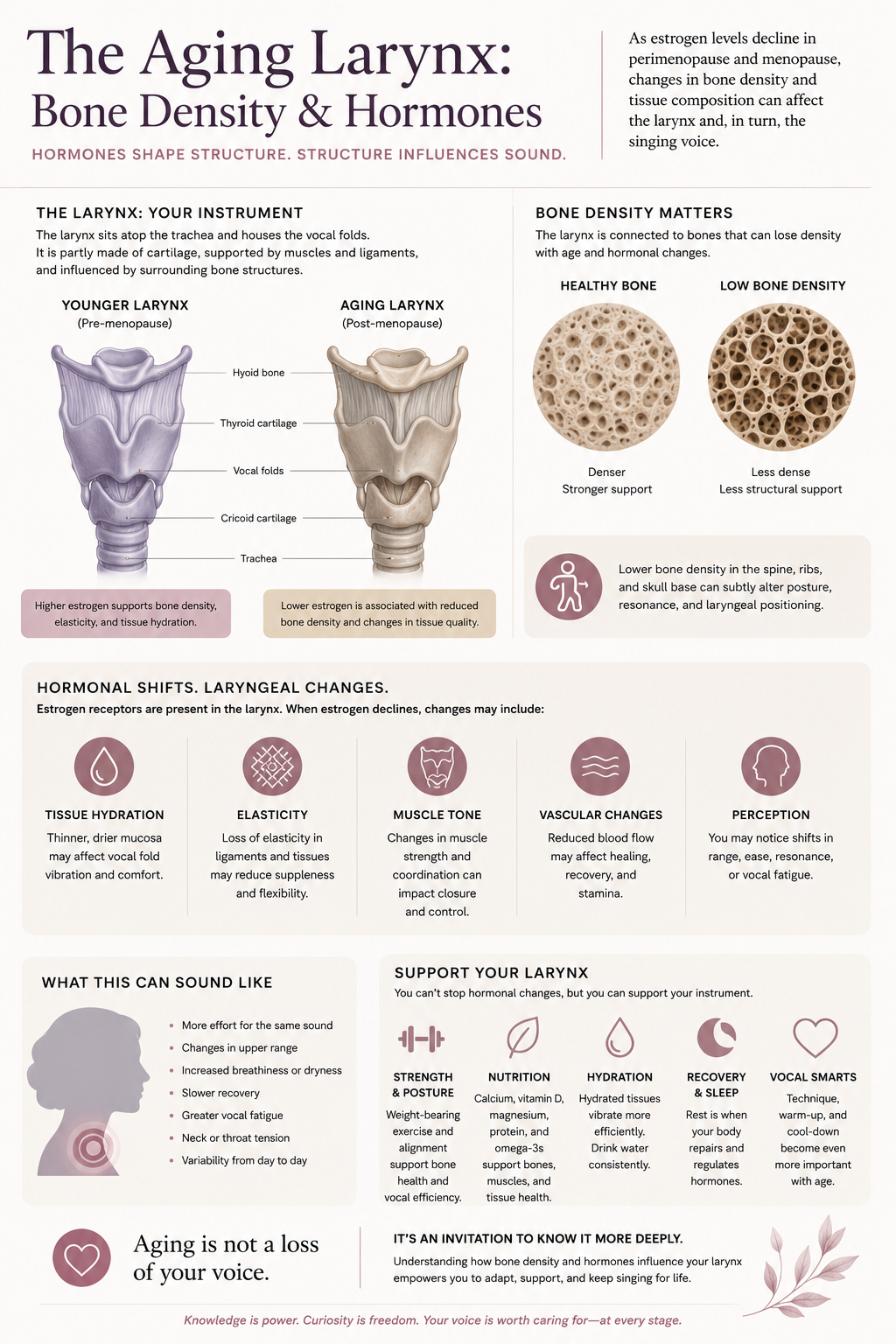
This is also the stage where many women begin exploring concrete medical interventions and support systems, including supplementation, nutritional intervention, hormone testing, and bioidentical hormone replacement therapy (BHRT). Research suggests that declining estrogen levels can impact vocal fold tissue hydration, elasticity, recovery, and muscular coordination.[2][4][5]
At the same time, singers must approach hormonal intervention thoughtfully and advocate for themselves within the medical system. Healthcare is often fragmented, and different specialists may be focused on entirely different outcomes. If your voice is central to your life or career, it needs to be part of every major health conversation you have.
Personally, while I did choose to begin BHRT, I would be extremely cautious about testosterone use as a singer. Androgen exposure has been associated with vocal fold thickening and lowering of pitch in women, changes that may not always be reversible.[1][2]
Your voice is not separate from your body.
Understanding your system and learning how to advocate for yourself may become one of the most important parts of sustaining your instrument long term.
Menopause and Vocal Aging
Research also suggests that menopause can impact speaking and singing pitch due to changes in tissue structure and hormonal support.[4]
Some postmenopausal singers report:
Reduced flexibility
Vocal dryness
Lower speaking pitch
Loss of upper range
Increased vocal fatigue
Roughness or instability
But this conversation needs nuance.
Because while some physical changes may occur, many singers also gain tremendous artistic advantages with age:
Greater efficiency
Better emotional communication
Improved interpretive depth
More consistent technical awareness
Increased psychological freedom
A mature voice is not a “lesser” voice.
It is simply a different instrument.
And great singers learn how to adapt to the instrument they have today, not the one they had at 22.
Five Things Singers Can Do to Support the Voice During Hormonal Fluctuations
1. Track your voice
Patterns matter. Stop treating every off day like a mystery.
2. Prioritize hydration and recovery
Hormonal changes can impact tissue hydration and inflammation.
3. Warm up more gradually
Especially during perimenopause and periods of fatigue.
4. Focus on efficiency, not force
Aggressive singing often backfires during hormonal instability.
5. Build a healthcare and vocal training team that understands the female singing voice
If you are a singer navigating hormonal changes, perimenopause, or menopause, you need to understand that vocal health is not just about vocal technique. The singing voice is deeply connected to sleep, stress, nutrition, inflammation, hydration, muscle mass, bone density, nervous system regulation, and hormone balance.
The challenge is that modern healthcare is often highly specialized and fragmented. Your gynecologist may be focused on reproductive health. Your endocrinologist may be focused on hormone levels and lab work. Your ENT may be looking specifically at the larynx. Your voice teacher may be focused on vocal function and artistic performance.
But as the singer, you are the one experiencing how all of these systems interact inside a single instrument.
That is why singers must learn to advocate for themselves.
If your voice is central to your life or career, it needs to be part of every major health conversation you have. Learn to track patterns. Ask questions. Seek out practitioners who understand the unique demands placed on professional voice users. Do not be afraid to pursue second opinions or explore evidence-based interventions that support long-term vocal health.
In many cases, the singer is the only person seeing the complete picture.
The Bigger Picture
The voice is not separate from the body.
Hormones influence tissue hydration, vocal fold flexibility, recovery, stamina, coordination, and even the way the folds vibrate. Stress, aging, sleep, inflammation, and nervous system regulation all shape the function of the instrument as well.
Yet historically, many singers were taught to ignore these realities or interpret them as personal failure.
We need to move beyond that.
Understanding how hormones affect the singing voice does not make singers fragile. It makes them informed.
And informed singers make better artistic, technical, and health decisions over the course of a lifetime.
References
Kadakia, S., Carlson, D., & Sataloff, R. “The Effect of Hormones on the Voice.” Journal of Singing, 2013.
Khare, V. The Influence of Sex Hormones on the Female Singing Voice. University of Miami, 2016.
Kadakia, S., Carlson, D., & Sataloff, R. “The Effect of Hormones on the Voice.” Journal of Singing, 2013.
“Menopause and its Effect on Voice.” Journal of Mid-life Health, 2021.
“Effect of Hormonal Changes in Pre and Post-Menopausal Women on Voice.” Review article, 2025.
