
What Your Voice May Be Telling You About Your Brain Health

Our voices help us connect, communicate, and participate in the things we love. Persistent changes deserve attention at any age.
New research connects diagnosed voice disorders with later cognitive decline. Here is what singers and their teachers should know, and when a change deserves medical attention.
As a voice teacher, I listen for more than beautiful sound. I listen for ease, flexibility, coordination, and changes in what a singer can comfortably do. When you work with someone regularly, you become familiar with their voice. You know what is typical for them.
That familiarity raises an interesting question: could a change we hear in a lesson tell us something about a singer's health beyond the voice itself?
A new study in the Journal of Voice suggests that diagnosed voice disorders may offer an early clue to cognitive decline. It gives singers and teachers a reason to pay attention, while leaving some important questions unanswered.
What the researchers found
New research from Drexel University, published in the Journal of Voice, suggests that voice disorders may offer an early warning of cognitive decline. In a study involving more than 833,000 patients, those with diagnosed voice disorders were more likely to develop cognitive problems over time than those without them. The association was even stronger than for hearing loss alone (which is already an established risk factor for dementia).
For singers and voice teachers, that raises an interesting possibility: changes we hear in the voice might tell us something about health beyond the vocal folds. We don’t yet know whether those changes reflect an underlying neurological process, whether difficulty communicating contributes to isolation and decline, or whether both are involved. But the findings give us another reason to pay attention when someone’s voice persistently changes.
The authors describe voice disorders as a potential early biomarker of cognitive decline. Their study establishes an association. It does not show that voice disorders cause dementia, establish which vocal changes are most predictive, or determine how early they appear compared with other biomarkers. But the findings give us another reason to pay close attention when someone is experiencing persistent voice changes.
Why might voice and cognitive health be connected?
The voice depends on coordinated activity involving the brain, nerves, breathing system, and larynx. A neurological process can affect speech and voice production. The authors point to conditions such as Parkinson's disease, in which changes in voice or speech can precede other motor symptoms.
But there is another possible pathway: a voice disorder can make participation harder.
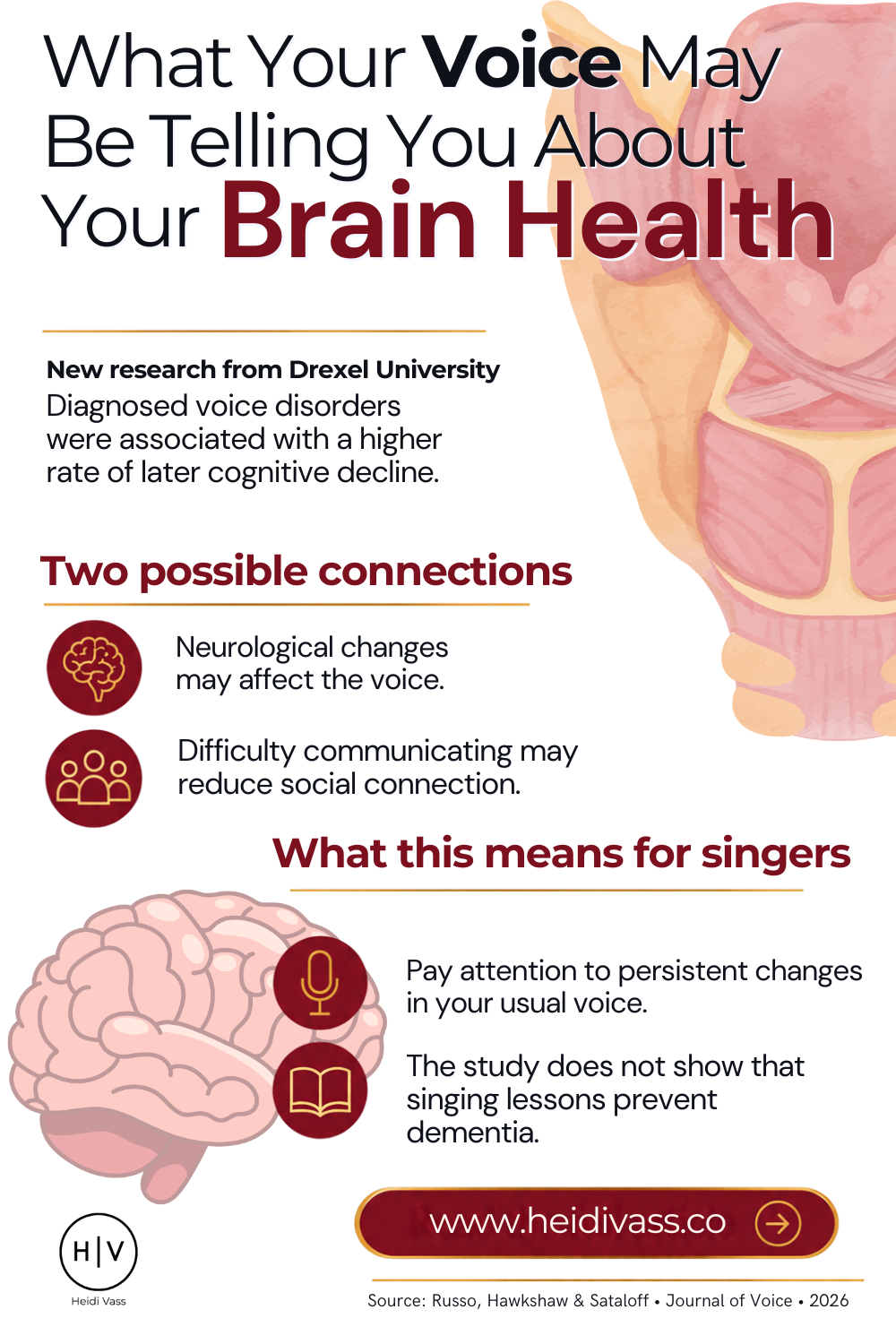
If speaking becomes uncomfortable, tiring, or embarrassing, someone may talk less. If singing becomes difficult, they may stop attending choir or withdraw from activities that once brought them connection and purpose. The authors suggest that reduced social and cognitive engagement could help explain the association.
These explanations could overlap. An underlying neurological process might affect the voice, while the resulting difficulty communicating could also reduce participation. This study cannot tell us how much either pathway contributes.
That distinction matters when we ask whether helping the voice could help the brain.
Could voice lessons help prevent dementia?
We do not know from this research.
The study did not test singing lessons, choir participation, or voice treatment as interventions to prevent cognitive decline. The authors explicitly call for research into whether early voice treatment could have a beneficial cognitive effect.
There is a meaningful question here: if someone can communicate more comfortably and continue participating in valued activities, could that support cognitive health? It deserves investigation. It is not yet a finding we can promise students.
What singers and teachers should listen for
The most useful comparison is with that singer's own established baseline. We should notice persistent changes rather than treat every difficult lesson as a warning sign.
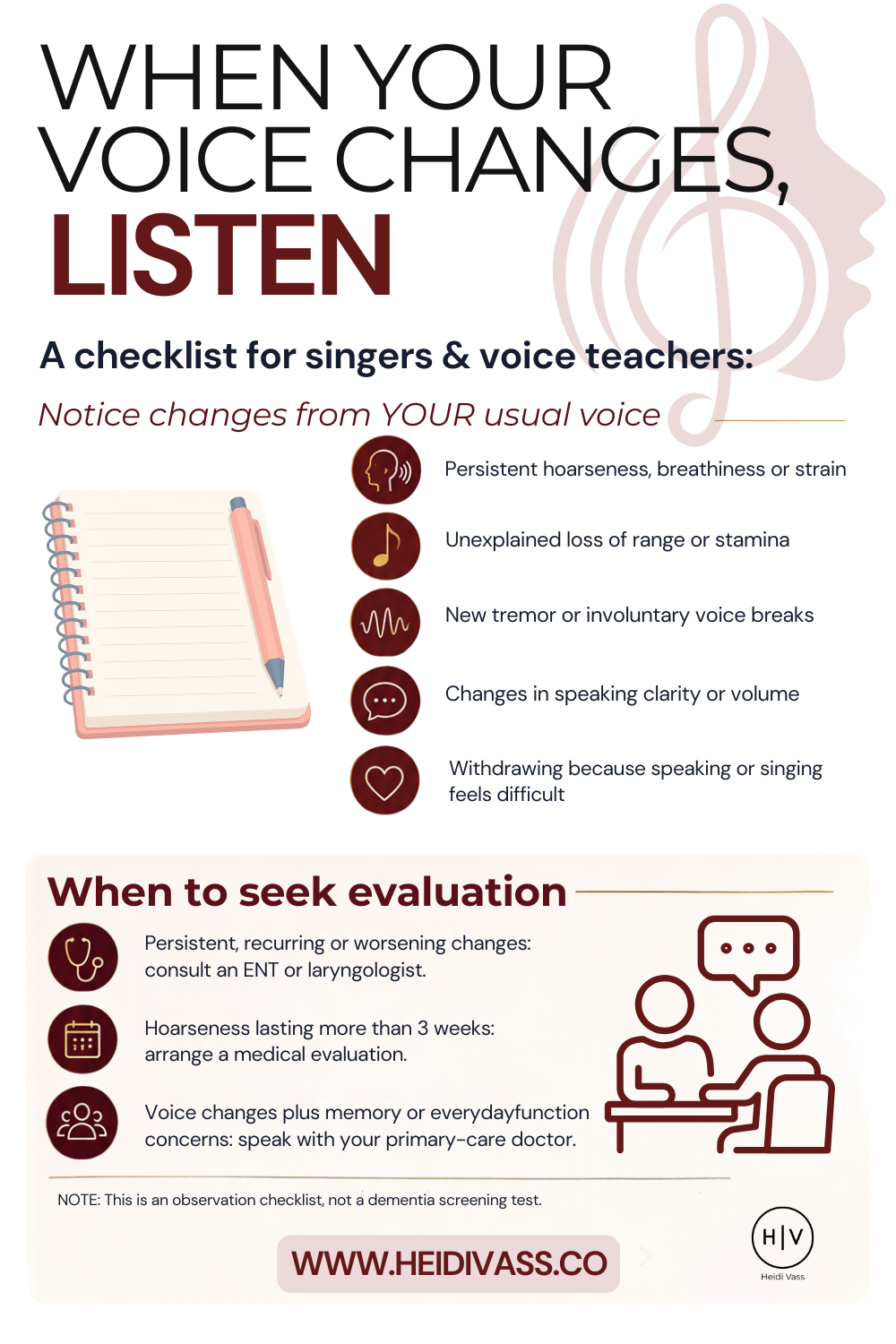
The following is a practical observation checklist, not a validated dementia screening tool. The study examined diagnosed voice disorders; it did not establish these individual observations as predictors of dementia.
A persistent change in vocal quality: new hoarseness, breathiness, strain, or weakness in speaking or singing.
An unexplained reduction in vocal function: familiar notes, phrases, or dynamics consistently become harder.
Increasing effort or fatigue: ordinary singing or conversation becomes unusually demanding.
Changes in vocal control: new tremor, involuntary breaks, or difficulty sustaining a previously comfortable sound.
Changes in everyday speech: new slurring, reduced clarity, or a noticeably softer speaking voice.
Reduced participation: the singer avoids conversation, rehearsal, or lessons because using the voice has become difficult.
These changes have many possible explanations, including illness, vocal injury, and other medical conditions. They cannot tell a teacher whether a singer has dementia. They can help us recognize when something deserves evaluation.
Notice the pattern, and document it
Before interpreting a change, ask practical questions. When did it start? Was the onset sudden or gradual? Is it improving, recurring, or getting worse? Does it affect speaking as well as singing? Has there been an illness, unusually heavy vocal use, surgery, or medication change?
With the singer's permission, a brief recording of the same comfortable task can help describe changes over time. Keep the task and recording conditions reasonably consistent. This documents an observation; it does not measure dementia risk.
If the singer or their family also reports changes in memory, language, or everyday functioning, those concerns belong in the medical conversation. An occasional forgotten lyric or a difficult new exercise, by itself, does not establish cognitive decline.
When should a teacher encourage medical evaluation?
Persistent, recurring, or worsening vocal changes deserve attention. An ENT, ideally a laryngologist experienced with singers, can assess the larynx and help determine the cause.
The National Institute on Deafness and Other Communication Disorders recommends seeing a doctor for hoarseness lasting more than three weeks. The American Academy of Otolaryngology–Head and Neck Surgery recommends laryngeal examination when dysphonia has not resolved or improved within four weeks, or sooner when a serious cause is suspected. Professional voice users may warrant expedited evaluation. Four weeks is not a requirement to wait.
Pain with speaking or swallowing, difficulty swallowing, a neck lump, or coughing blood warrants prompt medical attention. Sudden loss of voice during strenuous vocal use can indicate a vocal fold hemorrhage: stop singing, rest the voice, and seek immediate medical evaluation.
When vocal changes accompany concerns about memory, language, or daily functioning, encourage a primary-care appointment as well. Describe what has changed rather than propose a diagnosis.
Sudden trouble speaking or understanding speech, particularly with facial droop or one-sided weakness, can signal a stroke. Call 911. Severe breathing difficulty also requires emergency care.
For a routine referral, the conversation can be straightforward:
“I've noticed a consistent change from your usual voice over the past few weeks. I'd like you to have it medically evaluated so we understand what is happening and can support you appropriately.”
Listening is part of caring for the singer
Regular lessons give us an opportunity to know a voice over time. Whether that familiarity can reliably help identify early cognitive decline has not been tested in this study. But we can use it to notice changes, ask thoughtful questions, and encourage appropriate care.
As singers, our voices are part of how we communicate, participate, and connect. When those abilities change, we should take them seriously. Sometimes the next step is a technical adjustment. Sometimes it is a medical appointment. Good teaching includes recognizing when that appointment belongs in the conversation.
Have you noticed a lasting change in your speaking or singing voice? Bring it up with your teacher and your healthcare professional. You do not have to wait until it stops you from singing.
Sources
Russo, Anthony G., Mary J. Hawkshaw, and Robert T. Sataloff. “Voice Disorders as Early Biomarkers of Cognitive Decline.” Journal of Voice, published online 11 Aug. 2026. DOI: 10.1016/j.jvoice.2026.07.037.
National Institute on Deafness and Other Communication Disorders. “Hoarseness.” National Institutes of Health. Accessed 5 Oct. 2026.
Stachler, Robert J., et al. “Clinical Practice Guideline: Hoarseness (Dysphonia) (Update).” Otolaryngology–Head and Neck Surgery, vol. 158, suppl. 1, 2018, pp. S1–S42. DOI: 10.1177/0194599817751030.
Centers for Disease Control and Prevention. “Signs and Symptoms of Stroke.” CDC. Accessed 5 Oct. 2026.
